Tyre Tread Depth: 2026 Professional Guide for UK Drivers
Nearly two in five vehicles currently operating on UK roads possess tyres that are either illegal or dangerously close to the limit. You likely recognise that maintaining your tyre tread depth is a fundamental safety requirement, yet the technical distinction between a tyre that is merely legal and…

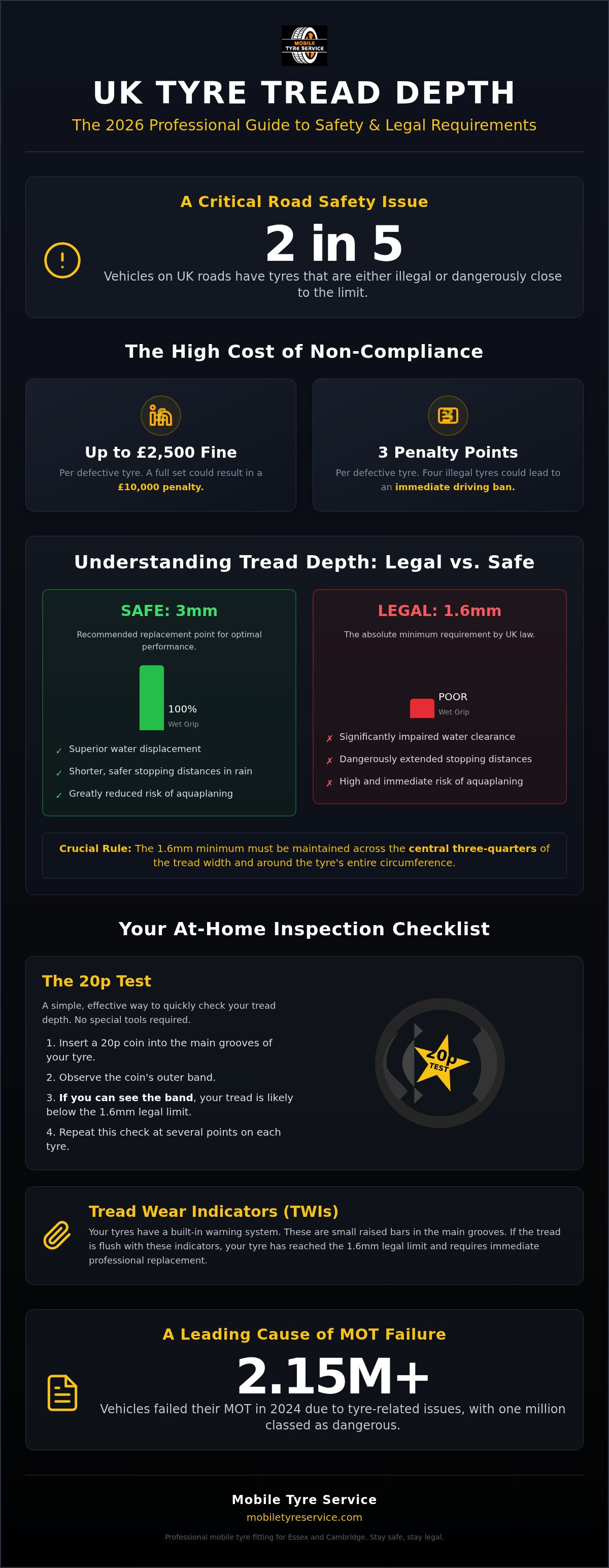
Nearly two in five vehicles currently operating on UK roads possess tyres that are either illegal or dangerously close to the limit. You likely recognise that maintaining your tyre tread depth is a fundamental safety requirement, yet the technical distinction between a tyre that is merely legal and one that is genuinely safe remains a source of high-stakes confusion. Driving on depleted tread doesn't just invite the risk of aquaplaning during heavy rain; it exposes you to an immediate £2,500 fine and three penalty points for every defective tyre found on your vehicle.
This professional 2026 guide provides the technical clarity you need to manage your vehicle's safety with precision. You will master the essential steps to accurately measure your tread at home and understand why the 1.6mm legal minimum is often insufficient for real-world driving conditions in Essex and Cambridge. We will detail the correct execution of the 20p test, explain the specific legal requirements for 2026, and identify the exact moment when a mobile tyre specialist is required to restore your vehicle's roadworthiness. This knowledge ensures you remain mobile, legal, and safe without the inconvenience of traditional garage visits.
Key Takeaways
- Understand the 2026 UK legal requirements for tyre tread depth to mitigate the risk of £2,500 fines and penalty points per tyre.
- Execute the 20p test with precision to verify your vehicle's roadworthiness and safety status instantly from your driveway.
- Differentiate between 'legal' and 'safe' tread levels to maintain superior control and shorter stopping distances in heavy rain.
- Recognise specific wear patterns that indicate maintenance requirements, helping you avoid premature tyre failure and unnecessary costs.
- Eliminate the risk of driving on defective tyres by utilising professional mobile tyre fitting at your home or workplace in Essex and Cambridge.
The UK Legal Requirements for Tyre Tread Depth
The law is clear. Under the legal framework of the Road Safety Act, UK motorists must maintain a minimum tyre tread depth of 1.6mm across the central three-quarters of the tread width and around the entire outer circumference of the tyre. This isn't a suggestion; it's a strict mandate designed to ensure every vehicle maintains sufficient grip on the tarmac. To understand what tyre tread is and how it functions, you must view the rubber grooves as a sophisticated drainage system designed to maintain constant contact with the road surface, even in adverse conditions.
The financial and legal consequences of neglect are severe. A single defective tyre triggers a fine of up to £2,500 and three penalty points. If all four tyres fall below the legal limit, you face a potential £10,000 penalty and an immediate driving ban. These enforcement measures reflect the high stakes of road safety. Law enforcement officers in Essex and Cambridge regularly conduct roadside inspections, and they don't grant leniency for "just being under" the limit.
Tyre defects remain a primary cause of MOT failures across the country. In 2024, over 2.15 million vehicles failed their MOT due to tyre-related issues, with one million of those cases classified as dangerous. If your tread is insufficient, your vehicle is legally unroadworthy. This status doesn't just risk a fine; it potentially invalidates your insurance policy in the event of an accident.
The 1.6mm Limit vs. The Safety Buffer
The 1.6mm limit is the absolute red line of legality, not a benchmark for safety. Professional safety organisations and manufacturers recommend replacing tyres when they reach 3mm. The performance gap is measurable and dramatic. As tread wears, the volume of water the tyre can displace drops significantly. This increases the risk of aquaplaning and extends stopping distances. Relying on the legal minimum during a typical East of England downpour is a high-risk strategy. We advise drivers to treat 3mm as the point for intervention to ensure peak braking performance remains intact.
Commercial Vehicle and Motorcycle Variations
Vans and light commercial vehicles, which are essential for the local economies of Essex and Cambridge, require even more vigilant monitoring. Whilst the 1.6mm rule applies to vehicles up to 3,500kg, the heavy loads these vehicles carry accelerate tread wear. Increased weight puts immense pressure on the tyre structure, often leading to uneven wear patterns if pressures aren't perfectly managed. For those operating commercial fleets, checking tyre tread depth weekly is a logistical necessity to avoid costly downtime and maintain regulatory compliance.
The Ultimate Tyre Tread Depth Inspection Checklist
A systematic inspection is the only way to confirm your vehicle's compliance and safety. Regularly monitoring your tyre tread depth is a non-negotiable responsibility for any driver. Before you begin, ensure your vehicle is parked on a flat, level surface. Engage the handbrake and select a gear or 'Park' to secure the vehicle. For easier access to the front tyres, turn the steering wheel to full lock. This exposure allows for a more comprehensive view of the rubber surface.
The dangers of low tread depth extend beyond legal penalties; they fundamentally compromise your vehicle's ability to stop and steer in the wet. Focus your inspection on the central three-quarters of the tyre's width. This specific area carries the primary responsibility for water clearance. If the tread is depleted here, the tyre is legally defective even if the outer edges appear healthy.
Step-by-Step: The 20p Coin Method
The 20p test is a reliable quick-check tool for roadside or driveway assessments. Follow these steps for an accurate reading:
- Insert a 20p coin into the lowest point of the main tread grooves.
- Observe the outer rim of the coin. If the band is visible above the tread, your tyre is likely illegal.
- Repeat this process at three distinct points around the entire circumference of each tyre.
Checking multiple points is vital. Tyres rarely wear at a perfectly uniform rate. A single compliant reading does not guarantee the whole tyre meets the 1.6mm threshold.
Identifying Tread Wear Indicators (TWIs)
Manufacturers integrate Tread Wear Indicators (TWIs) as a permanent early warning system. These are small, raised rubber bumps positioned within the base of the main grooves. When the surrounding tread wears down to the same level as these indicators, the tyre has reached the 1.6mm legal limit. Locating these bars allows for a rapid visual confirmation without tools. If you find your tread is flush with these markers, your vehicle is unroadworthy. If your self-inspection reveals borderline results, booking a mobile tyre fitting is the safest way to rectify the issue without driving an illegal vehicle on public roads.
Whilst coins and TWIs are useful, a dedicated digital depth gauge is the professional choice. These tools provide an exact millimetre reading, eliminating the ambiguity of visual checks. Precision is paramount when your safety and licence are at stake.
Common Causes of Uneven Tread Wear in the East of England
Uneven wear is a technical indicator of underlying mechanical or maintenance issues. Whilst many drivers focus solely on the 1.6mm legal limit, the reality of road safety is more complex. Professional safety data confirms that braking performance begins to degrade significantly once tyre tread depth drops below 3mm. When wear is inconsistent across the tyre's surface, this performance gap widens, creating unpredictable vehicle handling. Identifying these patterns early prevents premature tyre failure and ensures your vehicle remains within legal parameters.
- Inner or Outer Edge Wear: This usually signals a misalignment in the vehicle's suspension system. If the wheels aren't perfectly parallel, one edge of the tyre drags, stripping the tread rapidly.
- Centre Wear: Excessive wear in the middle of the tyre is the direct result of over-inflation. The high pressure causes the centre of the carcass to bulge, reducing the contact patch and concentrating all friction on a narrow strip.
- Shoulder Wear: If both outer edges are worn whilst the centre remains deep, the tyre is under-inflated. The tyre carcass flexes excessively, generating high heat levels that compromise the rubber's structural integrity.
- Cupped or Spotty Wear: Dips or "cups" in the tread suggest failing shock absorbers or worn braking components. The tyre is essentially bouncing on the road rather than maintaining constant contact.
The Impact of Essex and Cambridge Road Conditions
Local geography dictates specific wear patterns. The rural B-roads of Essex are notorious for potholes and uneven surfaces. A single significant impact can instantly knock your suspension out of alignment, leading to rapid edge wear. Conversely, Cambridge city centre presents a different challenge. Constant stop-start traffic and tight urban manoeuvres put extreme lateral stress on front tyres. We recommend that drivers in the East of England conduct a visual inspection every fortnight, especially following the winter months when road surface degradation is at its peak.
Driver Behaviour and Tread Longevity
Your driving style directly influences how long your tyres remain legal. Aggressive acceleration and heavy braking strip millimetres of rubber from the surface in a fraction of the expected lifespan. Maintaining even wear requires a disciplined approach to maintenance. Your vehicle's TPMS (Tyre Pressure Monitoring System) is a vital tool in this effort. It provides real-time alerts to pressure deviations, allowing you to correct inflation before it causes permanent damage to your tyre tread depth. Consistent monitoring is the most effective strategy for extending the life of your premium tyres.
The Hidden Dangers of Low Tread Depth
The technical function of a tyre changes fundamentally as it wears. A single new tyre can displace approximately 30 litres of water every second whilst travelling at a speed of 50mph. This extraordinary volume is managed by the deep grooves which act as high-speed drainage channels. As your tyre tread depth decreases, this displacement capacity collapses. When the grooves can no longer evacuate water, the tyre loses physical contact with the tarmac, leading to a total loss of steering control. This isn't a gradual decline; it's a critical threshold where safety systems become redundant.
Stopping distances provide the most startling evidence of this danger. In wet conditions, a vehicle with the legal minimum of 1.6mm tread requires an additional 11.9 metres to stop from 50mph compared to a vehicle with 8mm of tread. That distance is equivalent to nearly three car lengths. For drivers on the unlit A-roads connecting Essex and Cambridge, this margin often represents the difference between a controlled stop and a catastrophic collision. Poorly maintained tyres contribute to an average of 152 road deaths and serious injuries annually in the UK, highlighting the lethal reality of neglected rubber.
Wet Weather Performance: A Critical Safety Gap
The physics of aquaplaning involves a "wedge" of water building up in front of the tyre. When the tread is too shallow to channel this water away, the wedge lifts the tyre off the road surface. You're effectively sailing on a thin film of liquid. During these incidents, your steering wheel will feel light and unresponsive. Your braking inputs will fail to slow the vehicle because there's no friction. Modern safety features like ABS and electronic stability control rely entirely on the tyre's grip to function. If the tread can't find the road, these sophisticated systems cannot intervene to save you.
Winter Risks on Unlit Local Roads
Rural Essex commutes present unique challenges during the winter months. Low tyre tread depth is particularly hazardous when encountering mud, slush, or black ice on unlit country lanes. Even "All-Season" tyres require significant tread to "bite" into loose or frozen surfaces. Without deep grooves to compress and clear snow or mud, the tyre simply spins, leaving you stranded or sliding into verges. Preparing your vehicle for East Anglian winters requires more than a legal pass; it requires a safety buffer. If your inspection reveals tread nearing the 3mm mark, don't risk a dangerous journey to a garage; book a mobile tyre fitting at home to ensure your vehicle is professionally equipped for the season.
Professional Mobile Tyre Replacement: The Elite Solution
Discovering that your tyre tread depth has fallen below the 1.6mm legal threshold presents an immediate dilemma. Driving a vehicle with illegal tyres to a traditional service centre is a high-stakes gamble. You risk a £2,500 fine and three penalty points per tyre during that single journey. More importantly, you are operating a vehicle with compromised braking and steering capabilities. Mobile tyre fitting provides the only logical solution by bringing elite technical intervention directly to your location in Essex or Cambridge.
Our mobile units function as specialised response vehicles. They carry the same high-precision mounting and balancing technology found in premium stationary garages. We don't just swap rubber; we provide a comprehensive safety restoration. Every installation includes new valves and digital wheel balancing as standard. Our technicians also perform specialist TPMS sensor checks to ensure your vehicle's safety systems are communicating accurately with your new tyres. This systematic approach ensures your vehicle returns to the road in peak condition.
Why Mobile Fitting Beats the Traditional Garage
Traditional tyre replacement often involves wasted hours in a sterile waiting room. We eliminate this inefficiency. Our technicians operate on your driveway or at your workplace, allowing you to remain productive whilst we secure your vehicle. We provide direct access to elite tyre brands such as Michelin and Bridgestone, ensuring your car is equipped with the highest tier of performance rubber. Our team possesses the technical mastery to handle complex requirements on-site, including the removal of stubborn locking wheel nuts and the recalibration of sophisticated TPMS units.
Booking Your Rapid Response Tyre Change
Restoring your vehicle's roadworthiness is a streamlined process. You simply identify your tyre size from the sidewall and select your preferred brand from our extensive inventory. We are committed to rapid intervention across Essex and Cambridge, positioning our specialists to reach you when safety is most critical. For more information on our specific capabilities, visit our guide to Professional Mobile Tyre Fitting in Essex and Cambridge. Choosing a mobile service isn't just about convenience; it's a decisive action that removes an illegal vehicle from the road without exposing you to legal or physical risk.
Securing Your Vehicle's Roadworthiness for 2026
Maintaining optimal tyre tread depth is a continuous commitment to road safety and legal compliance. You now understand that whilst the 1.6mm limit is the legal minimum, the 3mm threshold is the technical standard for maintaining superior wet-weather grip. Neglecting these measurements exposes you to severe financial penalties and compromised vehicle control. Proactive monitoring ensures you avoid the risk of aquaplaning and unexpected legal complications.
When your inspection reveals depleted tread, the safest response is to avoid driving the vehicle entirely. Our specialist mobile units provide rapid roadside and home intervention across Essex and Cambridge, bringing high-precision garage technology to your door. Every installation includes elite TPMS sensor maintenance as standard, ensuring your vehicle's safety systems remain fully operational. We eliminate the logistical burden of traditional garage visits whilst restoring your mobility with elite expertise. Don't leave your safety to chance; professional intervention is just a booking away.
Book your professional mobile tyre fitting in Essex or Cambridge today. Take decisive action now to ensure your vehicle remains safe and legal on every journey.
Frequently Asked Questions
What is the legal tyre tread depth in the UK for 2026?
The legal tyre tread depth for cars and light vans in 2026 remains 1.6mm. This measurement must be consistent across the central three-quarters of the tyre's breadth and around its entire outer circumference. Any tyre falling below this threshold is legally defective. We recommend regular inspections to ensure your vehicle remains compliant with UK road safety regulations and avoids the risk of immediate enforcement action from the DVSA or local police.
How do I perform the 20p tyre tread test correctly?
Place a 20p coin into the main tread grooves of your tyre. If the outer band of the coin remains hidden, your tread is likely above the 1.6mm legal limit. If you can see the band, your tyres require immediate professional inspection. You should repeat this test at three different points around the tyre to account for uneven wear patterns caused by specific road conditions encountered across Essex.
Can I be fined if only one of my tyres has low tread depth?
Yes, UK law applies penalties on a per-tyre basis. If a single tyre is found to be below the legal limit, you face a fine of up to £2,500 and three penalty points on your licence. If all four tyres are illegal, these penalties scale to a £10,000 fine and twelve points, which typically results in an automatic driving disqualification. Maintaining every tyre is essential for total legal and financial protection.
Is 3mm tread depth considered dangerous for wet weather driving?
Whilst 3mm is legally compliant, it is the threshold where wet-weather performance degrades significantly. Stopping distances at 3mm are considerably longer than those of a new tyre. Safety experts recommend replacement at this stage to maintain optimal water displacement and prevent aquaplaning. For drivers frequently using unlit B-roads in Cambridge, waiting until the 1.6mm limit is reached represents an unnecessary and high-stakes safety risk that compromises vehicle control.
What happens if my tyres fail an MOT due to tread depth?
A tread depth below 1.6mm results in an automatic MOT failure. If the defect is classified as "dangerous" by the examiner, you are legally prohibited from driving the vehicle until the tyres are replaced. Driving a vehicle that has failed an MOT for dangerous defects carries severe legal penalties. In these situations, a mobile tyre fitting service is the most efficient way to restore roadworthiness without risking a prohibited journey on public roads.
How often should I check my tyre tread depth?
You should check your tyre tread depth at least once every month. Drivers in Essex and Cambridge often encounter potholes and debris that accelerate wear. If you cover high mileage or frequently navigate rural routes, we advise fortnightly inspections. Regular checks allow you to identify uneven wear patterns early, potentially saving you the cost of a full replacement by identifying pressure or suspension issues before they become critical safety failures.
Can a mobile tyre fitter replace my tyres if they are illegal?
Mobile technicians are fully equipped to replace illegal tyres at your home or workplace. This is the safest and most professional method for addressing defective tread. Driving an illegal vehicle to a traditional garage exposes you to fines and safety risks. Our mobile units provide a systematic intervention, ensuring your vehicle becomes legal and safe again without you ever having to risk a dangerous journey on public roads with defective equipment.
Do I need to check the tread depth on my spare tyre?
UK law does not mandate that you carry a spare tyre. However, if you choose to carry one, it must be in a roadworthy condition if it is fitted to the vehicle. Using a spare with less than 1.6mm of tread is illegal and carries the same penalties as your primary tyres. We recommend including your spare in your monthly inspection routine to ensure it is ready for a high-pressure roadside emergency.
Need a mobile tyre service?
We cover Harlow, Bishop's Stortford, Cambridge and all surrounding areas — 24/7.
Call: 07535 899956