Tyre Sidewall Damage: When to Replace the Tyre
A cut, puncture or bulge in a tyre sidewall means the tyre needs replacing, not repairing. If you’re wondering whether tyre sidewall damage can be repaired, the answer is no: a repair cannot safely restore the sidewall’s structure.It’s understandable to hope a mark is only cosmetic, especially after…
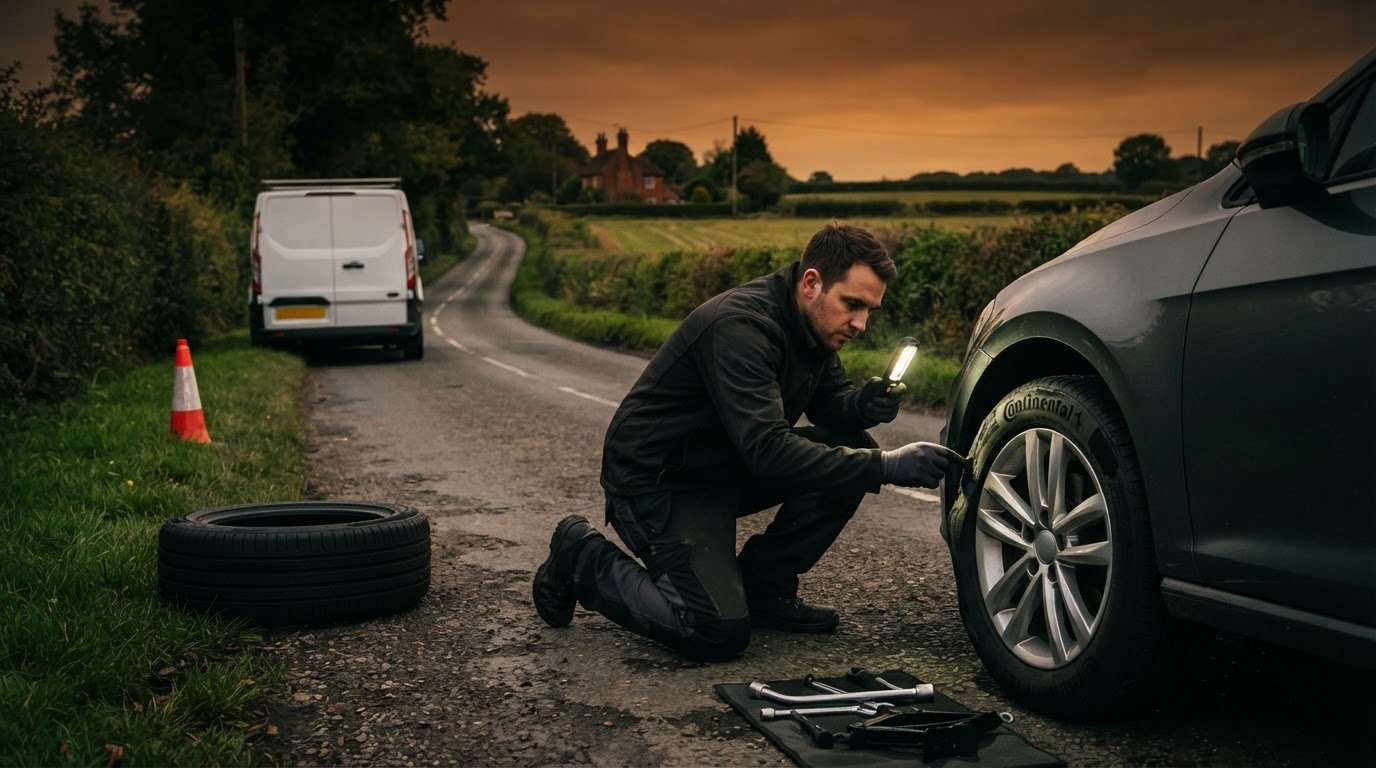
A cut, puncture or bulge in a tyre sidewall means the tyre needs replacing, not repairing. If you’re wondering whether tyre sidewall damage can be repaired, the answer is no: a repair cannot safely restore the sidewall’s structure.
It’s understandable to hope a mark is only cosmetic, especially after brushing a kerb or hitting a pothole. Some scuffs may be superficial, but a deep cut, exposed inner layers, cracks or a bulge needs urgent attention. Damage can also be hidden on the inner sidewall, so an outside view may not show the full picture.
This guide explains what to look for, why driving on a damaged sidewall is risky, and when the tyre needs replacing. You’ll also learn how UK MOT requirements relate to tyre damage, what to do after an impact, and how mobile tyre fitting and repair can help at your location.
Key Takeaways
- Look for cuts, cracks, bulges and pronounced scuffs after an impact, and remember that damage can be on the inner sidewall too.
- A bulge or deep cut can weaken the tyre and lead to sudden pressure loss, so don’t continue driving on a tyre that appears structurally damaged.
- Sidewall cuts, punctures, bulges and exposed inner layers require tyre replacement rather than a repair.
- Check tread as well as sidewall condition: according to the UK Government, the legal minimum tread depth is 1.6 mm across the central three-quarters of the tyre tread.
Tyre sidewall damage: what should you do?
After a kerb strike or pothole impact, inspect the tyre before driving further. The sidewall is the section between the tread and the bead, which sits against the wheel. Check both the inner and outer sides: a bulge or cut may be hidden from outside. If you notice unusual vibration, treat it as a warning and arrange an urgent tyre check.
Different marks have different implications. A bulge can indicate damage to the carcass ply beneath the rubber. A deep cut or puncture may expose inner layers and compromise the tyre’s structure. Cracks can point to ageing or exposure to sunlight and ozone. Numerous or pronounced scratches also need professional examination, while a slight, localised deformation can occur where radial tyre plies overlap.
Use a torch to inspect the whole circumference, including the inner sidewall where visible. Don’t confuse superficial rubbing with a deep gouge: a shallow scuff may affect only the surface, but exposed cords, a split or a raised bulge signals a more serious problem. Sharp stones can cause cuts, while a kerb impact can damage the sidewall without leaving an obvious mark.
- After hitting a pothole or kerb, check both sides for cuts, bulges and abrasions.
- After driving over sharp stones, inspect for punctures or torn rubber.
- If a mark is deep, raised or unclear, avoid relying on a surface-only visual check.
Will car insurance or breakdown cover pay for tyre sidewall damage? It depends on your policy terms. Check your motor policy for accidental tyre damage, and your breakdown terms for the assistance provided and any tyre-related exclusions.
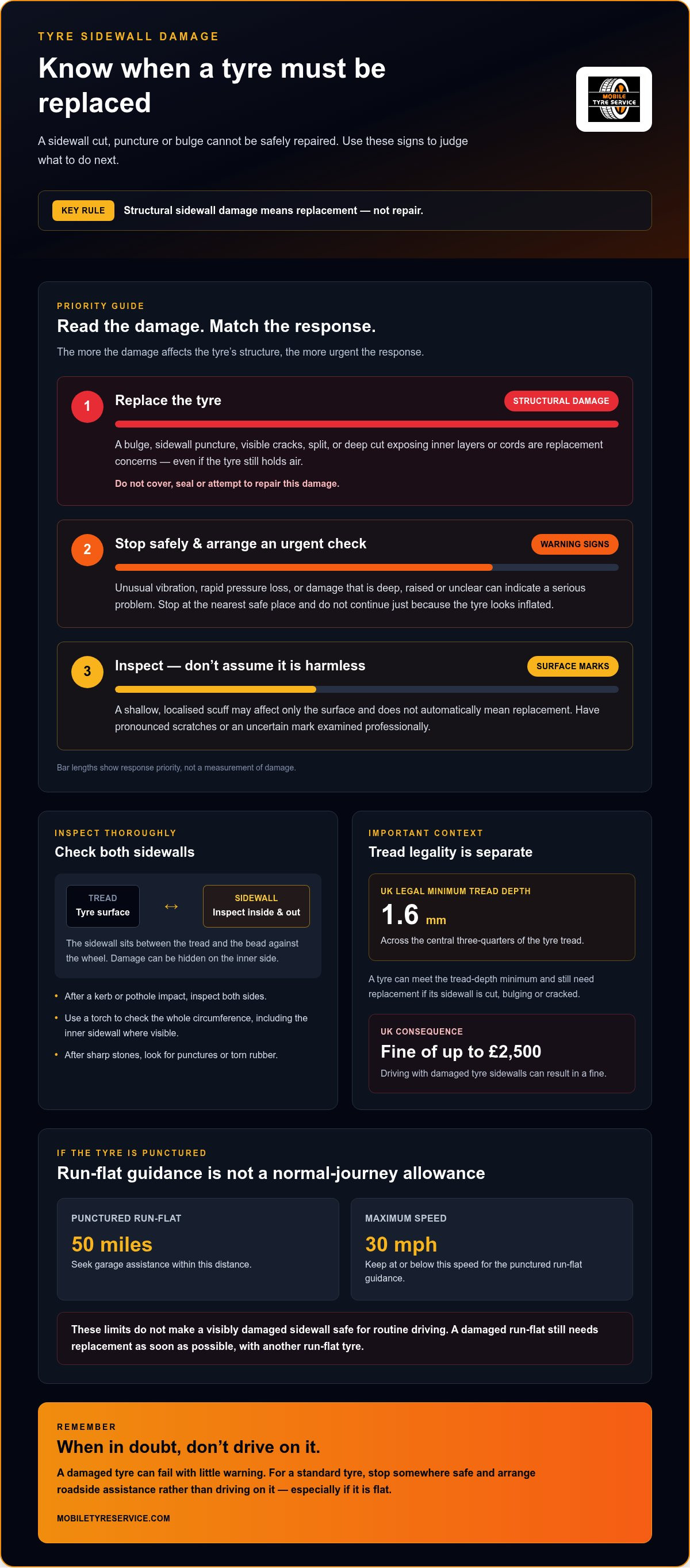
Keep tread condition in view as well as sidewall damage: according to the UK Government, the legal minimum tyre tread depth is 1.6 mm across the central three-quarters of the tyre tread. A tyre can have legal tread depth yet still need attention if its sidewall is cut, bulging or cracked.
Risks of driving with a damaged sidewall
A damaged sidewall can fail with little warning. Unlike a tread puncture, a deep sidewall cut may damage the tyre’s carcass ply, allowing air to escape suddenly. A bulge signals weakened internal structure; if it bursts while driving, the tyre can lose pressure rapidly. This can affect steering and control, particularly when cornering or braking.
How can you tell whether the damage is dangerous? A raised bulge, deep cut, exposed fabric or rapid pressure loss indicates serious damage. Unusual vibration is another warning sign, even if the damaged area is hard to see. Stop as soon as it’s safe, and don’t continue just because the tyre still appears inflated.
Driving on a damaged tyre, even for a short distance, is not recommended because it could fail unexpectedly. A flat tyre is also unsafe to drive on: rolling on it can crush and further damage the sidewall. For a standard tyre, stop somewhere safe and arrange roadside assistance rather than trying to reach a garage on the flat.
- A bulge can burst and cause rapid pressure loss.
- A deep cut can weaken the carcass ply beneath the rubber.
- A deflated tyre can sustain further damage as the wheel rolls on it.
A run-flat tyre is different, but it isn’t permission to continue a normal journey. If a run-flat is punctured, seek garage assistance within 50 miles and keep speed at or below 30 mph. These limits apply to the punctured run-flat guidance; they do not make a visibly damaged tyre safe for routine driving.
In the UK, driving with damaged tyre sidewalls can result in a fine of up to £2,500. Treat visible damage as a safety issue, not merely a cosmetic defect. If you notice a cut, bulge or pressure loss while travelling, stop at the nearest safe place and arrange help before driving again.
When to replace a damaged tyre
Replace a tyre if its sidewall has a bulge, puncture, visible cracks or a deep cut exposing inner layers. These signs indicate that the tyre’s structure may be compromised, even if it still holds air. A small surface scuff differs from a cut that reaches the cords; appearance, depth and location all matter when assessing the damage.
In the UK, tyres must be free from bulges, cuts and punctures to be driven legally. Severe sidewall damage can also cause an MOT failure if it compromises safety. Don’t wait for the next MOT to act: passing an inspection does not make a damaged tyre safe for everyday driving. A professional inspection can establish whether a mark is superficial or the tyre needs replacing.
- Replace a tyre with a sidewall puncture, bulge or exposed cords.
- Replace it if a deep cut reveals inner layers, even when it does not pass through completely.
- Treat visible cracks as a replacement concern, rather than covering or sealing them.
How much does a replacement tyre cost in the UK compared with a repair? The price depends on the case and is given after a quote request; tyre specification, vehicle compatibility and fitting requirements affect the cost. A sidewall replacement isn’t comparable with a safe sidewall repair, because sidewall damage cannot be repaired safely.
Run-flat and self-sealing tyres are not exceptions: sidewall damage still makes them unsuitable for repair. A damaged run-flat should be replaced as soon as possible, and its replacement must also be a run-flat tyre. A self-sealing feature does not change the decision if the sidewall is cut, punctured or bulging.
Before replacing a tyre, match it to the vehicle’s requirements and the damaged tyre’s type. This is especially important for run-flat tyres: fitting a standard tyre would not meet the stated replacement requirement. If the damage is only a superficial scuff, that alone does not mean replacement is necessary; structural damage is the key concern.
Whether sidewall damage can be repaired
If you’re asking whether tyre sidewall damage can be repaired, the safe answer is no. A repair cannot restore the tyre’s structural integrity in this area.
Damage that makes a tyre unsafe to repair
A sidewall cut, puncture, split, gouge, bulge or exposed cord makes the tyre unsuitable for repair. The reason is structural: the sidewall flexes under pressure and helps maintain the tyre’s shape, but lacks the reinforcement belts found beneath the tread. A patch cannot reliably restore that construction. When damage reaches the inner layers, replacing the tyre is the safe course.
Punctures near the tyre shoulder
A puncture near the shoulder is not treated as a repairable tread puncture. The shoulder sits close to the sidewall, where the tyre’s construction changes and flexes. Under BSAU159, a minor repair is limited to the central three-quarters of the tyre. Damage outside that zone, including a shoulder puncture, falls beyond that repair area and requires replacement.
The boundary matters because a puncture’s position affects whether a repair can hold air under pressure. BSAU159 also says a repair should not be attempted when the damaged area exceeds 6 mm in diameter. Those limits apply to minor tyre repairs, not as permission to repair sidewall damage.
For example, a small puncture in the central tread area may meet the location and size criteria for a minor repair. A cut running from the tread towards the shoulder does not become safe to repair just because it looks narrow. Splits, cuts and gouges are not repairable under the stated criteria, nor are sidewall bulges or exposed cords.
Don’t use sealant or a plug to treat a sidewall wound as a permanent fix. These do not restore the damaged structure. A mobile tyre repair is relevant to repairable tyre damage, but a sidewall fault needs replacement rather than repair.
Mobile Tyre Service: MOBILE TYRE FITTING
Mobile Tyre Service provides mobile tyre fitting when sidewall damage means the tyre needs replacing. We can fit a replacement at your location, including at home, so you don’t need to drive on a structurally damaged tyre.
Mobile tyre repair is suitable for repairable tyre damage, not cuts, punctures or bulges in the sidewall. If the damage is in the tread area, whether a repair is suitable depends on its location and condition. When replacement is needed, mobile tyre fitting is a practical way to get the vehicle back on the road safely.
For a damaged sidewall or a tyre that needs replacing, contact Mobile Tyre Service or visit mobiletyreservice.com.
Make your next move with confidence
If you’re still wondering whether tyre sidewall damage can be repaired, let the tyre’s condition guide your next step. Arrange a suitable replacement rather than trying a temporary fix that could leave the vehicle unready for its next journey. A clear plan also helps you avoid rushed decisions at the roadside.
Before arranging fitting, note your vehicle’s make and model and the tyre size shown in the handbook or on a readable tyre. Record where the damage is, and take a photograph only from a safe position. These details help explain what the vehicle needs and make the next conversation more efficient. If the vehicle is in an unsafe place, prioritise getting yourself to safety.
Mobile Tyre Service can help with mobile tyre fitting, including fitting at home, when you need a replacement. For a straightforward next step, contact Mobile Tyre Service and share the relevant vehicle and tyre details. You can move forward with a clear plan and get the tyre issue addressed.
Frequently Asked Questions
Can My Tyre Be Repaired?
Some punctures in the central tread area may be repairable, but sidewall damage is not. For example, a small tread puncture differs from a cut running towards the shoulder, even if both look similar from outside. Repair suitability depends on the damage’s position, size and condition. The tyre must also meet the relevant criteria, rather than simply hold air after a temporary fix.
Can speed bumps damage tyres and cause a bulge?
Speed bumps aren’t expected to damage tyres, although striking one hard may affect the suspension. A bulge is more commonly associated with impact damage, such as hitting a pothole or kerb. If you notice a new bulge after crossing a speed bump, don’t assume it’s harmless or that the bump caused it. Check the tyre and arrange an inspection before resuming normal driving.
When Should You Replace a Tyre?
Replace a tyre when damage affects its structure, or when tread reaches the legal limit. According to the UK Government, the legal minimum tread depth is 1.6 mm across the central three-quarters of the tyre tread. For example, a tyre with adequate tread still needs replacement if its sidewall has a bulge or deep cut. Don’t wait for a warning light to identify visible damage.
Why is a tyre bulge dangerous?
A tyre bulge indicates that the internal structure may have weakened, leaving the tyre less able to contain air under pressure. If the damaged area fails, pressure can drop rapidly and the vehicle may become harder to control. For example, a bulge noticed during a pre-journey check is a reason to stop and arrange help, not to test the tyre on a longer drive.
Can a tyre with sidewall damage be repaired in the UK?
No. If you’re asking whether tyre sidewall damage can be repaired in the UK, a sidewall cut or puncture cannot be safely repaired; the tyre needs replacing. This applies even when a cut looks small or hasn’t passed all the way through the rubber, because internal damage can still affect the tyre’s integrity. Mobile tyre repair is for repairable damage, not a substitute for replacing a damaged sidewall.
What are the UK legal limits for tyre damage, cuts, bulges and exposed cords?
Tyres must be free from bulges, cuts and punctures to be driven legally. Exposed cords indicate serious damage and make the tyre unsafe for use. The UK Government sets the minimum tread depth at 1.6 mm across the central three-quarters of the tread. Severe sidewall damage can cause an MOT failure if it compromises safety, so don’t rely on the next test to address it.
Need a mobile tyre service?
We cover Harlow, Bishop's Stortford, Cambridge and all surrounding areas — 24/7.
Call: 01279 881234