Tyre puncture: repair or replace? A guide for UK drivers
If you’re weighing up tyre puncture repair or replace, the damage you can see isn’t enough to make the decision. A professional needs to check the tyre’s condition, including for internal damage. If it’s losing pressure or your vehicle’s handling has changed, stop somewhere safe and don’t continue d…

If you’re weighing up tyre puncture repair or replace, the damage you can see isn’t enough to make the decision. A professional needs to check the tyre’s condition, including for internal damage. If it’s losing pressure or your vehicle’s handling has changed, stop somewhere safe and don’t continue driving on it.
Not every puncture is suitable for repair. This guide explains what to do first, how a tyre is assessed against the UK repair standard and when replacement may be the safer option.
You’ll also learn why puncture location, damage and the tyre’s condition matter, and why temporary sealant or a DIY plug isn’t a permanent repair. For drivers in Essex or Cambridge, a mobile tyre assessment may help identify the appropriate next step. Check local coverage and availability for your location.
Key Takeaways
- If a tyre is punctured, stop somewhere safe, use your hazard lights and don’t inspect the damage from the traffic side.
- Whether tyre puncture repair or replacement is appropriate depends on a professional inspection, not appearance alone.
- Puncture position, size, tyre condition and signs of internal damage can all affect the decision.
- Photos can help with initial triage, but they can’t confirm whether a tyre is safe to repair.
- When seeking mobile tyre help in Essex or Cambridge, share your location, vehicle details and any known tyre information. Check local coverage and booking availability.
Tyre puncture: first steps to protect you and your car
A sudden pressure warning, vibration or visibly flat tyre can leave you unsure whether to keep moving. Put safety first: stop in a safe place, switch on your hazard lights and don’t risk standing beside traffic to inspect the wheel. Deciding on tyre puncture repair or replacement can wait until you and your passengers are out of immediate danger.
What should you do when you discover a puncture?
If you’re on a busy road, prioritise reaching a safer stopping place over examining the tyre. Don’t stop in a live lane or attempt a repair beside moving traffic. Once stopped, use your hazard lights and keep clear of the traffic side of the vehicle. If you can’t get to a safe place, contact appropriate roadside assistance and follow their instructions.
Check your vehicle handbook for the manufacturer’s guidance on punctures, tyre pressure warnings and whether your vehicle has run-flat tyres. Run-flat tyres are designed to resist the effects of deflation, but that doesn’t mean you should keep driving without checking the handbook’s limits and instructions. Use your existing roadside assistance arrangements if you need help. Don’t attempt to change or repair a wheel in poor conditions or an unsafe position.
Can you drive on a punctured tyre?
Don’t assume a tyre is safe to drive on if it’s losing pressure, visibly flat or showing damage. Driving on it can worsen the damage, and a small-looking puncture doesn’t reveal the tyre’s internal condition. A pressure warning signals a problem to investigate, not that the tyre can be repaired.
If the vehicle is already in a safe place, avoid driving it until you’ve received professional advice. If it’s exposed to danger, move only if you can do so safely, then stop somewhere more secure. If you’re uncertain, contact roadside assistance rather than testing the tyre on the road.
Safety rule: An initial check can identify an obvious hazard, but only a professional inspection can assess whether the tyre is suitable for repair.
A technician may need to inspect the tyre beyond what’s visible on the vehicle before recommending repair or replacement. A mobile tyre professional may be able to assess it at your location. Check local coverage and booking availability, and treat a punctured or damaged tyre as unsafe to drive on until it has been assessed.
How a professional decides whether a tyre puncture can be repaired
A puncture’s visible appearance is only the starting point. To decide whether tyre puncture repair or replacement is appropriate, a technician assesses where and how the tyre is damaged, its overall condition and whether driving on it has caused internal harm. A photograph or quick look at the wheel can’t confirm repairability.
Why puncture location and damage matter
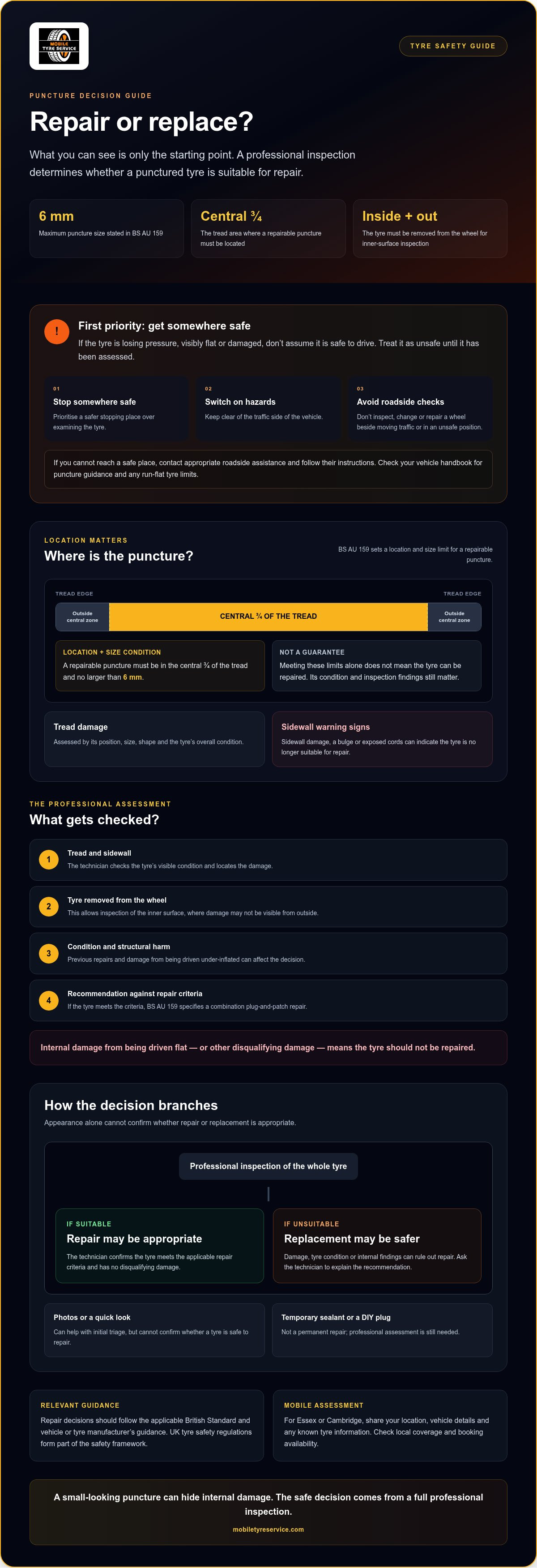
Damage in the tread may be assessed differently from damage to the sidewall. The sidewall flexes as the tyre moves, so damage there, a bulge or exposed cords can indicate that the tyre is no longer suitable for repair. The puncture’s size and shape matter too: under BS AU 159, a repairable puncture must be in the central three-quarters of the tread and no larger than 6mm.
Meeting those limits doesn’t mean every puncture in the permitted area can be repaired. The tyre’s condition, previous repairs and signs of damage from being driven under-inflated can affect the decision. Internal damage may not show on the outside, even if the object that caused the puncture looks small.
What happens during a tyre inspection?
A proper assessment includes checking the tread and sidewall, locating the damage and looking for signs of structural harm. The tyre must be removed from the wheel so its inner surface can be inspected. If it meets the repair criteria, BS AU 159 specifies a combination plug-and-patch repair. A tyre with internal damage from being driven flat, or other disqualifying damage, should not be repaired.
The Motor Vehicle Tyres (Safety) Regulations form part of the UK’s tyre safety framework. Repair decisions should also follow the applicable British Standard and the vehicle or tyre manufacturer’s guidance. A technician may take a more cautious approach if the tyre’s condition raises safety concerns.
Key point: Repair or replacement depends on what a full inspection finds, not on how minor the puncture looks from the outside.
Ask the technician to explain the inspection findings and why repair or replacement is recommended. If you’re in Essex or Cambridge, you can enquire about a mobile tyre repair assessment at your location. Check local coverage and booking availability.
Tyre puncture repair or replacement: how to compare the options
The decision isn’t about choosing the quickest or least disruptive option. It depends on whether a technician’s inspection finds the tyre safe and suitable for a compliant repair. A puncture in the tread isn’t automatically repairable, and replacement may be necessary even if the damage looks minor from the outside.
| Option | Inspection outcome | Safety and next step |
|---|---|---|
| Repair | Damage meets the applicable repair criteria, and inspection finds no disqualifying internal or external damage. | A technician can carry out a repair using the appropriate method. Confirm the tyre has been assessed and repaired in line with current guidance. |
| Replacement | Damage falls outside permitted repair areas, exceeds applicable limits, or the tyre’s condition makes repair unsuitable. | Fit a suitable replacement rather than relying on a repair that inspection does not support. |
| Further assessment | The tyre’s internal condition or damage cannot be confirmed from an external check. | Have the tyre properly inspected before deciding. Don’t treat uncertainty as approval to drive or repair it. |
When might a repair be considered?
A repair is an option only if inspection confirms the tyre is suitable. Under BS AU 159, a repairable puncture must be in the central three-quarters of the tread and no larger than 6mm. The tyre must be removed from the wheel for internal inspection, and the repair must use a combination plug-and-patch method. These criteria don’t guarantee that a particular tyre can be repaired; its full condition and any manufacturer guidance also matter.
When is replacement the safer decision?
Replacement is appropriate if damage is outside the permitted repair area, exceeds the relevant limit, or the tyre has sidewall damage, a bulge or exposed cords. Internal damage from driving on a flat or under-inflated tyre can also rule out repair. The puncture may appear small, but that doesn’t reveal what has happened inside the tyre.
If inspection shows the tyre isn’t suitable for repair, choosing replacement is a safety decision, not an unnecessary extra step. Ask the technician to explain the findings and recommendation. For background on what may affect the mobile tyre repair cost, consult the relevant guide and confirm service details directly before booking.
For drivers considering tyre puncture repair or replacement, let the inspection guide the decision. Don’t request a repair simply because it seems preferable; proceed only when the tyre’s condition and applicable guidance support it. Routine maintenance also plays a major role in overall vehicle safety; whether arranging a local check or booking a professional car service nz to keep a car running smoothly, regular servicing ensures tyres, brakes and key components are evaluated by certified mechanics.
Next steps: puncture assessment in Essex or Cambridge
Clear information helps a mobile tyre professional understand what has happened and what may be needed. If you’re arranging an assessment in Essex or Cambridge, first confirm that your specific location is covered and booking is available. Don’t approach the tyre or take photographs if the vehicle is in an unsafe position.
What information should you have ready?
Share your exact location, vehicle make and model, which tyre is affected and what you noticed before stopping. Mention any tyre pressure warning and whether the tyre appears flat, has visible damage or lost pressure gradually. If you know the tyre size, provide it, but don’t put yourself at risk to find it.
Tyre size is usually printed on the sidewall and may also be recorded in the vehicle handbook or other vehicle documents. For converted or specialist leisure vehicles, such as those from Route 300 Campers, tyre load ratings and sizing specifications may also be confirmed in your vehicle conversion paperwork. Check the sidewall only if the car is safely parked and you can approach the tyre without entering traffic or standing somewhere hazardous. If you can’t read the markings safely, say so.
- Give a precise location, including a nearby landmark if useful.
- Describe what happened, such as hearing a bang, finding a nail or noticing a pressure warning.
- Share clear photographs only if you can take them safely, and explain that they show external damage only.
What should you expect from a mobile assessment?
A photograph can support initial triage, but it can’t show the tyre’s internal condition or confirm that a repair is suitable. A technician must assess the tyre before advising whether repair or replacement is appropriate. The inspection outcome, not the first description or image, determines the next step.
When deciding on tyre puncture repair or replacement, prepare the details above and ask what the inspection has found before proceeding. For cost-related information, consult the existing mobile tyre repair cost guide and confirm service details and charges directly before booking.
Mobile tyre repair and fitting may be available at your location in Essex or Cambridge, subject to local coverage and booking availability. Enquire about a mobile tyre assessment and provide your location and vehicle details.
Mobile tyre puncture help: make a safe, informed decision
A mobile service can bring tyre assessment and work to the vehicle’s location, which may be useful if a puncture makes driving unsafe or impractical. The right choice still depends on a professional inspection. Don’t assume a tyre can be repaired because the damage appears small, and don’t drive if its condition or the vehicle’s handling gives you reason for concern.
When mobile tyre service may help
Where available, mobile tyre repair or fitting can allow a technician to assess the tyre at your home or another suitable location. If inspection finds the tyre repairable, a repair may be appropriate; if not, replacement may be recommended. The inspection determines the outcome, and service availability depends on your location and booking arrangements.
Mobile Tyre Service provides mobile tyre fitting and repair, including at home, and its coverage includes Essex and Cambridge. Check that your specific location is covered and confirm availability before arranging assistance. A mobile visit doesn’t guarantee that the tyre can be repaired; the assessment may show that replacement is the safer option.
How to request the right assistance
To help clarify what service may be appropriate, share your precise location, vehicle make and model, which tyre is affected and what you can safely observe. Mention warning lights or pressure alerts, whether the tyre appears flat and any recent change in handling. You don’t need to inspect the tyre or gather details from an unsafe position.
Explain whether the vehicle is parked at home, in a car park or elsewhere, and whether it can be approached safely. If it may be unsafe to drive, say so and ask what arrangements are suitable rather than moving the vehicle to make the booking easier.
If a tyre pressure warning remains after tyre work, don’t assume the tyre is still punctured or ignore the alert. Mobile TPMS sensor services may be relevant. Ask whether this service is suitable for your vehicle and circumstances, and have the warning properly assessed.
For a tyre puncture repair or replacement decision, prioritise safety, confirm local coverage and let the inspection guide the next step. If you’re in Essex or Cambridge, enquire about mobile tyre assistance with your location and vehicle details, then confirm availability before proceeding.
Make your next move with confidence
If you’re deciding on tyre puncture repair or replacement, keep the priority clear: stay somewhere safe and don’t judge repairability by appearance alone. A technician’s inspection, including the tyre’s internal condition, determines whether repair is suitable or replacement is needed. Until you’ve had professional advice, don’t drive on a tyre that may be unsafe.
Mobile tyre repair and fitting can bring assessment and suitable tyre work to your vehicle’s location, subject to local coverage and availability. Mobile Tyre Service covers Essex and Cambridge, so confirm your specific location and booking options. If a tyre pressure warning remains after tyre work, mobile TPMS sensor services may also be relevant; ask whether they suit your vehicle.
Have your location, vehicle details and a clear description of the symptoms ready. Request mobile tyre assistance for your location and confirm the next step with the service provider.
Frequently Asked Questions
Can a punctured tyre always be repaired?
No, a punctured tyre cannot always be repaired. Whether repair is suitable depends on the puncture’s position and size, the tyre’s overall condition and any internal damage, which may not be visible from outside. A small-looking hole alone doesn’t prove it’s safe. A technician needs to inspect the tyre and check current repair guidance and manufacturer requirements. If it fails assessment, replacement may be the safer choice.
Can you repair a puncture in a tyre sidewall?
Usually, sidewall damage isn’t treated like a repairable tread puncture. The sidewall flexes as the tyre operates, so damage there can compromise its integrity. Don’t assume a repair is suitable based on appearance; a professional must assess it against current applicable guidance. If the tyre is visibly damaged or deflated, don’t drive on it. Stop somewhere safe and arrange professional advice or assistance before moving the vehicle.
Is it safe to drive with a slow puncture?
Not necessarily. Even a slow pressure loss can affect handling and may cause further tyre damage, so distance travelled or a tyre that looks nearly normal can’t establish that driving is safe. Stop somewhere safe, consult your vehicle handbook and seek professional advice. If the tyre is visibly flat or damaged, don’t continue driving on it. If you can’t move safely, contact appropriate roadside assistance.
How does a technician decide whether to repair or replace a tyre?
A technician assesses the puncture’s position and dimensions, the tyre’s overall condition and whether driving while under-inflated has caused internal damage. A proper check may require removing the tyre from the wheel so the inside can be examined. The assessment must follow current applicable standards and the vehicle or tyre manufacturer’s guidance. Repair is an option only if those checks confirm the tyre is suitable; otherwise, replacement may be advised.
Can a puncture be repaired at home or at the roadside?
Yes, a mobile technician may assess a punctured tyre at the vehicle’s location, depending on local coverage and circumstances. The inspection determines whether repair is appropriate or replacement is needed; a visit can’t guarantee either outcome. Don’t attempt roadside work if traffic, weather or where you’ve stopped makes it unsafe. Drivers in Essex or Cambridge should confirm that their specific location is covered and check booking availability before arranging assistance.
What should I do if my tyre pressure warning light stays on after a puncture repair?
Don’t ignore a warning that stays on after puncture work. Follow your vehicle handbook to check tyre pressures using the recommended procedure, and seek professional advice if the alert remains or the vehicle handles unusually. The warning doesn’t prove the TPMS sensor is faulty; it may need further assessment. Mobile Tyre Service provides mobile TPMS sensor services. Confirm availability for your specific location in Essex or Cambridge.
For mobile tyre fitting, repair or TPMS sensor assistance in Essex or Cambridge, contact Mobile Tyre Service with your location and vehicle details, and confirm local availability.
Need a mobile tyre service?
We cover Harlow, Bishop's Stortford, Cambridge and all surrounding areas — 24/7.
Call: 01279 881234