TPMS Warning Light On? A Comprehensive Guide to Tyre Pressure Monitoring Systems
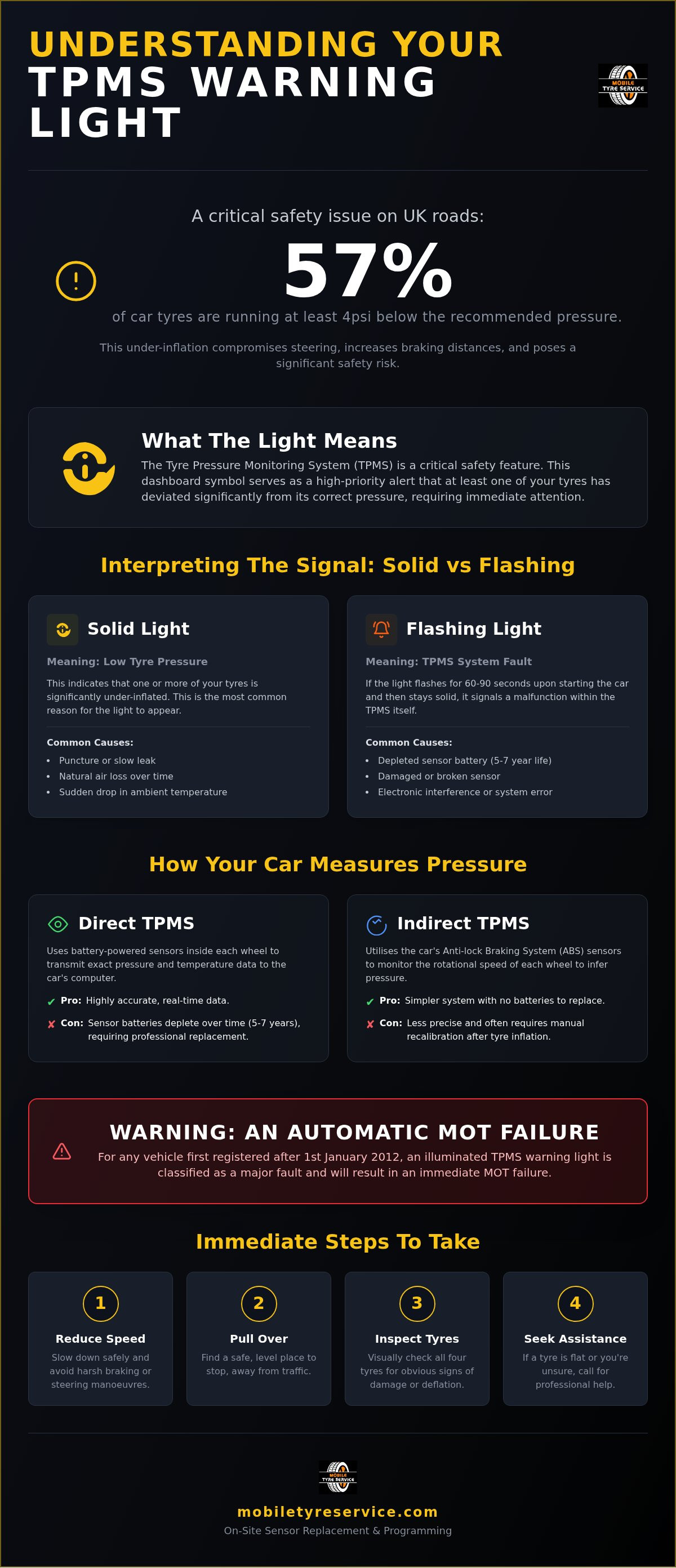
An estimated 57% of car tyres on UK roads are currently running at least 4psi below the manufacturer’s recommended pressure. Finding your TPMS warning light on while driving through Essex or Cambridge is more than a mere inconvenience; it's a high-stakes safety signal from your vehicle's internal mo…

An estimated 57% of car tyres on UK roads are currently running at least 4psi below the manufacturer’s recommended pressure. Finding your TPMS warning light on while driving through Essex or Cambridge is more than a mere inconvenience; it's a high-stakes safety signal from your vehicle's internal monitoring unit. You likely feel a surge of anxiety about a potential blowout or frustration at the prospect of losing hours in a local garage. It's a common dilemma that pits your busy schedule against your fundamental road safety.
This comprehensive guide ensures you understand exactly why that alert has appeared and how to secure a resolution without leaving your driveway. We'll examine the critical differences between flashing and solid indicators, explain why a faulty sensor is an automatic MOT failure for vehicles registered after 2012, and detail the technical process of on-site sensor programming. You will discover how mobile specialist intervention provides a precise, convenient alternative to traditional workshops. This allows you to maintain your mobility and your safety simultaneously through elite, high-precision diagnostics delivered directly to your location.
Key Takeaways
- Learn to interpret the dashboard symbol correctly and understand its role as a high-precision safety monitor for your tyres.
- Identify the critical difference between a solid and a flashing TPMS warning light on your display to assess the urgency of the fault.
- Master the immediate safety protocols required when an alert sounds, including safe roadside inspection and pressure verification.
- Recognise why a malfunctioning sensor triggers an automatic MOT failure for vehicles registered from 2012 onwards.
- Discover how elite mobile units provide on-site sensor replacement and programming, eliminating the need for inconvenient garage visits.
Understanding the TPMS Warning Light on Your Dashboard
The Tire-Pressure Monitoring System (TPMS) is a sophisticated safety network integrated into your vehicle's electronic architecture. Its primary function is to provide real-time alerts regarding under-inflation, which is critical for maintaining vehicle stability and fuel efficiency. When you see the TPMS warning light on your dashboard, it typically manifests as a yellow icon resembling a horseshoe with a central exclamation mark. This symbol represents the cross-section of a tyre. It serves as a high-priority notification that at least one tyre has deviated from its calibrated pressure parameters. Modern vehicle behaviour relies heavily on precise tyre pressures; under-inflated tyres increase braking distances and compromise steering response.
The Legal Requirement: TPMS and the MOT Test
Ignoring this dashboard alert carries significant legal consequences. For any vehicle first registered after 1st January 2012, a lit TPMS warning light results in an immediate MOT failure. This classification as a major fault reflects the high-stakes nature of tyre safety. Beyond the legal mandate, driving with a faulty system masks underlying issues like slow punctures or structural degradation. Since 2014, UK legislation has mandated that all new passenger vehicles must be equipped with a functional tyre pressure monitoring system. Professional intervention is required to reset the system and verify the integrity of your tyres safely.
Direct vs Indirect TPMS: How Your Car Measures Pressure
Manufacturers utilise two distinct technologies to monitor your tyres. Direct TPMS is the more advanced solution. It uses battery-powered sensors mounted inside each wheel to transmit exact pressure and temperature data to the vehicle's computer. While highly accurate, these sensors eventually require professional replacement or battery maintenance. Our specialised mobile units carry the diagnostic tools necessary to programme and fit these components at your location.
Indirect TPMS does not use dedicated pressure sensors. Instead, it utilises the existing Anti-lock Braking System (ABS) to measure the rotational speed of each wheel. An under-inflated tyre has a slightly smaller diameter and rotates faster than its counterparts. The system detects this discrepancy and triggers the alert. Although indirect systems are simpler, they lack the precision of direct sensors and often require manual recalibration after every pressure adjustment. Understanding which system your vehicle uses is essential for effective maintenance and rapid fault resolution.
Primary Reasons Why Your TPMS Light Stays Illuminated
Low tyre pressure remains the most frequent reason for finding your TPMS warning light on. This drop usually results from a physical puncture or a slow leak within the tyre carcass. Maintaining correct inflation is a fundamental aspect of vehicle safety, as outlined in the NHTSA guidelines on tire safety. Beyond simple air loss, mechanical damage to the sensor itself can occur. Road debris or improper handling during previous tyre changes often compromises the delicate internal components. If you suspect a structural issue, our specialists provide rapid mobile tyre repair to restore your vehicle's safety parameters.
The Impact of Seasonal Temperature Changes
Cold weather significantly alters tyre pressure. In regions like Essex and Cambridge, plummeting winter temperatures cause the air inside your tyres to contract. This physical density change reduces the internal pressure, often triggering the dashboard alert on frosty mornings. You might observe the light extinguishing after several miles of driving. This occurs because friction generates heat, expanding the air and restoring the pressure to a level above the sensor's threshold. However, a light that remains illuminated despite driving indicates a persistent pressure loss that requires expert investigation. Our specialised mobile unit can identify whether your alert is a temporary environmental reaction or a critical safety fault.
Sensor Battery Life and Electronic Faults
Electronic failure is another common cause for a persistent warning signal. TPMS sensors are sealed units powered by internal lithium-ion batteries. These batteries typically possess a service life of 5 to 7 years. Because the units are hermetically sealed to withstand harsh road conditions, the battery cannot be replaced independently. The entire sensor must be renewed once the power cell depletes. Electronic interference or "cross-talk" from other nearby wireless devices can also disrupt the signal transmission to your car's central computer. Identifying these specific electronic faults requires specialised diagnostic equipment. We utilise high-precision tools to scan each sensor and verify its transmission strength, ensuring we only replace components that have genuinely failed.
Interpreting Warning Signals: Flashing vs Solid TPMS Lights
Identifying the visual behaviour of your dashboard alert is the first step in assessing operational risk. A solid yellow light indicates a pressure drop below the calibrated safety threshold in at least one tyre. Conversely, a flashing light that eventually remains solid signifies a systemic failure within the electronics. According to the National Highway Traffic Safety Administration (NHTSA) guidelines on TPMS, these distinct signals are designed to prevent catastrophic tyre failure and improve road safety. Immediate professional diagnosis is the only reliable method to verify your vehicle's safety and restore system integrity accurately.
When the Light Flashes for 60-90 Seconds
If you notice the alert flashing for approximately 60 to 90 seconds upon starting your engine, the vehicle is reporting a hardware fault rather than a pressure issue. This specific sequence is the universal indicator for a system malfunction. It often points to a depleted sensor battery, mechanical damage to the sensor, or a communication error between the wheel unit and the vehicle's electronic control unit (ECU). Whilst this fault persists, the system is technically blind and cannot monitor your tyres for sudden pressure loss. This leaves you vulnerable to undetected punctures during high-speed travel. Our mobile technicians carry elite diagnostic tools to scan the sensors and re-establish this critical safety link at your home or workplace in Essex or Cambridge.
Solid Light: The Pressure Alert Protocol
A solid light requires a disciplined and immediate response. You must locate a safe, level area to stop and inspect all four tyres for visible damage, embedded objects, or significant deflation. Don't attempt to drive long distances whilst the TPMS warning light on your dashboard remains illuminated. Even a minor pressure drop compromises braking distances and steering precision. If you find a foreign object in the tread, you must determine is my tyre puncture repairable based on its location and size before attempting to reinflate. Driving on an under-inflated tyre generates excessive heat, which can lead to rapid sidewall failure. We provide rapid-response mobile support to assess and resolve these pressure alerts on-site, ensuring your vehicle remains safe and road-legal.
Immediate Steps to Take When the Tyre Pressure Light Appears
Finding the TPMS warning light on your dashboard while mid-journey requires a disciplined and immediate response. You must first identify a safe, level location to halt the vehicle away from active traffic. Conduct a meticulous visual inspection of all four tyres. Look for obvious signs of deflation, embedded debris like nails, or structural compromises such as sidewall bulging. If you possess a reliable pressure gauge, verify the readings against the manufacturer’s specifications found in your door shut or fuel cap. If a gauge is unavailable, proceed with extreme caution to the nearest air pump to confirm the levels.
How to Correctly Reset Your TPMS System
Resetting the system is a precision task that should only occur after you have confirmed and adjusted all tyre pressures to their correct levels. Most modern vehicles utilise dashboard menus or a dedicated physical button, often located in the glovebox or near the steering column. You must never reset the light simply to hide the alert whilst a pressure drop persists. This action masks a genuine safety risk and prevents the system from protecting you. Some vehicles require a short calibration drive, typically 10 to 15 minutes at speeds above 20mph, to allow the sensors to synchronise with the vehicle's computer. If the TPMS warning light on your display returns after this process, it indicates a hardware failure or a persistent leak that requires a specialised mobile TPMS sensor service.
Safety First: When to Call for Roadside Assistance
Certain scenarios dictate that you must not continue driving. If you observe a tyre that appears "squashed" or notice visible bulging in the sidewall, you have entered a high-risk danger zone. Driving even a short distance in this state risks irreparable damage to the wheel rim and significantly increases the probability of a sudden blowout. Unlike generic service providers who suggest visiting a local centre, we recognise the inherent danger in driving on compromised tyres. For motorists in Cambridge and Essex, our mobile intervention is the elite, risk-free alternative. We bring technical mastery directly to your location, preventing further vehicle damage and ensuring your absolute safety. You can maintain your schedule by choosing a specialised mobile tyre service to resolve the fault where you stand.
Professional Mobile TPMS Solutions in Essex and Cambridge
When you discover your TPMS warning light on, the most secure course of action is to bring the diagnostic solution directly to your vehicle. Mobile Tyre Service operates as a specialised intervention unit, prioritising your safety and your schedule. We eliminate the inherent risks of driving on under-inflated or structurally compromised tyres by delivering high-precision diagnostics to your home or workplace. This on-site approach ensures your vehicle remains stationary until its safety systems are fully restored and verified.
Our TPMS sensor fitting service represents a premium alternative to traditional garage visits. We maintain a comprehensive inventory of sensors and the technical equipment required to programme or clone units for all major vehicle makes and models. This ensures that your new hardware communicates perfectly with your car's electronic control unit (ECU). We are committed to providing a rapid, professional response across the Essex and Cambridge regions, grounding our elite service in a physical, real-world response that restores your mobility without delay.
On-Site Diagnostic Precision
Our technicians utilise high-end handheld diagnostic tools to "ping" each individual sensor. This allows us to read internal battery life and verify signal transmission strength without the need to remove the tyre from the wheel rim. We can pinpoint the exact faulty sensor amongst the four with absolute certainty, preventing unnecessary part replacements and reducing your costs. Our mobile intervention units operate with the clockwork efficiency of a specialised response team, arriving fully equipped to resolve your technical fault at the roadside or on your driveway.
The Benefits of Choosing Local Mobile Experts
For busy professionals in Cambridge and Essex, time is a critical asset that shouldn't be wasted in a workshop. Our service is designed to integrate seamlessly into your day, removing the need to wait in cold, oily garages or inconvenient waiting rooms. We provide a high-precision, elite experience that values your mobility and your time equally. Choosing local experts ensures you receive a service tailored to the specific technical requirements of the region's motorists. By bringing the garage to you, we provide a level of convenience and safety that national generic providers cannot match.
Book your elite mobile TPMS service today to restore your vehicle's safety parameters with professional precision and technical mastery.
Restore Your Vehicle Safety with Elite Mobile Intervention
A persistent dashboard alert is a technical directive that requires immediate diagnostic action. You now understand that a TPMS warning light on your display signifies either a critical pressure drop or a systemic electronic failure. Ignoring these signals risks catastrophic tyre failure and ensures an automatic MOT failure for vehicles registered since 2012. Driving to a traditional garage on compromised tyres introduces unnecessary risk to your wheel rims and your personal safety.
Our elite mobile technicians provide the high-precision alternative that modern motorists in Essex and Cambridge require. We deliver on-site diagnostics and sensor programming directly to your driveway, ensuring your vehicle is roadworthy without you ever leaving your home or workplace. Our rapid response units are perpetually prepared to resolve sensor faults with technical mastery and clockwork efficiency. We identify the exact fault using specialised handheld tools, replacing only the necessary components to restore your system's integrity. Don't compromise your road safety or your schedule by delaying essential maintenance. Drive with total confidence knowing your tyres are monitored by a fully functional, high-precision system.
Secure your professional TPMS sensor replacement in Essex or Cambridge now
Frequently Asked Questions
Can I drive with the TPMS light on?
No, it's not recommended to continue driving with the alert illuminated. Driving on under-inflated tyres increases the risk of a blowout and significantly compromises your vehicle's braking distance. If the light is flashing, it indicates a system malfunction that leaves you without critical safety monitoring. You should stop safely and seek professional mobile assistance in Essex or Cambridge to diagnose the fault immediately and ensure your continued safety.
How much does it cost to replace a TPMS sensor in the UK?
The cost of sensor replacement varies depending on your vehicle's specific make and model. Factors such as whether you require an original equipment manufacturer (OEM) part or a high-quality aftermarket alternative will influence the final price. Since these units are sealed electronics, the entire sensor must be replaced once the battery fails. For motorists in Cambridge and Essex, we provide specific quotes based on your vehicle's technical requirements.
Why did my TPMS light come on after I changed my tyres?
This often occurs because the system requires a manual reset or a calibration drive to recognise the new pressure levels. In some cases, the delicate sensor may have sustained mechanical damage during the tyre change process if handled incorrectly by a non-specialist. If the TPMS warning light on your dashboard remains after a reset, a specialist must scan the sensors to ensure they are transmitting correctly to the vehicle's computer.
Will a TPMS light fail an MOT test?
Yes, an illuminated TPMS light is classified as a major fault and results in an automatic MOT failure for vehicles registered after 1st January 2012. The system must be fully operational to pass the inspection. This regulation reflects the legal mandate for functional safety monitoring on UK roads. Ensuring your sensors are maintained by elite mobile technicians prevents avoidable failures and keeps your vehicle legally compliant during its annual test.
How long do tyre pressure sensors usually last?
Most TPMS sensors have an operational lifespan of 5 to 7 years. This duration is dictated by the internal lithium-ion battery, which is hermetically sealed within the unit and cannot be replaced independently. Once the battery depletes, the sensor stops transmitting data to the vehicle's central computer. Environmental factors and high mileage can also influence this timeframe. We utilise specialised diagnostic tools to read remaining battery life for motorists across Essex.
Why is my TPMS light on but my tyres are fine?
If your physical tyre pressures are correct, the alert likely stems from a sensor malfunction or an electronic communication error. A dead internal battery or a faulty sensor will trigger a warning even if inflation is perfect. Seasonal temperature drops can also cause temporary pressure fluctuations that activate the system. Our mobile diagnostic unit can ping your sensors on-site to identify the specific electronic fault without the need to remove your tyres.
Does the TPMS light come on for the spare tyre?
This depends entirely on your vehicle's specific system architecture. Some premium manufacturers include a sensor in the full-sized spare tyre, which will trigger the dashboard alert if its pressure drops whilst stored in the boot. However, most space-saver spares do not contain sensors. If your main tyres are correctly inflated but the light persists, checking the spare's pressure is a logical diagnostic step before calling for professional mobile assistance.
How do I know which sensor is faulty?
While some modern dashboards display a graphic showing the specific tyre, many vehicles only provide a general warning. Identifying the exact faulty unit amongst the four requires high-end handheld diagnostic equipment. Our technicians use these tools to scan each wheel individually at your location in Cambridge or Essex. This precision allows us to isolate the malfunctioning sensor and perform a targeted replacement, ensuring your TPMS warning light on the display is cleared efficiently.
Need a mobile tyre service?
We cover Harlow, Bishop's Stortford, Cambridge and all surrounding areas — 24/7.
Call: 01279 881234