The Critical Dangers of Driving on a Flat Tyre: Why Every Metre Matters
Would you gamble £2,500 and three penalty points on a two minute drive to the nearest garage? Most motorists assume limping a few hundred metres on a flat won't cause lasting harm, but the physics of vehicle weight tell a different story. The dangers of driving on a flat tyre are immediate and often…

Would you gamble £2,500 and three penalty points on a two minute drive to the nearest garage? Most motorists assume limping a few hundred metres on a flat won't cause lasting harm, but the physics of vehicle weight tell a different story. The dangers of driving on a flat tyre are immediate and often irreversible. Within seconds, the lack of air pressure forces your wheel rim to crush the tyre's internal structure, turning a simple puncture into a total scrap loss.
It's understandable to feel anxious when a warning light flashes on a busy Essex A-road or a quiet Cambridge lane. You want to reach safety quickly. However, continuing to move without pressure risks catastrophic rim damage and compromises your steering control. This guide examines the severe mechanical, safety, and legal risks you face when ignoring a deflation. You'll discover the precise point of no return for tyre repairs and learn how professional mobile tyre fitting serves as the only secure protocol for roadside failure.
Key Takeaways
- Identify why a total loss of pneumatic pressure leads to immediate tyre de-seating and unpredictable vehicle behaviour.
- Discover how the dangers of driving on a flat tyre include rapid internal heat buildup that permanently destroys the rubber compound and wheel rim.
- Understand the UK statutory penalties for driving in a dangerous condition, including fines up to £2,500 and three penalty points per defective tyre.
- Learn the correct emergency protocol to maintain steering control and reach a safe location without using heavy braking.
- Explore how rapid-response mobile tyre fitting in Essex and Cambridge eliminates the need to risk your vehicle's mechanical integrity.
Immediate Loss of Vehicle Control and Handling
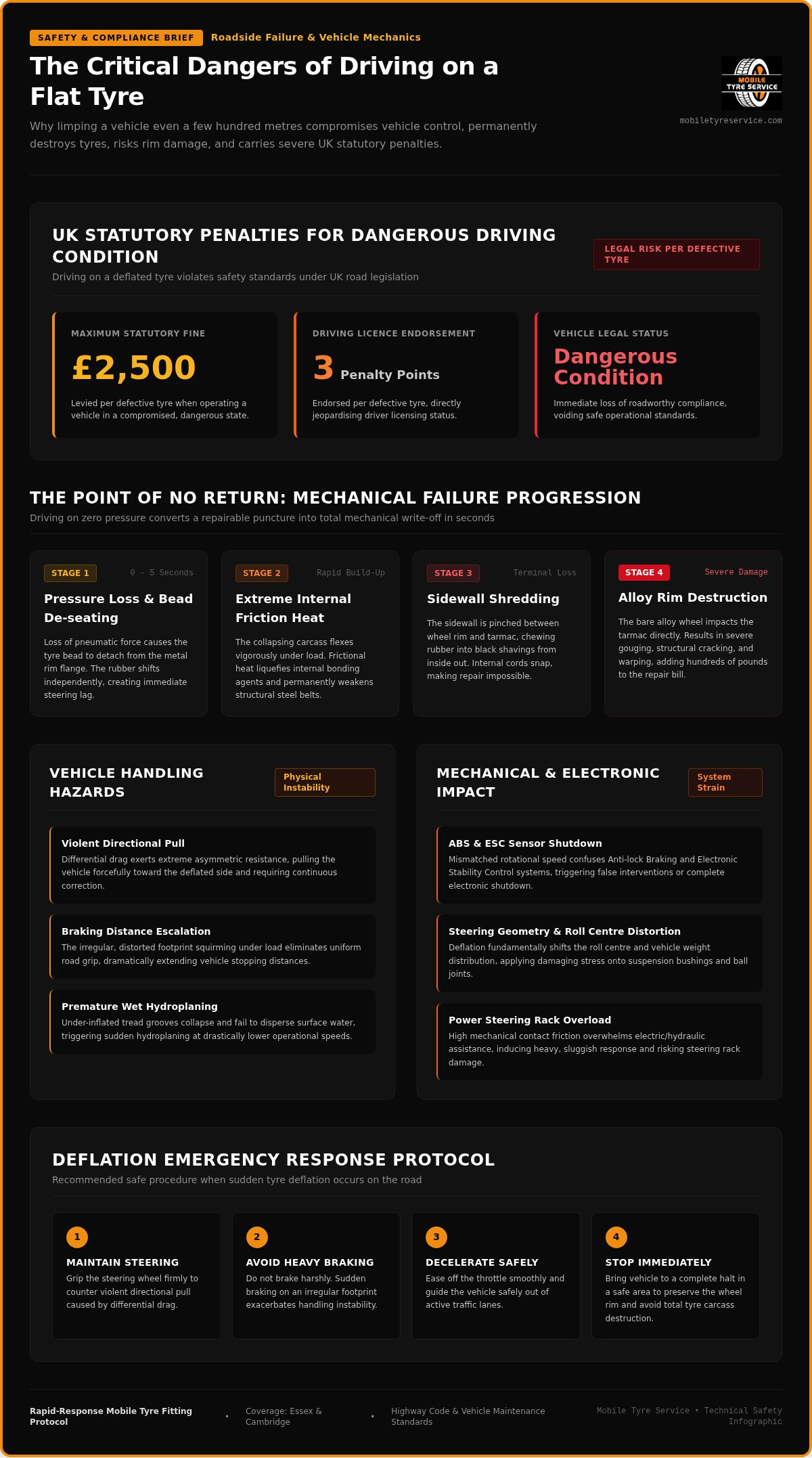
The moment pneumatic pressure vanishes, the structural integrity of your vehicle's contact with the road disappears. One of the most immediate dangers of driving on a flat tyre is the risk of the tyre de-seating from the wheel rim. Without compressed air to force the tyre bead against the metal flange, the rubber begins to move independently of the wheel. This creates a terrifying lag between your steering inputs and the vehicle's response. You lose the precision required to maintain a straight line, especially at higher speeds on major arteries across Essex and Cambridge.
Braking distances escalate sharply because the deflated tyre cannot provide a consistent footprint. Instead of a uniform grip, the rubber bunches and squirms under load. The vehicle will pull violently toward the side of the deflation, requiring constant physical correction. This effect is compounded on damp surfaces; an under-inflated tyre cannot effectively disperse water, leading to hydroplaning at much lower speeds than usual. Even a small amount of surface water becomes a hazard when the tread pattern is distorted by lack of pressure.
The Impact on Steering Geometry
A flat tyre fundamentally alters your vehicle's steering geometry by shifting the roll centre and disrupting the weight balance. The contact patch expands into an irregular, high-friction shape that places immense strain on suspension bushings and ball joints. Your power steering system must work significantly harder to overcome this mechanical resistance. In many cases, the hydraulic or electric assistance cannot fully compensate for the drag, making the car feel heavy and unresponsive during critical manoeuvres. Continued movement in this state can cause secondary damage to the steering rack itself. To address these complex mechanical issues caused by tyre failure, particularly in Japanese vehicles, specialised facilities like Speedy Roo Motorsports & Repair Inc offer the high-precision diagnostic and repair services required to restore your vehicle's safety.
Braking Instability and Safety Systems
Modern safety features like Anti-lock Braking Systems (ABS) and Electronic Stability Control (ESC) rely on wheel speed sensors to function correctly. When you continue to drive on a flat, that wheel rotates at a different speed compared to the others. This data discrepancy can cause these systems to intervene incorrectly or shut down entirely, leaving you without electronic assistance during an emergency. Understanding tire blowout mechanics and vehicle dynamics is vital for any driver facing a sudden deflation. Differential drag is the primary cause of the violent steering pull experienced when one wheel encounters significantly more resistance than the others.
Irreparable Structural Damage to the Tyre and Rim
Driving even a short distance without air pressure transforms a manageable puncture into a terminal mechanical failure. One of the primary dangers of driving on a flat tyre is the rapid, extreme accumulation of internal heat. As the deflated rubber flexes and folds under the vehicle's weight, friction between the internal layers generates temperatures high enough to liquefy the bonding agents. This process permanently degrades the rubber compound and compromises the steel belts within the carcass. Once this thermal damage occurs, the tyre loses its structural integrity and becomes a safety liability that cannot be salvaged.
The "shredding" effect is the final stage of this destruction. Without air to maintain the tyre's shape, the sidewall collapses and is pinched between the metal wheel rim and the road surface. This creates a grinding action that literally chews through the rubber from the inside out. You'll often see black rubber shavings inside the tyre once it's removed; this is the physical remains of your tyre's destroyed internal liner. According to Highway Code guidance on flat tyres and vehicle maintenance, drivers must stop as soon as it's safe to do so to prevent such catastrophic degradation.
The Physics of Sidewall Collapse
A standard pneumatic tyre relies entirely on air pressure to hold its form. The sidewall is engineered for flexibility and lateral stability, not for load-bearing in a collapsed state. When the pressure drops, the bead, which is the reinforced edge seating the tyre to the rim, begins to disintegrate. Professional technicians look for heat discolouration or "scuffing" on the outer sidewall as clear indicators of terminal failure. If these signs are present, the internal polyester and steel cords have likely snapped or separated, making a safe repair impossible. For vehicles that are deemed a total loss due to such structural damage, you can check out Melbourne Car Removal for expert disposal services in the Melbourne region.
Protecting the Wheel Rim
Beyond the cost of the rubber, the financial stakes increase when the wheel rim is involved. Driving on a flat eventually forces the alloy rim into direct contact with the tarmac. This leads to gouging, structural cracking, or warping of the expensive metal. Replacing a premium alloy wheel can cost hundreds of pounds, far exceeding the price of a simple tyre swap. Stopping immediately preserves the rim's circularity and prevents the need for costly mechanical replacements. If you're stranded in Essex or Cambridge, opting for a professional mobile tyre fitting service ensures your vehicle is handled with the precision required to protect your alloys from further harm.
Legal Implications and Financial Penalties in the UK
The legal dangers of driving on a flat tyre carry severe consequences under the Road Traffic Act 1988. In the UK, operating a vehicle with a tyre in a dangerous condition is a serious motoring offence that police officers enforce with high-precision scrutiny. A single defective tyre can result in a fine of up to £2,500 and three penalty points on your driving record. If you're found to have multiple unroadworthy tyres, the penalties escalate rapidly.
- Fines: Up to £2,500 per defective tyre, potentially reaching £10,000 for a full set.
- Penalty Points: Three points per tyre; 12 points across a vehicle triggers an automatic six-month disqualification.
- Endorsement Codes: Referencing UK driving endorsement codes and penalty points, the CU30 code applies specifically to using a vehicle with defective tyres.
- MOT Status: A flat or damaged tyre results in an immediate MOT failure, making the vehicle illegal to use on public roads.
DVSA Standards and Police Enforcement
Police officers use specific criteria to determine if a vehicle is in a dangerous condition. If a tyre is completely flat or the sidewall has collapsed, the vehicle is legally unroadworthy. Claiming you were "limping" to a local garage in Essex or Cambridge is rarely accepted as a valid legal defence. The law requires you to stop as soon as a defect is identified to ensure public safety. Ignoring a Tyre Pressure Monitoring System (TPMS) warning light significantly increases your legal culpability. It demonstrates that you knowingly operated a defective vehicle, which can lead to a more serious charge of dangerous driving if your actions lead to a collision.
Insurance and Liability Risks
Operating a vehicle with a known flat tyre is often classified as negligent maintenance by motor insurers. In the event of an accident, an investigation that reveals a pre-existing tyre defect can lead to a total claim rejection. You'll be held personally liable for all third-party damages and the cost of your own vehicle repairs. The financial burden is immense. While some motorists worry about the immediate mobile tyre repair cost, these figures are negligible compared to the financial ruin of an uninsured accident or a high-court liability claim. Professional roadside intervention from Mobile Tyre Service ensures your vehicle remains compliant with both the law and your insurance policy requirements.
Emergency Response: What to Do When Your Tyre Fails
When a tyre fails at speed, your immediate physical response determines the outcome. You must grip the steering wheel firmly with both hands to counteract the sudden pull caused by differential drag. Avoid the instinctive urge to slam on the brakes. Rapid deceleration shifts the vehicle's weight forward, which can cause a de-seated tyre to fold and throw the car into a spin. Instead, ease off the accelerator and allow the engine's natural resistance to slow you down. Understanding the dangers of driving on a flat tyre means knowing that even a few seconds of incorrect braking can lead to a total loss of control.
Steer the vehicle toward a safe, level area well away from moving traffic. Activate your hazard lights immediately to provide maximum visibility to other motorists. If you're carrying a reflective jacket, put it on before exiting the vehicle through the door furthest from the road. Once stationary, perform a quick visual assessment. Determine if the tyre is completely flat or simply losing pressure. If the rim is touching the ground, do not move the vehicle again, as this indicates terminal pressure loss.
Securing the Roadside Scene
A "Safety First" mindset is essential on busy UK roads like the A12 or M11. You should never attempt a DIY tyre change on a motorway hard shoulder or a narrow A-road verge. The risk of being struck by passing vehicles is exceptionally high. If you're on a standard road, place a warning triangle at least 45 metres behind your vehicle to alert oncoming drivers. This creates a necessary buffer zone for any approaching traffic and allows other motorists time to adjust their speed or lane position.
Calling for Professional Intervention
Securing a mobile tyre fitting service is the most logical and safe protocol for a stranded motorist. It eliminates the risk of working in a live traffic environment and prevents the mechanical damage discussed in previous sections. Before you call, have your tyre size, found on the sidewall, and your exact location ready. Using a digital location tool or a specific landmark helps the response unit reach you with high precision. Ensure your locking wheel nut key is accessible, as this is vital for a swift replacement. The safe zone for roadside waiting is defined as being behind a safety barrier or well away from the carriageway on the verge. To resolve your situation without further risk, you can secure expert mobile tyre fitting from a rapid response unit.
Professional Mobile Tyre Solutions in Essex and Cambridge
Mobile Tyre Service operates as a specialised intervention force across the region. We understand the physical dangers of driving on a flat tyre and provide the logistical solution to eliminate those risks entirely. Our rapid response units are strategically positioned to reach motorists in Essex and Cambridge with elite efficiency. By bringing the workshop directly to your location, we remove the need for you to limp a damaged vehicle through traffic, protecting your wheel rims and ensuring your total safety.
Our technicians provide a comprehensive mobile TPMS sensor service to address the electronic warnings that often precede a total pneumatic failure. If a puncture is detected early and meets the strict criteria of British Standard BS AU 159, we perform on-site puncture repairs with high-precision accuracy. This specialised approach saves you the expense of a full tyre replacement whilst maintaining the roadworthiness of your vehicle. We act as a decisive problem-solver, delivering technical mastery to your doorstep.
Local Expertise in Essex and Cambridge
We possess deep knowledge of the regional road network, from the congested A127 in Essex to the arterial A14 in Cambridge. This geographical mastery translates to faster arrival times and more accurate logistical planning. Whether you're stranded in a business car park or parked on a residential driveway, our units operate with surgical precision. Choosing a dedicated local specialist ensures you receive a level of accountability and technical focus that national generalists often lack. We prioritise the specific needs of Essex and Cambridge motorists, grounding our service in real-world, local response times.
Why Choose Our Mobile Unit?
Each mobile unit is a high-precision facility equipped with the latest fitting and balancing technology. We don't just swap rubber; we ensure every installation meets elite mechanical standards. You don't need to waste hours in a garage waiting room or risk driving on a defective tyre to reach a service centre. We organise the intervention around your schedule, providing a premium experience that values your time. Precision is our standard, and mobility is our method. Book your professional mobile tyre fitting in Essex or Cambridge now to restore your vehicle's integrity without the risks associated with roadside failure.
Prioritising Roadside Safety and Mechanical Integrity
Driving on a flat tyre is a high-stakes gamble that risks total vehicle instability, irreversible rim destruction, and severe legal penalties. The dangers of driving on a flat tyre extend beyond the immediate mechanical failure; they compromise your safety and legal standing under UK road laws. Every metre travelled without pneumatic pressure increases the likelihood of a total scrap loss rather than a simple, cost-effective repair. You don't have to risk your alloys or your licence to reach a service centre.
Mobile Tyre Service operates as a specialised intervention force to prevent these outcomes across Essex and Cambridge. Our professional roadside intervention specialists utilise fully equipped mobile fitting units to deliver technical mastery directly to your driveway or the roadside. We provide expert TPMS maintenance and high-precision puncture repair services designed to restore your vehicle's integrity immediately. Secure your elite mobile tyre service in Essex and Cambridge today and regain your mobility with total confidence. It's the most efficient way to protect your vehicle and your safety.
Frequently Asked Questions
How far can I safely drive on a flat tyre?
You cannot safely drive any distance on a completely flat tyre. Once pneumatic pressure reaches zero, the vehicle's weight rests entirely on the tyre's sidewall and the wheel rim. This setup lacks the stability required for steering or braking. Continuing for even a few hundred metres causes terminal structural damage. You should stop the vehicle immediately in a safe location and contact a professional mobile unit for assistance.
Will driving on a flat tyre ruin my wheel rim?
Yes, driving on a deflation will likely destroy your wheel rim. Without the air-filled cushion of the tyre, the metal rim makes direct contact with the road surface. This causes immediate gouging, structural cracking, and warping. Replacing a premium alloy wheel is significantly more expensive than a standard tyre replacement. To protect your vehicle's mechanical integrity, you must stop moving before the rubber separates from the wheel bead.
Is it illegal to drive on a flat tyre in the UK?
It is illegal to operate a vehicle in a dangerous condition on UK roads. Driving with a flat tyre can lead to a CU30 endorsement, carrying three penalty points and a fine of up to £2,500 per defective tyre. If the police determine that your vehicle poses a risk to other road users, you may face more serious charges. The dangers of driving on a flat tyre include these severe legal and financial ramifications.
Can a flat tyre be repaired after being driven on?
A tyre that has been driven on whilst flat is rarely repairable. Professional standards like BS AU 159 prohibit repairs if there is evidence of internal structural degradation. This typically appears as "run-flat" damage, where the inner liner has been shredded by the wheel rim. A specialist technician must inspect the internal carcass for heat discolouration or loose rubber shavings before certifying any puncture repair as safe for road use.
What should I do if my TPMS warning light comes on whilst driving?
You must decelerate smoothly and find a safe location to inspect your tyres immediately. The TPMS warning indicates that at least one tyre has dropped below the safe pressure threshold. Don't ignore this signal, as it's your first line of defence against a catastrophic blowout. Check the pressures with a gauge and inspect for visible punctures. If the pressure is critically low, call for a mobile technician rather than attempting to reach a garage.
Is it safe to use a tyre sealant kit as a permanent fix?
No, tyre sealant kits are strictly temporary measures designed to get you to the nearest place of safety. They cannot fix sidewall damage, large punctures, or tyres that have unseated from the rim. The chemical residue often makes a permanent professional repair impossible. These kits don't address the underlying structural integrity of the tyre. For a long-term solution, you should seek a professional mobile fitting service to replace the compromised unit.
Why is mobile tyre fitting safer than driving to a garage?
Mobile tyre fitting is safer because it removes the need to operate a compromised vehicle. Driving to a garage with a deflation risks a total loss of control and permanent rim damage. A mobile unit brings high-precision equipment directly to your home or roadside location in Essex or Cambridge. This allows a specialist to perform a safe replacement or repair in a controlled environment without you having to navigate live traffic on a defective tyre.
Do I need to replace both tyres on the same axle if one goes flat?
It is highly recommended to replace both tyres on the same axle to maintain balanced handling and braking. Significant differences in tread depth between the left and right sides can disrupt the vehicle's stability systems and cause the car to pull under braking. If your remaining tyre is nearly worn, a dual replacement ensures the vehicle operates with maximum precision. A professional technician can assess the tread depth and advise on the safest configuration.
Need a mobile tyre service?
We cover Harlow, Bishop's Stortford, Cambridge and all surrounding areas — 24/7.
Call: 01279 881234