Slow puncture repair at home in Essex: what to do next
Could a tyre that looks intact still be losing enough pressure to make driving unsafe? A slow leak can be difficult to trace, and driving to a garage may not feel like a safe option. This guide explains what slow puncture repair at home Essex drivers can arrange through a mobile tyre service, and wh…
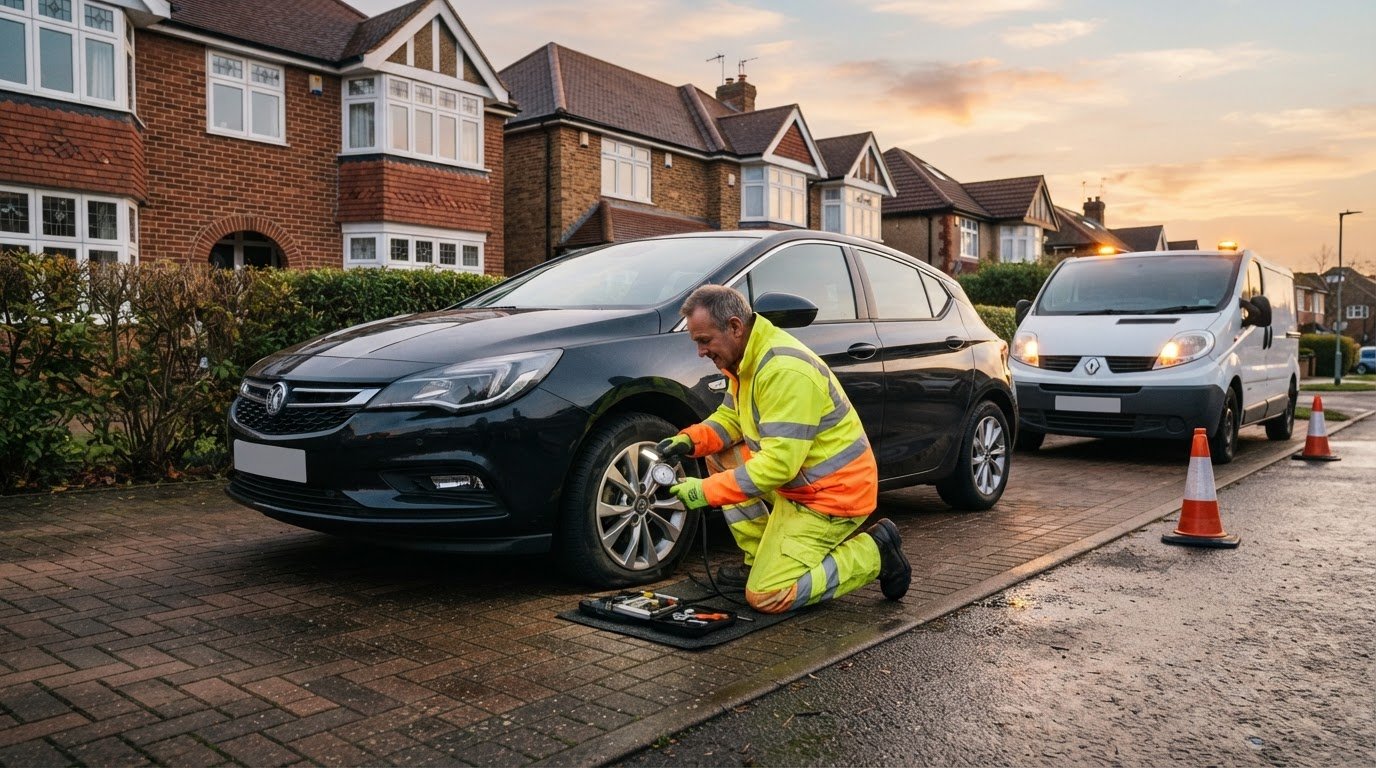
Could a tyre that looks intact still be losing enough pressure to make driving unsafe? A slow leak can be difficult to trace, and driving to a garage may not feel like a safe option. This guide explains what slow puncture repair at home Essex drivers can arrange through a mobile tyre service, and why a professional assessment must come before any repair decision. A small object in the tread, a faulty valve or a poor seal between the tyre and wheel could be the cause.
It’s understandable to want a quick fix when the pressure keeps dropping. But not every puncture is repairable, and driving on an under-inflated tyre can cause further damage. If the vehicle feels unsafe to move, leave it parked in a safe place and arrange help at your location rather than risk the journey.
You’ll learn what to do while waiting for professional help, how the damage’s location and the tyre’s condition affect repairability, and when replacement may be needed instead. Mobile Tyre Service provides mobile tyre repair at customers’ homes in Essex, so the tyre can be assessed without taking a potentially compromised vehicle to a garage.
Key Takeaways
- Record how often the tyre loses pressure and note any visible changes to describe the problem clearly.
- A leak may come from tread damage, a valve issue or the bead area, so its source needs a professional assessment.
- Whether slow puncture repair at home Essex is possible depends on the damage’s location and the tyre’s overall condition.
- Have your vehicle’s location, tyre details and symptoms ready when arranging a mobile visit.
- An inspection may lead to repair or replacement, so don’t assume every puncture can be fixed.
Slow puncture at home in Essex: recognise the signs and stay safe
Finding a tyre losing pressure on your driveway can disrupt the day and leave you unsure whether the car is safe to move. A tyre may look normal at first, even as air escapes gradually. Look for clues, but don’t handle the tyre or drive to see what happens.
How can you recognise a slow puncture?
A recurring pressure drop over hours or days can indicate a slow leak, although it doesn’t reveal the cause. The tyre might look lower than the others, or you may spot an object such as a nail in the tread. A tyre-pressure warning can alert you to falling pressure, but it can’t diagnose why it’s happening.
- Pressure falls again after the tyre has been inflated.
- A tyre looks visibly lower than the others.
- An object or other visible damage appears on the tyre.
A sudden flat is different: the tyre may lose pressure rapidly or become visibly deflated. Don’t assume a gradual warning means the car is safe to drive, or that a sudden loss has a particular cause. A professional inspection is needed to assess the tyre and identify where air is escaping.
What should you do before help arrives?
Keep the vehicle stationary if the tyre looks damaged, significantly deflated or unsafe. Avoid driving on a visibly under-inflated tyre, as continued use can cause further damage. If inspecting or approaching the wheel would put you at risk, leave it alone and prioritise your safety.
- If it’s safe, look at the tyre from a safe position. Note any visible object or damage, but don’t touch or remove anything embedded in it.
- Check the pressure only if you can do so safely. Follow the vehicle handbook for the correct checking procedure and pressure guidance.
- Note which tyre is affected and whether the pressure has dropped more than once. This can help you explain the problem when arranging help.
- Keep the car parked if its condition makes moving it unsafe. Arrange a professional assessment at home rather than attempting a journey on a compromised tyre.
Repeated inflation does not repair a puncture. Adding air may change the pressure temporarily, but it won’t establish why the tyre is losing air or whether it’s safe to use. Don’t rely on repeated inflation as a fix, and don’t remove an embedded object: disturbing it could worsen the leak.
If pressure is falling rapidly, or you can’t manage the situation safely, stop and keep clear of the vehicle. Slow puncture repair at home in Essex gives drivers a practical way to arrange a professional assessment without driving a potentially compromised tyre to a garage.
What causes a slow puncture, and what does a mobile inspection involve?
A tyre can lose air for several reasons, and a visible clue doesn’t always show where the leak begins. A nail in the tread might be easy to spot, but pressure loss can also come from a valve issue or a poor seal where the tyre meets the wheel. These causes need different assessments, so a photograph or quick glance can’t confirm the fault or determine the right solution.
Where can a tyre lose air from?
A sharp object can damage the tread and allow air to escape. The valve used to inflate the tyre may also be involved. Alternatively, air may leak around the tyre bead, the edge that seals against the wheel. A tyre can lose pressure without an obvious nail or screw, and seeing an object doesn’t establish whether the damage is suitable for repair.
Other signs, such as a tyre looking lower or a pressure warning, indicate a concern rather than a diagnosis. A tyre-pressure monitoring system can alert you to a pressure change, but it doesn’t identify whether the tread, valve or bead is responsible. The vehicle handbook explains how to check tyre pressures and interpret the warning for your model. Treat a warning as a reason to assess the situation, not as a diagnosis.
What happens during an on-site tyre assessment?
During a mobile visit, a technician assesses the tyre’s condition and works to identify the source of air loss. The visible surface is only part of the picture, and a surface check may not reveal the full extent or nature of the problem. The assessment guides the decision on whether repair is appropriate or replacement is needed.
Finding the leak is the first step, not proof that the tyre can be repaired. The source, location and condition of the tyre all matter. A puncture in one area may be assessed differently from damage near the edge, while an apparent valve or bead leak also needs evaluation. No single visible clue can determine the outcome remotely.
For drivers looking for slow puncture repair at home Essex, a mobile assessment brings professional help to the vehicle’s location. It’s a practical alternative to driving a tyre that may be losing pressure to a garage. Keep notes about the pressure loss and any visible clues ready, then let the inspection findings determine the next step. You can arrange a mobile tyre repair at home in Essex.
Can a slow puncture be repaired? The safety checks that decide
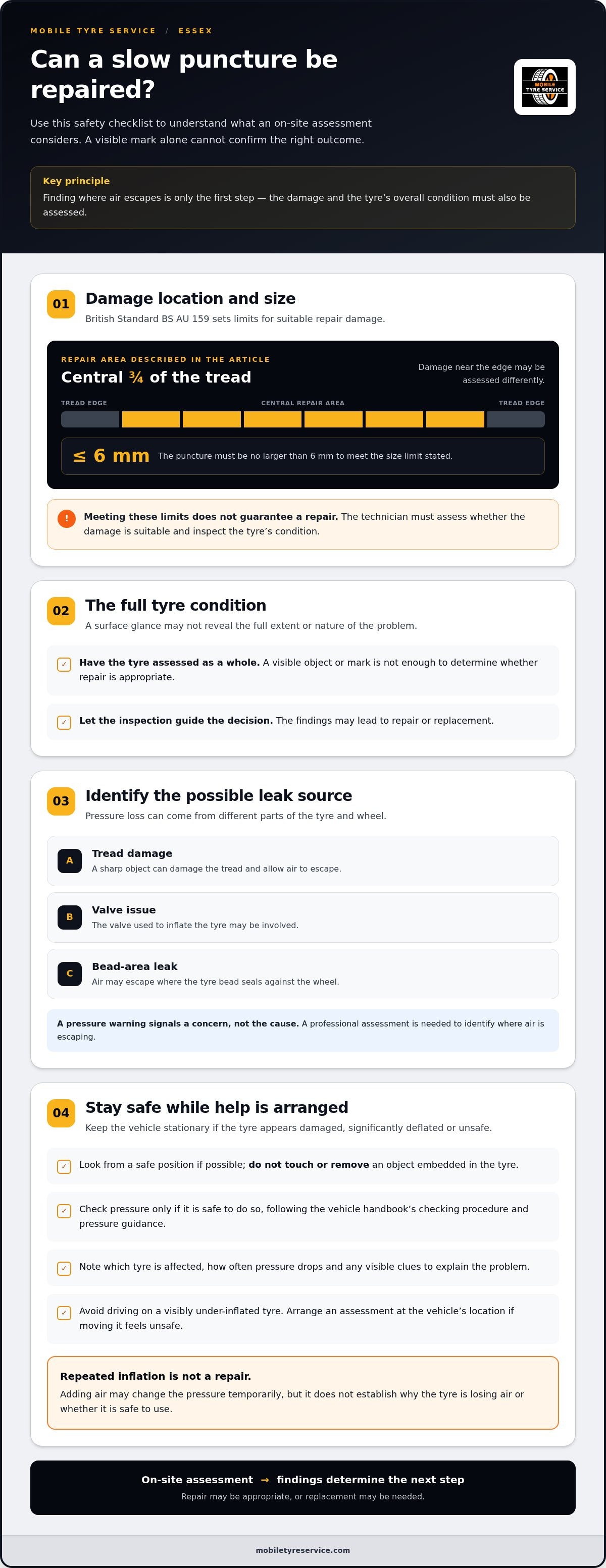
An at-home visit doesn’t mean every tyre can be repaired. Repair is an option only if the damage and the tyre’s condition meet the relevant safety criteria. The technician needs to assess the full tyre, not just the visible mark or object, before recommending repair or replacement.
In the UK, tyre repairs are assessed against British Standard BS AU 159. Its criteria restrict repairs to suitable damage in the central three-quarters of the tread, with a puncture no larger than 6 mm. Meeting those limits alone doesn’t guarantee a repair: the tyre’s condition and any damage that isn’t visible from the outside also matter.
Which punctures may be suitable for repair?
Some limited damage in the tread area may be repairable if a full tyre assessment finds it suitable. The technician considers the damage’s location and size alongside the tyre’s overall condition. A visible nail in the tread is only a clue, not a decision. The assessment may reveal other issues that affect whether a safe repair is possible.
| What the assessment finds | What it may mean |
|---|---|
| Limited damage in a suitable area of the tread, with the tyre otherwise in suitable condition | A repair may be considered after a full professional assessment. |
| Damage on or close to the sidewall or shoulder | It is not treated as a routine tread repair; replacement may be needed. |
| Extensive damage, signs of internal harm, or a tyre in poor overall condition | Repair may be unsuitable, and replacement may be the safer outcome. |
| A visible puncture with other concerns about the tyre | The puncture alone cannot determine the decision; the whole tyre needs assessment. |
When might replacement be the safer outcome?
Sidewall damage, extensive damage or a tyre in poor condition can make repair unsuitable. The sidewall flexes as the tyre operates, so damage there isn’t equivalent to a small tread puncture. A tyre with internal damage may also be unsafe to repair, even if the outside looks relatively intact.
Replacement is a safety-led alternative when the assessment shows the tyre can’t be repaired appropriately. The purpose of professional assessment is to identify a safe next step, not to promise a particular result. The recommendation depends on the damage and condition of that specific tyre.
For slow puncture repair at home Essex, a mobile visit lets the tyre be assessed at your location rather than driving on a potentially compromised tyre. The decision depends on the evidence: where the damage is, how extensive it is and whether the tyre remains suitable for safe use after repair.
How to prepare for slow puncture repair at home in Essex
A little preparation makes an at-home tyre assessment more straightforward. You don’t need to diagnose the leak or decide whether the tyre can be repaired before arranging help. Share clear details about the vehicle’s location and what you’ve observed. This gives the mobile technician useful context and helps you plan without moving a car that may be unsafe to drive.
What information should you have ready?
Have the Essex address or precise vehicle location ready, particularly if it’s parked somewhere other than your usual driveway. Describe which tyre is affected and how its pressure has changed, such as whether it keeps dropping after inflation or looks lower than the others. If readily available, note the vehicle details and the tyre size printed on the tyre. Don’t delay arranging help to find information you can’t access safely.
How can you make the home visit easier?
Keep the vehicle parked in a safe, accessible position where the affected tyre can be assessed. If it’s already stationary and driving could be unsafe, leave it there rather than repositioning it for convenience. Give a precise location and share any practical access details that could help the technician reach the vehicle. The assessment comes first; the findings determine whether repair or replacement is appropriate.
- Identify the vehicle location. Provide the address or a clear description of where it’s parked in Essex.
- Describe the tyre symptoms. Note which tyre is affected, how quickly the pressure appears to fall and any visible damage. Don’t remove an object or handle a damaged tyre to gather details.
- Share available tyre information. Give the vehicle details and tyre size if you can read them safely and easily.
- Keep the vehicle safely accessible. Leave it parked if its condition makes moving it unsafe, and make the location clear for the mobile visit.
These details help explain the situation, but they can’t confirm the cause or guarantee a particular outcome. A tyre that looks repairable from the outside may have other issues, while a pressure drop without an obvious puncture still needs assessment. The technician examines the tyre before recommending the next step. Repair is carried out only if the tyre is suitable; replacement may be advised if it isn’t.
If you’re comparing your options before arranging slow puncture repair at home Essex, the mobile tyre repair cost guide offers further reading. When you’re ready, arrange mobile tyre repair at home and provide the location, tyre details and symptoms you’ve gathered. A mobile visit is a practical alternative to driving a potentially compromised tyre to a garage, with the assessment guiding the decision on repair or replacement.
Arrange mobile slow puncture repair at home in Essex
If a tyre keeps losing pressure, an assessment at home can be a practical next step, particularly when driving it to a garage may be unsafe or difficult. Report the pressure loss, arrange a mobile visit to the vehicle’s location, then use the technician’s assessment to decide what happens next. An at-home visit brings the tyre service to you, but it doesn’t mean a repair is guaranteed. The tyre’s condition determines the appropriate outcome.
What to expect from a professional mobile tyre repair
Mobile Tyre Service provides mobile tyre repair and fitting at customers’ locations in Essex. During the visit, the technician assesses the tyre and reported pressure loss before recommending what should happen next. Depending on the findings, that may be a repair or replacement. The decision follows the assessment, not an assumption based on how the tyre looks from the outside or how slowly it has been losing air.
This distinction matters. A tyre that appears to have a small puncture may have damage or condition issues that make repair unsuitable. The initial symptom alone can’t establish that replacement is necessary either. An on-site assessment provides the basis for a recommendation for that particular tyre. If repair isn’t appropriate, replacement may be the safer course.
Before the visit, keep the vehicle parked if you’re unsure it can be moved safely. Share its location and a clear description of the problem when arranging the service. You don’t need to identify the cause yourself. Repeated inflation or a visible object doesn’t prove the tyre is ready for use, so let the technician’s assessment guide the decision.
Take the next step in Essex
A slow pressure loss can be easy to underestimate, especially if the tyre still looks close to normal. Don’t assume it’s safe to drive simply because the loss seems gradual. If the tyre appears significantly deflated, visibly damaged or unsafe, leave the vehicle stationary and arrange a professional assessment at its location. This avoids worsening the tyre’s condition through an unnecessary journey.
For drivers seeking slow puncture repair at home Essex, the sequence is clear: report the issue, arrange a mobile visit and use the assessment to decide what follows. Mobile Tyre Service offers an at-home option in Essex, providing a practical alternative to taking a questionable tyre to a garage. The recommendation depends on what the technician finds.
Share the vehicle’s location and the symptoms you’ve noticed, then arrange mobile tyre repair at home in Essex. Keep the vehicle stationary if moving it could be unsafe, and let the professional assessment determine whether repair or replacement is suitable.
Make a safe plan for your next journey
A tyre losing pressure can put your plans on hold, but you don’t have to decide on a repair yourself. Arrange an assessment and use its findings to make an informed decision about the vehicle. Until you know the tyre is suitable for use, don’t treat a temporary pressure increase or an apparently minor leak as reassurance.
For slow puncture repair at home Essex, Mobile Tyre Service can assess the tyre at your preferred location. The technician’s recommendation depends on its condition, with repair or replacement considered as appropriate. This is a practical way to address the issue without making a potentially unsafe drive just to seek an assessment.
Share where the vehicle is and what you’ve noticed, then take the next step towards resolving the pressure loss. Arrange mobile tyre repair at home in Essex and let a professional assessment guide the way forward. With the right information and a safety-led decision, you can move towards getting back on the road with confidence.
Frequently Asked Questions
Can I drive with a slow puncture?
It’s safest not to drive on a tyre that’s losing pressure until its condition has been assessed. If the tyre looks compressed, pressure is dropping quickly or the vehicle’s handling feels different, stop somewhere safe and don’t continue the journey. Driving can put extra strain on an under-inflated tyre and worsen damage. Arrange a professional assessment rather than relying on repeated inflation to make the journey safe.
Can a tyre lose pressure without a visible nail or screw?
Yes. A leak may not have an obvious object in the tread. Air can escape from a hard-to-see area, including around the valve or where the tyre seals against the wheel. A visual check may not reveal the source, so don’t assume the tyre is sound just because you can’t spot a nail or screw. A pressure warning signals a problem, not its cause.
Can a tyre valve cause a slow puncture?
Yes. A valve or its components can allow air to escape gradually, even when the tread looks undamaged. You may notice the pressure falling again after inflation without seeing a clear puncture. Avoid trying to tighten or alter the valve yourself, as this won’t establish the cause. Include the recurring pressure loss when arranging an assessment, so the technician knows what you’ve observed.
Should I use tyre sealant before arranging a repair?
Use sealant only in line with the instructions for your vehicle and the product. Emergency sealant kits are temporary measures, not permanent repairs, and are intended to help you reach a safe place for professional attention. Tell the technician if you’ve used sealant, as it may affect the tyre assessment. If the vehicle or tyre seems unsafe to move, don’t use a kit as a reason to drive.
Can cold weather make a tyre pressure warning appear?
Yes. Colder temperatures can reduce tyre pressure and may trigger a warning, but don’t assume temperature explains a warning that persists or returns. Check the pressure when it’s safe, following the vehicle handbook’s instructions, and compare it with the recommended figure for your vehicle. If one tyre continues to lose pressure, arrange an assessment to establish whether there’s a leak or another issue.
Can a tyre be repaired more than once?
Sometimes, but a previous repair can affect whether another repair is suitable. The technician needs to assess the tyre’s condition and consider the location of existing repairs alongside any new damage. A tyre with previous repairs isn’t automatically suitable or unsuitable. Don’t rely on a visual check to decide; the full assessment determines whether another repair is appropriate or replacement is the safer option.
How long does a slow puncture repair take at home?
There isn’t one fixed duration. The time depends on what the technician finds during the assessment and whether repair is appropriate or replacement is needed. A search for “slow puncture repair at home Essex” can help locate a mobile option, but it can’t predict the work required for a particular tyre. Arrange a visit and let the on-site assessment establish the next step.
Need a mobile tyre service?
We cover Harlow, Bishop's Stortford, Cambridge and all surrounding areas — 24/7.
Call: 01279 881234