Roadside Tyre Repair Checklist: Essential Steps for Essex and Cambridge Motorists
One in five vehicle breakdowns on UK motorways and A-roads are now caused by tyre defects, leaving over 58,000 motorists stranded in the last year alone. If you've found yourself pulled over on a busy Essex or Cambridge carriageway, you know that a roadside tyre repair is not just a convenience but…

One in five vehicle breakdowns on UK motorways and A-roads are now caused by tyre defects, leaving over 58,000 motorists stranded in the last year alone. If you've found yourself pulled over on a busy Essex or Cambridge carriageway, you know that a roadside tyre repair is not just a convenience but a critical safety operation. We understand the immediate anxiety of being stationary in a high-speed environment and the uncertainty of whether your puncture meets the strict criteria for a safe, professional intervention.
Follow this professional checklist to stay safe whilst our elite mobile technicians restore your vehicle’s mobility on the roadside. You'll learn exactly how to secure your position, how we determine if a repair is BS AU 159 compliant, and what to expect from our specialised rapid-response units. This guide ensures you remain protected whilst we execute a systematic repair that gets you back on the road with minimal disruption to your schedule.
Key Takeaways
- Learn the critical protocol for securing your vehicle on busy Essex roads, including the correct placement of warning triangles and hazard lights.
- Discover the technical criteria our specialists use to determine if a roadside tyre repair is BS AU 159 compliant or requires a full replacement.
- Understand the elite equipment used during a mobile intervention, ensuring your vehicle is handled with industrial-grade precision even on uneven surfaces.
- Gain clarity on the "Repair or Replace" protocol that prioritises your safety and mobility across the Cambridge and Essex road networks.
Immediate Roadside Safety: Your Emergency Checklist
A puncture on a high-speed road is a high-stakes emergency. Before you consider the mechanics of a roadside tyre repair, you must secure your immediate environment. Your vehicle is a vulnerable target when stationary on a busy carriageway. Professional Tire maintenance can prevent many failures, but when a blowout occurs, your priority is survival and visibility. Follow these precise steps to manage the scene before our intervention unit arrives.
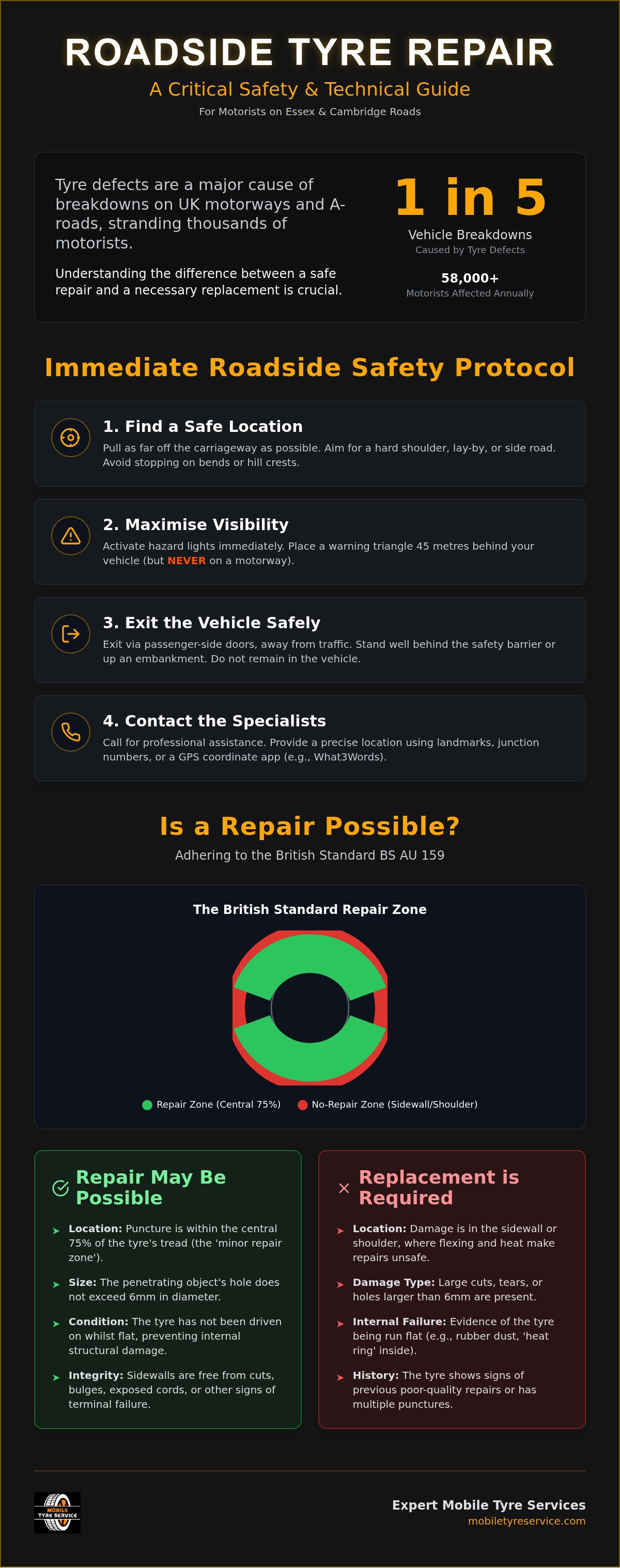
- Find a safe location: Pull as far off the carriageway as possible. Aim for a hard shoulder, a designated lay-by, or a quiet side road. Avoid stopping on bends or just over the brow of a hill.
- Hazard awareness: Activate your hazard lights immediately. If it's safe to do so, place a warning triangle 45 metres behind your vehicle on the same side of the road. Never do this on a motorway.
- Exit the vehicle: Don't stay inside the car. Exit via the passenger side doors to remain away from live traffic. Move up the embankment or stand well behind the safety barrier.
- Contact the specialists: Call our dispatch team with your precise location. Use the What3Words app to provide a three-metre square coordinate for rapid deployment.
Positioning for Roadside Assistance
Your vehicle's position dictates the safety of the technician and the speed of the repair. Ensure there's at least one metre of clearance around the affected tyre. This space allows our specialist to deploy industrial-grade jacks and compressors without encroaching on the live lane. If you're on a slope, turn your steering wheel so the wheels point away from the road. This prevents the vehicle from rolling into traffic if the handbrake fails. Keep your sidelights on during hours of darkness or poor visibility. It's vital that our rapid-response unit can identify your vehicle from a distance amongst the flow of traffic.
Identifying Your Location in Essex or Cambridge
Precision is the cornerstone of our rapid-response service. Note key landmarks or junction numbers if you're stranded on major routes like the M11, A12, or A14. These arteries are high-volume zones where every second counts. Use your smartphone to pin your exact GPS coordinates for our dispatch team. If you're on a smart motorway without a hard shoulder, look for the nearest Emergency Area (EA). We treat these as high-priority zones. Clearly state if you're in a high-risk area so our roadside tyre repair unit can prepare for a high-speed intervention. Our technicians understand the Essex and Cambridge road networks intimately, but exact data ensures we reach you without delay.
Is Your Puncture Repairable? The Technical Criteria Checklist
A flat tyre doesn't always signal the end of its service life. However, safety remains the non-negotiable priority for any elite technician. Determining whether a roadside tyre repair is possible requires a rigorous inspection against specific technical benchmarks. We don't guess; we measure and inspect with surgical precision to ensure the structural integrity of your vehicle is never compromised.
- The Minor Repair Zone: The puncture must be located within the central 75% of the tyre’s breadth. Any damage outside this area is considered the "major repair zone" and is structurally unfixable.
- Entry Hole Diameter: The penetration must not exceed 6mm in diameter. Larger holes, often caused by heavy debris or bolts, compromise the internal steel belts beyond safe limits.
- Structural Integrity: The tyre must not have been driven on whilst flat. Running on low pressure causes the sidewall to overheat and disintegrate internally, often leaving a "ring of heat" or rubber dust inside the carcass.
- Sidewall Condition: The external rubber must be free from bulges, deep cuts, or exposed cords. These are clear indicators of terminal failure.
BS AU 159 Compliance Explained
BS AU 159 is the definitive British Standard that governs the materials and methods used for professional tyre repairs in the United Kingdom. We never repair punctures in the sidewall or shoulder because these areas undergo the most flex and heat during transit. A compliant repair is never a simple "plug" from the outside. Our specialists must remove the tyre from the rim to conduct a full internal inspection, ensuring no hidden damage exists before applying a permanent combi-plug and patch. If you're unsure about your tyre's condition, our experts provide a mobile tyre repair assessment that adheres to these elite standards.
When a Repair is Prohibited
There are instances where a repair is legally and technically impossible. If a tyre shows evidence of previous poor-quality repairs or multiple punctures in the same quadrant, it's considered unsafe. The Highway Code emphasises the importance of vehicle maintenance, and this includes maintaining a tread depth of at least 1.6mm. Any tyre below this legal limit is an automatic fail. Furthermore, aged tyres exhibiting "crazing" or perishing of the rubber cannot be safely repaired. In these scenarios, a standard roadside tyre repair is bypassed for a full replacement to ensure your journey in Essex or Cambridge continues without further delay.
The Roadside Tyre Repair Process: What to Expect
Our intervention begins the moment the specialised mobile unit arrives at your location. These vans are not mere transport vehicles; they are high-precision mobile workshops equipped with industrial-grade compressors and heavy-duty jacks. Our technicians immediately identify vehicle-specific lift points to ensure a secure elevation. This is critical when working on the uneven or soft verges often found along the A14 or rural Essex lanes. We prioritise stability to protect both the technician and your vehicle's undercarriage during the roadside tyre repair.
Once the wheel is removed, de-mounting the tyre is a mandatory step for a compliant fix. We never perform "blind" repairs from the outside. A thorough internal inspection allows us to identify "run-flat" damage, where the internal structure has been compromised by the wheel rim during the initial deflation. We also extract any hidden debris that could trigger a secondary failure. The fix itself utilises a "Plug-Patch" method. This involves a vulcanising plug that fills the entry hole whilst the internal patch seals the liner, creating a permanent bond that restores the tyre to its original safety specifications.
Advanced Mobile Equipment
Technical accuracy is maintained through the use of sophisticated on-board machinery. Each unit carries a digital balancing machine to ensure the repaired wheel is completely vibration-free before it's refitted. We use calibrated torque wrenches to tighten wheel nuts strictly to manufacturer specifications. This prevents the common risk of over-tightening which can damage wheel studs. Our specialists also utilise TPMS diagnostic tools to reset your tyre pressure monitoring system. These rigorous protocols mirror international NHTSA tire safety guidelines, ensuring that every component of the wheel assembly functions as intended after a roadside tyre repair.
Final Safety Checks
The process concludes with a series of disciplined safety audits. We inflate the tyre to the exact PSI recommended for your vehicle load and perform a final leak test using a chemical detection fluid. Our technician will confirm that your locking wheel nut key is returned safely to its storage location. Before departure, we conduct a visual assessment of your other three tyres. We check for pressure discrepancies or signs of perishing, providing you with a complete status report of your vehicle's mobility. This systematic approach ensures that when you resume your journey, you do so with absolute confidence in your equipment.
Repair vs. Replacement: Making the Critical Call
Safety and structural integrity dictate every decision we make on the roadside. While a roadside tyre repair is often the most economical solution, it's not always the safest. We prioritise your long-term security over a temporary fix if the tyre’s internal architecture is compromised. Our technicians follow a strict "Repair or Replace" protocol. This means every mobile unit arrives carrying a suitable replacement tyre. If the damage falls outside the BS AU 159 safety zone, we can proceed with a full installation immediately. You won't be left stranded waiting for a recovery truck.
Specific tyre technologies require specialised intervention. Most manufacturers advise against repairing run-flat tyres. These tyres feature reinforced sidewalls that support the vehicle's weight when air pressure is lost. Once driven on whilst flat, the heat build-up can mask internal structural damage that a standard inspection might miss. Similarly, high-performance tyres with V, W, or Y speed ratings are subject to extreme centrifugal forces. A plug-patch repair can lower the effective speed rating or create a weak point. We assess these variables on-site to ensure your vehicle remains capable of safe motorway speeds.
The Cost-Benefit Analysis
A repair is undeniably the cheaper option in the short term. However, a new tyre provides the ultimate peace of mind for high-speed driving on the M11 or A12. Premium tyres are precision-engineered components. When the steel belts are severed or the rubber is scorched, a patch is merely a secondary seal. Our mobile technicians provide an honest, jargon-free recommendation based on the physical evidence found during the de-mounting process. We believe in transparency. If we recommend a replacement, it's because the tyre no longer meets our elite safety standards. For a professional assessment, you can Book your elite roadside intervention now.
TPMS Considerations
Tyre Pressure Monitoring Systems (TPMS) are your first line of defence. These sensors detect pressure drops early, often allowing you to stop before total tyre failure occurs. A faulty or damaged sensor can lead to a dangerous blowout if it fails to alert you to a slow puncture. During a roadside tyre repair, we inspect the TPMS sensor for physical damage or battery failure. If the sensor is compromised, it must be replaced to maintain the vehicle's safety systems. We specialise in TPMS sensor mobile replacement to ensure your dashboard remains clear of warning lights. Maintaining this system is essential for future tyre health and MOT compliance.
Booking Your Elite Roadside Intervention in Essex & Cambridge
When a tyre failure occurs, you require immediate access to specialists who understand the local geography. Our dispatch team provides direct communication with technicians who navigate the Essex and Cambridge road networks daily. We treat every roadside tyre repair as a priority mission. Our response units are strategically positioned to reach critical arteries like the A12 and M11 without the delays associated with national call centres. This disciplined approach ensures that your wait time is minimised. You'll receive clear, upfront pricing with no hidden roadside emergency surcharges. We operate with high-precision logistics to restore your mobility quickly and professionally.
Our operation functions as a specialised intervention force rather than a generalist recovery service. We don't just tow your vehicle; we fix the problem on-site to get you moving. This removes the need for expensive recovery trucks and secondary garage visits. Every call-out is handled with professional urgency, ensuring that your disruption is kept to an absolute minimum. We maintain a high standard of technical mastery, applying the same precision to a roadside puncture as we would to a pre-booked home installation.
Our Local Service Area
Our operational reach covers the entire region with surgical focus. We serve major hubs including Chelmsford, Colchester, Cambridge City Centre, and Huntingdon. Our technicians possess the expertise to navigate complex rural roads and congested arterial routes with equal efficiency. Whether you're stranded at home, your workplace, or the roadside, our mobile units are equipped to intervene. We don't just cover the main motorways; we provide comprehensive support across the smaller villages and industrial estates of Essex and Cambridge. This local saturation allows us to maintain a steady rhythm of reliability that national providers cannot match.
Final Preparation for the Technician
Efficiency on the roadside depends on accurate data and preparation. Before our unit arrives, ensure you have your locking wheel nut key ready. Locating this small but vital component prevents unnecessary delays during the de-mounting process. You should also confirm your tyre size by checking the sidewall. Look for a sequence such as 205/55 R16. Providing this information during booking ensures we arrive with the correct equipment or a suitable replacement tyre if a roadside tyre repair is prohibited. Most importantly, remain in a safe location behind the barrier or inside your property until our branded mobile unit is visible. Our technicians will identify themselves immediately upon arrival to begin the intervention.
Secure Your Journey with Elite Technical Support
Navigating a tyre emergency requires immediate action and technical mastery. You now understand the critical steps for roadside safety and the rigorous BS AU 159 standards that dictate a professional fix. Every intervention we perform is a disciplined mission to restore your vehicle's structural integrity. Whether you're on the A12 or parked at home, our specialists provide a definitive solution that prioritises your safety over a simple patch. We don't just fix tyres; we restore your peace of mind.
Our rapid-response units are perpetually prepared to handle your roadside tyre repair with industrial-grade equipment. We combine local expertise across Essex and Cambridge with the precision of a specialised first responder unit. Don't let a puncture compromise your schedule or your safety. Secure Your Roadside Repair with Mobile Tyre Service and benefit from our BS AU 159 compliant repairs and specialist roadside units. We're ready to deploy and get you back on the road with total confidence.
Frequently Asked Questions
Is roadside tyre repair safe on a motorway?
Safety is our absolute priority. We only conduct repairs in designated emergency areas, lay-bys, or on wide hard shoulders where there's sufficient clearance from live traffic. If your vehicle is stranded in a live lane or a high-risk zone without a barrier, you must contact emergency services immediately. Our technicians follow a disciplined safety protocol to ensure the environment is secure before they begin any technical intervention on your vehicle.
Can a sidewall puncture be repaired by a mobile technician?
No, sidewall punctures are structurally unfixable under any circumstances. BS AU 159 regulations strictly prohibit repairs to the sidewall or the shoulder of a tyre because these areas endure the highest levels of flex and heat. If a technician discovers damage in this zone, they'll recommend an immediate replacement. We carry suitable replacement tyres in our elite mobile units to ensure you aren't left stranded due to a non-repairable puncture.
How long does a professional roadside tyre repair take?
A professional roadside tyre repair typically takes between 30 and 45 minutes once the technician is on-site. This duration allows for a systematic approach, including safely jacking the vehicle, de-mounting the tyre for a mandatory internal inspection, and applying the vulcanised plug-patch. We also perform a digital wheel balance and reset your pressure systems, ensuring the vehicle meets our high-precision safety standards before you resume your journey through Essex or Cambridge.
Do I need to have a spare tyre for the technician to help me?
You don't need to carry a spare tyre for our team to assist you. Our specialised mobile units are equipped to handle punctures directly or provide a fresh tyre if the original is beyond repair. Many modern vehicles now lack spares, relying instead on temporary sealant kits which often fail. We bring the solution to your location, whether that involves a technical repair or a full installation from our on-board stock.
What happens if my tyre cannot be repaired on the roadside?
If a repair is prohibited due to the location of the puncture or internal structural damage, we proceed with an immediate mobile tyre fitting. Our units are stocked with a range of common tyre sizes to ensure we can resolve the failure on the spot. This elite approach removes the need for a recovery truck or a secondary visit to a garage, keeping your journey disruption to an absolute minimum.
Is a mobile tyre repair permanent or just a temporary fix?
A professional roadside tyre repair performed to BS AU 159 standards is a permanent solution. Unlike emergency sealant foams or external plug kits, our internal "combi-plug" method vulcanises the rubber to create a durable, airtight seal. This fix is designed to last for the remaining legal life of the tyre, provided the tread depth stays above the 1.6mm limit and no secondary damage occurs during future transit.
Can you repair tyres on a vehicle with TPMS sensors?
Yes, we specialise in maintaining tyres on vehicles equipped with Tyre Pressure Monitoring Systems. Our technicians use specific diagnostic tools to ensure the sensors aren't damaged during the de-mounting process. We also carry replacement TPMS sensor mobile units if the original hardware has been compromised by the puncture or the initial loss of pressure. This ensures your vehicle's safety systems remain fully operational after the repair is completed.
What is the cost of a roadside tyre repair in Essex?
The cost is determined by several variables, including the time of day, your exact coordinates in Essex, and the complexity of the intervention. While garage repairs are often cheaper, our mobile service provides the elite convenience of a rapid-response unit coming directly to you. We provide transparent, upfront pricing during the booking process to ensure there are no hidden surcharges once our specialist arrives at your roadside location.
Need a mobile tyre service?
We cover Harlow, Bishop's Stortford, Cambridge and all surrounding areas — 24/7.
Call: 01279 881234