Quick Tyre Change Service in Cambridge: How to Get the Right Help
A tyre loses pressure on the way to work, or a puncture makes your car difficult to move. Searching for a quick tyre change service Cambridge drivers can arrange on-site? Mobile tyre fitting brings the work to a suitable location, so you don’t have to drive to a fitting centre on a damaged tyre. It…

A tyre loses pressure on the way to work, or a puncture makes your car difficult to move. Searching for a quick tyre change service Cambridge drivers can arrange on-site? Mobile tyre fitting brings the work to a suitable location, so you don’t have to drive to a fitting centre on a damaged tyre.
It isn’t always obvious whether a tyre needs replacing or can be repaired. The right option depends on the type and position of the damage, so a professional assessment is important. When arranging a visit, share your location, vehicle details and what you’ve noticed about the tyre.
This guide explains how to arrange a mobile tyre change in Cambridge, what information to prepare and how repair compares with replacement. It also covers choosing a suitable location for on-site work, so you can make a practical plan and take the next step safely.
Key Takeaways
- A quick tyre change service Cambridge drivers can arrange on-site can avoid driving to a fitting centre with a damaged tyre.
- Have your vehicle details, tyre size, precise location and a clear description of the problem ready.
- Whether a tyre can be repaired depends on the type and position of the damage.
- Choose a safe, accessible place for the visit and explain any access restrictions when arranging the service.
- Mobile Tyre Service provides on-site tyre fitting, repair and TPMS sensor services at customers’ preferred locations.
Need a Quick Tyre Change in Cambridge? Start with the Right Service
A mobile tyre change means having tyre work carried out where your vehicle is, rather than driving to a fitting centre. It can be a practical option if a tyre is flat, visibly damaged or worn enough to raise safety concerns. For a quick tyre change service Cambridge drivers should explain the problem and give the vehicle’s location. “Quick” describes a focused request, not a guaranteed arrival time.
The right next step depends on the tyre’s condition, the vehicle and whether the location is suitable for on-site work. A technician can assess the tyre and determine whether repair or replacement is appropriate. Don’t assume a tyre can be repaired because the damage looks small, or that it needs replacing based on appearance alone.
When does a tyre problem call for a change?
A flat tyre, visible damage or tread worn close to its limit are reasons to stop and arrange a professional assessment. If the vehicle feels unstable or the tyre has lost pressure, don’t drive it to a fitting centre. Move to a safe place if possible, and avoid inspecting the tyre where passing traffic or other hazards could put you at risk.
Replacing a damaged tyre addresses a specific fault, while a seasonal swap is planned preparation. An assessment helps establish which is appropriate for the tyre’s actual condition.
What does mobile tyre fitting in Cambridge involve?
Mobile fitting brings tyre work to a customer’s location in Cambridge, including a home or roadside setting with suitable access. The work is carried out on-site, avoiding the need to drive a vehicle with a potentially unsafe tyre to a fitting centre. For general context on tyre construction and types, see Understanding Tyre Basics.
Location matters. A driveway with clear access may be suitable, while a narrow or exposed roadside position could make work difficult or unsafe. When arranging the visit, give the precise location and explain any access restrictions. This helps the service understand the setting and the work requested.
Before arranging help, note whether the issue is a flat, visible damage or worn tread, and mention any change in how the vehicle handles. You don’t need to diagnose the tyre yourself. Your observations help describe the problem, while a professional assessment determines whether repair or replacement is appropriate.
What Helps a Mobile Tyre Change Run Smoothly in Cambridge?
Clear details help the service understand what tyre work you need and where the vehicle is. Before arranging a quick tyre change service Cambridge drivers can prepare the vehicle information, tyre details, exact location and access notes. This gives a useful overview of the request before the on-site visit.
Use this short sequence:
- Identify the vehicle by make, model and registration.
- Check the tyre size marking if it’s safe and practical.
- Describe the problem, including any pressure warning or change in handling.
- Give the exact location and explain how the vehicle can be accessed safely.
These details help distinguish a fitting request from a repair enquiry and flag practical considerations such as restricted parking or an exposed roadside position. Arrival and fitting times can vary with location, access and the circumstances of the job.
Which vehicle and tyre details should you have ready?
Share the vehicle’s make, model and registration. If you can safely view the tyre, note the size printed on its sidewall. A marking such as 205/55 R16 is an example of the information that helps identify a tyre. Don’t put yourself in danger to read it. Describe what you can see and leave the assessment to the technician.
Explain whether the tyre is flat, losing pressure or visibly damaged. Mention any tyre-pressure warning on the dashboard and when it appeared. Include any change in how the vehicle drives. These observations describe the problem, but don’t establish by themselves whether repair or replacement is suitable.
How should you prepare the Cambridge fitting location?
Say whether the vehicle is at home, on a roadside or somewhere else accessible. Give a precise address or clear directions, then mention anything that could affect access, such as a parking restriction, narrow entrance or limited room beside the vehicle. On-site work needs a safe position with suitable access.
If the vehicle has stopped roadside, stay in a safe place away from moving traffic. Don’t stand beside the tyre to inspect it if the surroundings put you at risk. Explain the vehicle’s position and any nearby hazards when arranging the service.
With these details ready, you can make a clear request for mobile tyre fitting and repair at a suitable location. Share the vehicle, tyre and access information so the service can understand the job and its setting.
Tyre Change or Repair? Compare the Options Before You Decide
A puncture or visible mark can leave you unsure whether to request a repair or replacement. Don’t decide from a quick visual guess. The type and position of the damage matter, and a professional assessment is the right way to establish the next step. A quick tyre change service Cambridge drivers arrange should address the tyre’s condition, rather than assume every problem needs a new tyre.
| Route | When it may apply | What happens next |
|---|---|---|
| Replacement | The tyre can’t safely be repaired. | A suitable replacement is fitted. |
| Professional assessment | The cause or extent of damage is unclear. | The tyre is examined to guide the decision. |
| Repair | Assessment finds the damage suitable for repair. | The tyre is repaired rather than replaced. |
This comparison is a guide, not a diagnosis. Damage in different areas of a tyre can have different implications, so a small-looking puncture isn’t automatically repairable. Equally, a tyre that has lost pressure isn’t automatically beyond repair. The assessment considers the damage and its position before determining the appropriate route.
When should a driver arrange a tyre change rather than assume repair?
Arrange a tyre assessment if you notice a puncture, pressure loss or visible damage. Replacement is appropriate when the tyre can’t safely be repaired, but that decision should follow an inspection. Avoid driving on a tyre that appears unsafe. If your question is specifically about punctures and repair, the Mobile Tyre Repair Cost guide covers that topic in more detail.
For a mobile fitting request, explain what you’ve noticed and whether the tyre is flat, losing pressure or visibly marked. This helps describe the problem, but doesn’t determine whether repair is suitable. The technician’s assessment establishes whether mobile tyre repair or replacement is appropriate for the tyre’s condition.
How does mobile fitting compare with travelling to a centre?
The main difference is where the tyre work takes place. Mobile fitting brings the work to a suitable customer location, such as home or roadside, instead of requiring you to drive to a fitting centre. This can be useful when a damaged tyre makes travel difficult. Mobile Tyre Service provides on-site tyre fitting and repair, rather than in-garage mechanical repairs or wheel alignment.
Choose the route based on the work needed and the tyre’s condition. If you’re uncertain, describe the symptoms and arrange a professional assessment before deciding between repair and replacement.
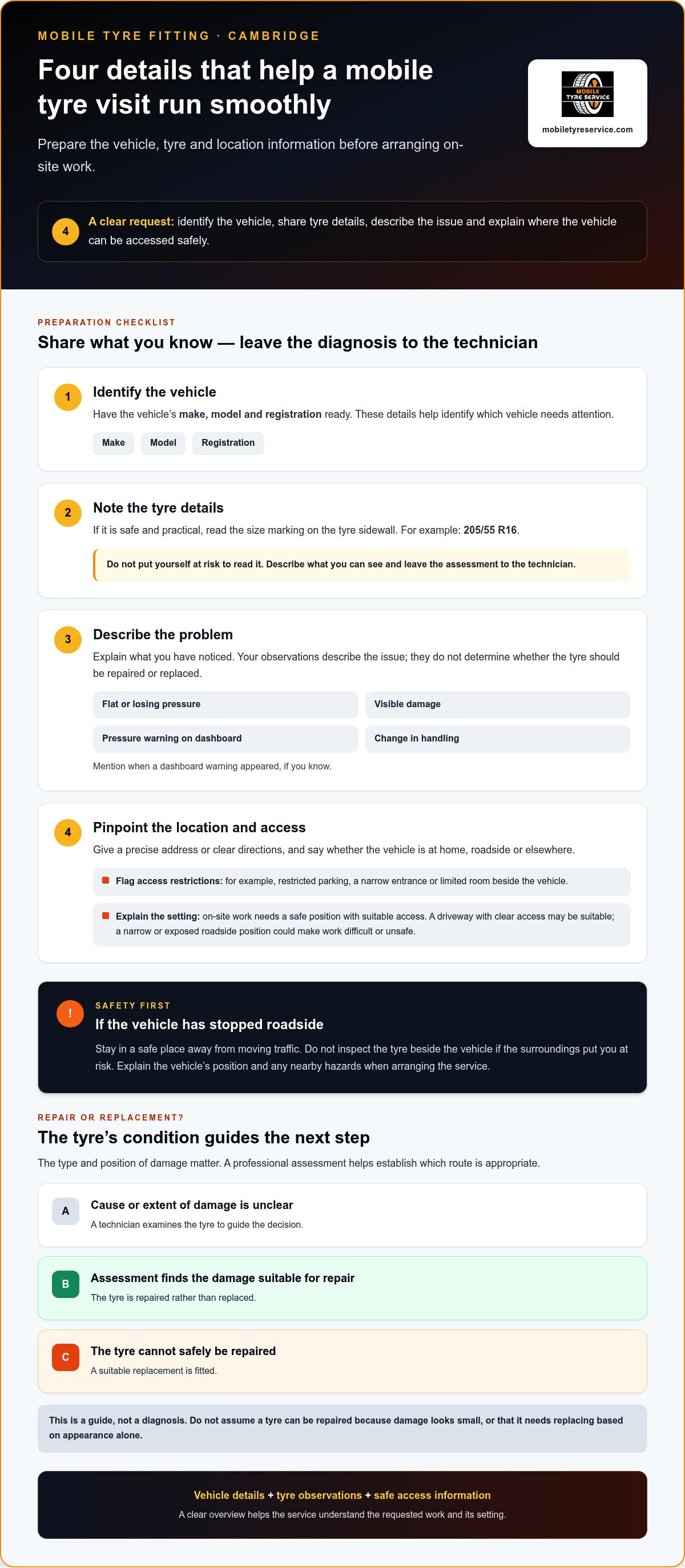
Cambridge Tyre Change Checklist: Prepare Before the Technician Arrives
A clear service request helps the technician understand the vehicle, the tyre issue and where the work is needed. Before arranging a quick tyre change service Cambridge drivers can run through this checklist. Gather what you can safely, but don’t put yourself at risk to inspect a tyre or find its markings.
What information makes the service request clearer?
Include the essentials in your request. If you’re unsure about a detail, say so rather than guessing. A concise, accurate description helps explain the job and any practical considerations for the visit.
- Vehicle: provide the make, model and registration.
- Tyre: share the size marking if you can read it safely, plus the number of tyres affected.
- Issue: say whether the tyre is flat, losing pressure, punctured or visibly damaged. Describe what you’ve noticed without trying to diagnose the cause.
- Warning: mention any tyre-pressure monitoring system (TPMS) alert on the dashboard and whether it remains displayed.
- Location: give the precise Cambridge address or roadside position, with useful directions.
- Access: explain parking restrictions, a narrow entrance, limited working space or other obstacles around the vehicle.
For example, “the front left tyre is flat, the TPMS warning is on, and the car is on my driveway with access through a narrow entrance” gives more useful context than “I have a tyre problem”. If more than one tyre is affected, identify each one. Don’t assume the warning light alone tells you which tyre needs attention.
Once you’ve gathered the details, arrange mobile tyre fitting or repair with the information ready. A complete request helps explain what’s needed, although visit and fitting times can vary with the location, access and circumstances.
What should you do while waiting in an unsafe roadside situation?
Put personal safety first. If the vehicle has stopped in a dangerous position, follow the vehicle manufacturer’s emergency instructions and relevant road-safety guidance. Keep yourself and any passengers clear of moving traffic, and don’t inspect the tyre if doing so exposes you to danger.
Don’t continue driving on a tyre that appears severely damaged or unsafe. Avoid moving the vehicle if doing so would put you at further risk. Tell the service where the vehicle is positioned and describe nearby hazards or access concerns. This helps explain the setting for on-site work, but doesn’t replace taking immediate steps to stay safe.
Arrange Mobile Tyre Fitting in Cambridge with Mobile Tyre Service
A damaged or flat tyre can make even a short journey difficult. Mobile Tyre Service provides on-site tyre fitting and repair at suitable customer locations, including home and roadside settings. The service also includes mobile TPMS sensor fitting and maintenance. Cambridge drivers can arrange tyre work at a suitable location without first driving to a fitting centre.
What can Mobile Tyre Service help with on-site?
Mobile tyre fitting is available when a replacement is needed, and mobile tyre repair is available when an assessment finds repair appropriate. The technician can assess the tyre’s condition and determine whether fitting or repair is suitable. That distinction matters: a flat tyre or dashboard warning doesn’t, by itself, show which outcome is right.
If the issue involves a tyre-pressure monitoring system, include the warning or sensor concern in your request. Mobile TPMS sensor services cover sensor fitting and maintenance. For further sensor-specific information, the Mobile TPMS Sensor Service guide explains that part of the service. Mobile Tyre Service focuses on tyre and TPMS work at a suitable location, rather than garage-based mechanical repairs or wheel alignment.
How do you take the next step for a Cambridge tyre change?
To arrange a quick tyre change service Cambridge drivers should give a clear account of the vehicle and the problem. Have the make, model and registration ready, along with the tyre size if you can read it safely. State how many tyres are affected, what you’ve noticed and whether a TPMS warning is showing. If you don’t know the tyre size, say so rather than guessing.
Give the vehicle’s precise location in Cambridge and explain how the technician can access it. Mention parking limits, restricted entrances or a roadside position that could affect safe working space. A suitable on-site location is essential, and arrival or fitting times can vary with the circumstances. Clear details help the service understand the job, but don’t guarantee a particular response time.
Gather the vehicle details, tyre size, number of affected tyres, a concise description of the issue and any access notes. You don’t need to diagnose the fault. Describe what you can observe and let the technician assess whether fitting or repair is appropriate.
For mobile tyre fitting or repair in Cambridge, arrange an on-site tyre service and share your vehicle, tyre and location details. This gives the service a clear starting point for responding to your tyre issue at a suitable location.
Make Your Next Move with a Clear Tyre-Service Request
A tyre problem can disrupt plans, but your next step can be straightforward. Treat the service request as a concise handover: explain what happened, identify the vehicle and give the location where the work is needed. You don’t need to decide in advance whether the tyre needs replacing or repairing. A technician can assess its condition and determine the appropriate work.
Mobile Tyre Service carries out tyre fitting and repair at suitable customer locations, as well as mobile TPMS sensor fitting and maintenance. For a quick tyre change service Cambridge drivers can arrange on-site, provide clear details and let the assessment guide the next step.
Arrange mobile tyre fitting in Cambridge and explain your tyre issue, vehicle details and location. A clear, practical request is a useful first step towards getting back on the road.
Frequently Asked Questions
How quickly can a mobile tyre fitter change a tyre in Cambridge?
There’s no fixed arrival or fitting time for a mobile tyre change in Cambridge. Timing depends on factors such as the vehicle’s location, access and the work required. A quick tyre change service Cambridge drivers arrange is a focused request, not a guarantee of immediate attendance. Give an accurate location and explain the tyre issue so the circumstances are clear.
Can a mobile tyre change be carried out at home in Cambridge?
Yes. Mobile tyre fitting can be carried out at home in Cambridge when there is suitable access and a safe working position. Explain whether the vehicle is on a driveway or behind a restricted entrance. Include any parking arrangements or space limitations when arranging the visit. Mobile Tyre Service also provides on-site fitting and repair at suitable customer locations in Essex.
Can a mobile tyre fitter repair a puncture instead of changing the tyre?
Yes, a puncture may be repairable, but an assessment must establish whether repair is appropriate for that tyre. Don’t assume every puncture can be fixed, or that every loss of pressure means the tyre needs replacing. The nature and position of the damage matter. Explain what you’ve noticed, and don’t rely on a quick visual check to decide whether the tyre is safe.
What information do I need to arrange a quick tyre change?
Have your vehicle registration, make and model, tyre size if available, and the number of affected tyres ready. Give the vehicle’s exact location in Cambridge and describe the issue plainly, such as a flat tyre or pressure loss. If you can’t safely read the tyre marking, don’t approach the vehicle to do so. Say you’re unsure and provide the other details accurately.
Is it safe to drive to a garage with a flat or damaged tyre?
Don’t drive if the tyre is flat or appears severely damaged or unsafe. Continuing could put you and others at risk and worsen the situation. If you’re stopped roadside, follow your vehicle manufacturer’s emergency guidance, keep clear of traffic and avoid inspecting the tyre in a hazardous position. Arrange assistance at a safe location rather than attempting to reach a fitting centre on an unsafe tyre.
Can a TPMS warning light come on after a tyre change?
Yes, a TPMS warning can appear after a tyre change, but the light alone doesn’t identify the cause or prove the new tyre is at fault. Check the vehicle handbook for the correct action, and have the tyre pressure and monitoring system assessed if the warning remains. Mobile Tyre Service provides TPMS sensor fitting and maintenance for sensor-related concerns at a suitable location.
Need a mobile tyre service?
We cover Harlow, Bishop's Stortford, Cambridge and all surrounding areas — 24/7.
Call: 01279 881234