Professional TPMS Sensor Replacement: The 2026 Mobile Service Guide
A single blinking light on your dashboard is no longer a minor nuisance; it is a definitive MOT failure that compromises your vehicle's safety and fuel economy. You likely feel the frustration of a persistent warning light and the anxiety of an approaching inspection. Finding time to visit a traditi…

A single blinking light on your dashboard is no longer a minor nuisance; it is a definitive MOT failure that compromises your vehicle's safety and fuel economy. You likely feel the frustration of a persistent warning light and the anxiety of an approaching inspection. Finding time to visit a traditional tyre centre remains a logistical challenge that most modern schedules cannot accommodate. We understand that your vehicle requires immediate, high-precision attention to maintain its operational integrity.
This 2026 guide ensures you master every aspect of professional TPMS sensor replacement. You will learn to identify technical failure signs and understand the advantages of elite mobile intervention at your home or workplace. We provide a comprehensive roadmap to achieving a clear dashboard and optimal vehicle safety through expert on-site installation. Our analysis covers the deployment of specialised mobile units across Essex and Cambridge to resolve sensor issues with surgical precision. We examine the transition from traditional garage visits to rapid-response technical services that prioritise your time and safety.
Key Takeaways
- Identify the critical technical indicators of sensor failure, such as intermittent signal loss and dashboard alerts triggered by battery depletion.
- Understand why a malfunctioning system results in a mandatory MOT failure and how it compromises your vehicle's safety and fuel economy.
- Discover how elite mobile TPMS sensor replacement at your home or workplace eliminates the risks and delays associated with traditional tyre centres.
- Learn about the high-precision programming and diagnostic tools required to ensure new sensors integrate seamlessly with your vehicle's computer.
- Recognise the logistical benefits of rapid-response technical units serving the Essex and Cambridge road networks for immediate intervention.
Understanding TPMS Sensor Replacement: Safety and Precision
The Tire-pressure monitoring system (TPMS) serves as your vehicle's first line of defence against catastrophic tyre failure. It is a high-precision electronic safety system that monitors internal air pressure and temperature in real time. Whilst many drivers view the dashboard warning as a minor inconvenience, it actually signals a critical failure in your vehicle's safety net. Most modern vehicles utilise direct systems. These systems employ a physical sensor mounted within the wheel assembly to provide exact data. This differs from indirect systems that estimate pressure via the ABS sensors. When these internal components fail, typically due to depleted batteries or physical damage, a professional TPMS sensor replacement becomes an urgent requirement to maintain roadworthiness.
The Evolution of Tyre Pressure Monitoring
Since 2014, the UK has mandated that all new passenger vehicles must be equipped with a functional monitoring system. This regulation transformed the humble tyre valve into a sophisticated electronic transmitter powered by a specialised lithium-ion battery. These units communicate directly with the vehicle's Electronic Control Unit (ECU). They provide a constant stream of data that prevents dangerous blowouts and tyre overheating. Modern sensors are designed for longevity, yet their batteries possess a limited lifespan. Industry data confirms that these batteries average between five and seven years of service. Once the power source reaches its limit, the entire unit requires replacement to restore the system's integrity.
Why Precision Replacement Matters
Executing a successful TPMS sensor replacement requires more than simple mechanical skill. It demands technical accuracy and the correct diagnostic equipment. Many generic universal sensors often fail to maintain a stable connection with the ECU. This leads to intermittent warning lights and system dropouts. Our specialised intervention force uses high-grade components that match your vehicle's specific frequency requirements. Professional installation also ensures that valve stems are secured with exact torque settings. Incorrect tightening can lead to slow leaks or physical stress fractures in the sensor body. When calibrated correctly, a functional system significantly improves fuel economy and extends tyre longevity. This precision prevents the premature wear associated with under-inflation, which can increase rolling resistance and degrade the tyre's internal structure over time.
Signs Your Vehicle Requires TPMS Sensor Intervention
Recognising the specific technical symptoms of sensor failure is essential for maintaining vehicle safety. A persistent "low pressure" warning light serves as the most common indicator. If this light remains illuminated after you have manually adjusted pressures to the correct levels, the sensor is likely failing to transmit accurate data. You may also encounter intermittent signal loss during high-speed motorway driving or during periods of extreme cold. These environmental stressors often reveal a depleted battery that can no longer maintain a stable transmission to the vehicle’s ECU. When the system detects these inconsistencies, it triggers a "TPMS Fault" or "Service Tyre Monitor System" message on your dashboard.
The 5-7 Year Battery Life Cycle
TPMS batteries are sealed units integrated directly into the sensor housing. They cannot be replaced individually. Once the energy cell reaches the end of its life cycle, the entire unit requires a professional TPMS sensor replacement. Age is the primary catalyst for failure in older vehicles. You might notice the sensor becoming slow to respond or providing erratic data before it fails completely. Adhering to the NHTSA guidance on TPMS replacement ensures that your vehicle remains compliant with international safety standards and prevents the system from becoming inoperative.
Physical damage also necessitates immediate intervention. Road salt and moisture often lead to corrosion on the valve stem, making it brittle and prone to snapping. If you notice any signs of oxidisation or physical cracking around the valve, the integrity of the seal is compromised. Road debris can also cause impact damage that disrupts the delicate internal electronics of the transmitter.
TPMS and the UK MOT Test
The legal framework surrounding tyre safety is stringent. Any vehicle registered after 1st January 2012 must be equipped with a fully functional monitoring system to pass its annual inspection. A lit TPMS warning light results in an immediate MOT failure, regardless of the actual tyre pressure. This regulation underscores the critical nature of the system for road safety. To avoid the inconvenience of a failed test, it's vital to recognise the necessity of a mobile TPMS sensor service before your test date. Our specialised units provide the necessary diagnostics to resolve these issues at your convenience. If you are experiencing dashboard alerts, booking a professional mobile tyre fitting intervention will restore your vehicle's safety status efficiently.
The Technical Process: Fitting and Programming New Sensors
Executing a professional TPMS sensor replacement requires surgical precision and specialised hardware. It is not a simple mechanical swap. Our mobile units utilise high-precision equipment to break the tyre bead without damaging the delicate internal electronics or the alloy rim. Once the tyre is partially dismounted, we extract the failed sensor and valve assembly with care. We then install a high-quality replacement that meets exact manufacturer specifications. This ensures the mechanical seal remains airtight and the electronic transmitter sits correctly within the wheel well. Professional installation prevents the accidental damage often associated with DIY attempts or generalist garages lacking specialised tools.
Diagnostic Testing and Fault Identification
Before we touch the tyre, we conduct a comprehensive diagnostic sweep. We use specialised handheld tools to "ping" each sensor, which allows us to check the remaining battery life and signal strength. This process identifies the specific failed unit immediately. It saves you time because we don't need to remove all four tyres to find the fault. These advanced diagnostic tools read unique sensor IDs directly through the tyre sidewall using low-frequency radio waves. By confirming the failure electronically, we eliminate guesswork and ensure the intervention is targeted and efficient.
ECU Programming and Calibration
The most critical stage is the "Relearn" phase. Every new sensor has a unique ID that must be paired with your vehicle's Electronic Control Unit (ECU). Simply fitting the part isn't enough; the car won't recognise the new transmitter without specific programming. This is where many DIY attempts fail. We follow protocols established by the Federal Motor Vehicle Safety Standard No. 138 to ensure the system functions at its peak safety capacity. This standard dictates how the system must alert the driver to pressure losses, making the programming phase a vital safety requirement.
Different vehicles require different methods. Some use an "Auto-learn" sequence where the car recognises the new ID after a short drive. However, many premium vehicles require an "OBDII Relearn" where we plug into the car's diagnostic port to write the new ID directly into the memory. This process ensures the system correctly identifies tyre positions, such as the Front Left versus the Rear Right. Without this calibration, your dashboard might report a low-pressure warning for the wrong wheel. This creates a significant safety risk during a real puncture event. Our technicians ensure the digital map of your tyres matches their physical reality before we leave the site.
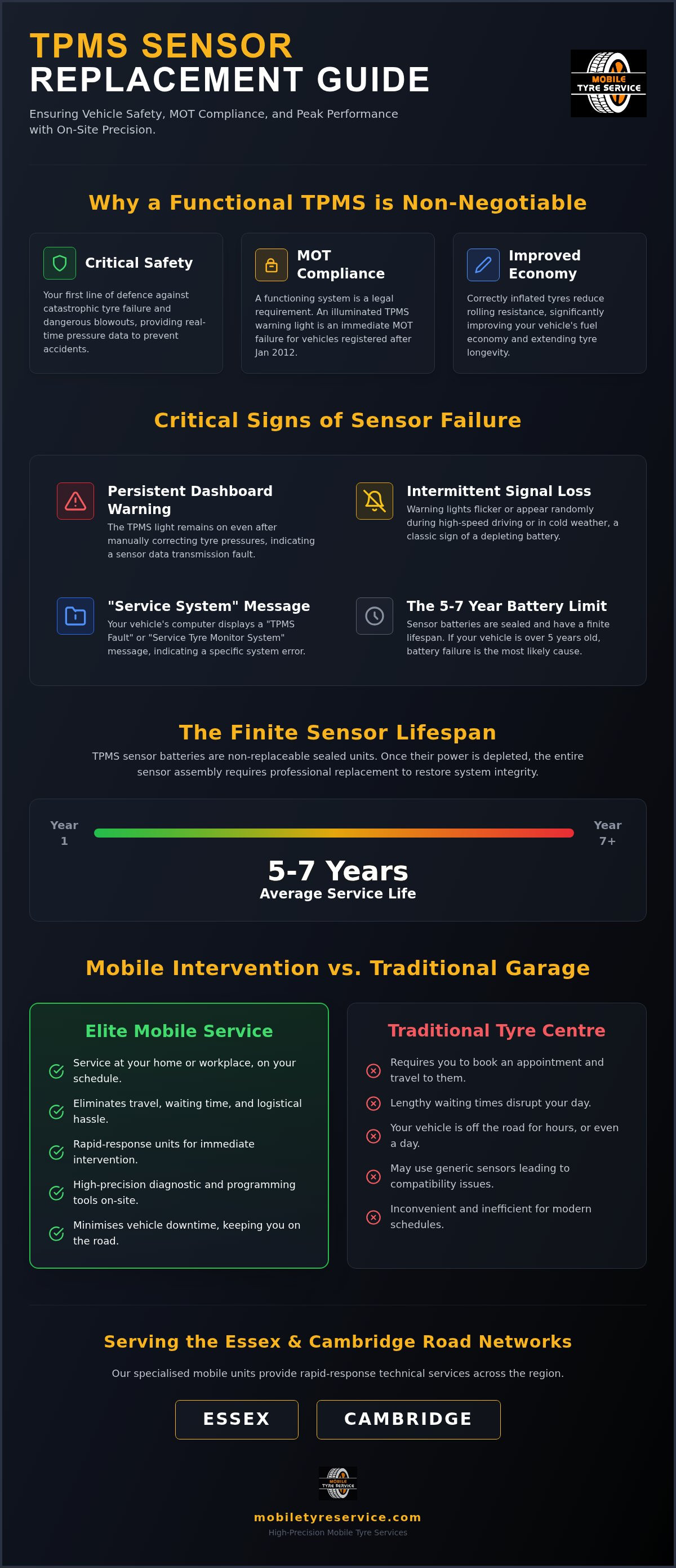
Comparing Mobile Intervention vs. Traditional Garage Visits
Choosing mobile intervention over a traditional garage visit provides a distinct safety advantage that many drivers overlook. Traditional garages require you to navigate the road network whilst your vehicle reports a safety fault. This is a fundamental risk. A professional TPMS sensor replacement should ideally occur where the vehicle is parked. This prevents the possibility of a tyre failure or a dangerous blowout occurring during the commute to a repair centre. Our mobile units operate as a specialised intervention force. We focus exclusively on tyres and sensors. This dedicated approach ensures a higher level of technical mastery than a generalist garage that handles everything from exhausts to brake pads.
Transparency is a core benefit of our on-site model. You observe the diagnostic results and the replacement process first-hand. In a traditional garage, your vehicle is taken into a restricted area. You lose visibility of the specific work being performed. Mobile service allows you to verify that the high-quality components and exact torque settings discussed in previous sections are actually applied to your wheels. This direct observation builds a level of trust that is often missing in the traditional automotive repair industry.
Elite Convenience for Busy Professionals
We eliminate the unproductive waiting room experience typical of traditional centres. You can schedule an appointment that fits your specific daily organisation. This maintains your vehicle's readiness without disrupting your work schedule or family life. Whether you are at a corporate office in Cambridge or at home in Essex, our technicians arrive equipped to handle the task whilst you continue your day. This approach ensures your commute remains uninterrupted and your vehicle is ready when you are.
Cost-Effectiveness of Mobile TPMS Services
Mobile services often offer superior value by reducing the logistical costs of vehicle maintenance. You avoid the hidden expenses of fuel and the significant time spent travelling to a repair centre. By operating without the massive overheads of a physical storefront, we provide elite service at competitive rates. For a broader perspective on pricing structures and maintenance, you can consult our mobile tyre repair cost guide. Securing a professional mobile tyre fitting appointment ensures your vehicle is roadworthy without the typical garage delays and travel expenses.
Elite Mobile TPMS Services in Essex and Cambridge
Our rapid response coverage extends across the comprehensive road networks of Essex and Cambridge. We operate as a specialised intervention force. We provide high-precision TPMS sensor replacement at your exact location. This regional focus allows us to maintain a deep understanding of the local vehicle demographics. We service everything from family SUVs to high-performance sports cars with equal technical mastery. Our commitment to local road safety remains absolute. We ensure every tyre we touch meets the highest safety standards through professional maintenance. Our technicians arrive fully equipped to handle complex electronic calibrations on-site. This eliminates the need for you to visit a fixed workshop.
Serving the Essex Road Network
We provide extensive coverage for major transit routes including the A12, the M25, and the A127. Our technicians offer on-site assistance for commuters at their places of work or residential addresses across Chelmsford, Colchester, and Basildon. The Essex geography presents unique challenges for tyre hardware. Coastal air in areas like Southend and Clacton accelerates valve corrosion through increased oxidisation. Road salt used heavily during East Anglian winters further degrades these delicate metal components. We address these specific regional stressors by using high-grade, corrosion-resistant sensors. This ensures your vehicle remains compliant and safe despite the harsh environmental conditions found across the county. We don't just swap parts; we install components designed to withstand the local climate.
Precision Support for Cambridge Drivers
Navigating the unique layout of Cambridge requires a logistical approach that traditional garages cannot match. Our specialised mobile units are equipped to reach professionals at the Cambridge Science Park and surrounding technology hubs without delay. We understand the high expectations of drivers in this region. Many operate premium or high-performance vehicles that require specific programming protocols and delicate handling. We ensure your vehicle is prepared for the diverse driving conditions of East Anglia. Whether you're navigating narrow city streets or rural arterial roads, our TPMS sensor replacement service restores your vehicle's safety systems with clinical efficiency. We bring the expertise of a tyre centre directly to your driveway. This prevents you from having to navigate the city's complex traffic patterns whilst your safety systems are compromised. Our service is designed to be a seamless, high-precision intervention that respects your time and your vehicle's engineering.
Secure Your Vehicle's Safety with Professional Intervention
Maintaining a functional tyre pressure monitoring system is a legal and safety obligation. We've established that sensor batteries possess a finite lifespan and that precise ECU programming is essential for system integrity. A professional TPMS sensor replacement ensures your vehicle remains compliant with MOT standards whilst protecting your fuel economy and tyre longevity. Our specialised mobile units provide a superior alternative to traditional garage visits by delivering technical mastery directly to your location.
We utilise specialised mobile diagnostic and programming equipment to ensure every installation meets exact manufacturer specifications. Our comprehensive coverage across Essex and Cambridge guarantees a rapid response from expert technicians focused on precision and safety. You don't need to risk driving with a compromised safety system when elite assistance is available at your home or workplace. Our team operates with the efficiency of a specialised unit to resolve your technical issues without delay.
Book your elite TPMS sensor replacement with Mobile Tyre Service today to restore your dashboard's clarity and your vehicle's roadworthiness. We look forward to ensuring your continued safety on the road.
Frequently Asked Questions
Can I drive my car with a faulty TPMS sensor?
Driving with a faulty sensor is technically possible, but it compromises your safety and the vehicle's monitoring capabilities. You lose the real-time data necessary to detect a sudden pressure drop or a slow puncture. This increases the risk of a dangerous blowout or tyre overheating. Additionally, a persistent warning light prevents you from knowing if other tyres have developed faults, as the system is already in a state of alert.
Is a TPMS sensor replacement an MOT failure in 2026?
A malfunctioning system results in an immediate MOT failure for any vehicle first registered after 1 January 2012. The 2026 standards remain stringent regarding safety-critical electronics. If the TPMS dashboard light is illuminated during the inspection, the vehicle will not pass. Arranging a professional TPMS sensor replacement before your test date is the most efficient way to ensure your vehicle meets current UK roadworthiness requirements and safety regulations.
How long do the batteries in tyre pressure sensors actually last?
The internal lithium-ion batteries typically last between five and seven years on average. These power cells are sealed within the sensor housing to protect them from moisture and road debris, meaning they cannot be replaced individually. Once the battery reaches its end-of-life, the transmitter stops communicating with the ECU. Factors such as extreme temperatures in Essex and Cambridge and your annual mileage can influence the exact duration of this battery life cycle.
Do I need to replace all four TPMS sensors at the same time?
You are not required to replace all four sensors simultaneously. However, because these components are usually installed at the same time during vehicle assembly, their batteries often fail in quick succession. If one sensor has reached the end of its five-to-seven-year life cycle, the others likely possess very little remaining power. Replacing the entire set during a single mobile intervention prevents repeated call-outs and ensures consistent system reliability across all wheels.
Can a mobile tyre fitter programme the sensors for my specific car model?
Our specialised mobile units are equipped with advanced diagnostic and programming hardware capable of servicing most vehicle makes and models. We carry out the necessary "relearn" procedures on-site, whether your car requires an OBDII connection or an automated sequence. This technical capability allows us to pair the new sensor ID with your vehicle's computer immediately. We ensure the system correctly identifies each tyre position before we conclude the service at your home.
Why has my TPMS light come on in cold weather?
Cold weather causes the air inside your tyres to contract, which physically lowers the pressure and may trigger the sensor. However, extreme cold also places additional strain on an ageing sensor battery. If the light remains on after you have adjusted the pressures to the manufacturer's recommended levels, it suggests a technical fault. Our technicians use handheld tools to determine if the issue is environmental or if a full TPMS sensor replacement is necessary.
What is the average cost of a TPMS sensor replacement in the UK?
The total cost depends on several technical factors, including whether your vehicle requires an Original Equipment Manufacturer (OEM) part or a high-quality aftermarket alternative. Vehicle brand and the complexity of the programming procedure also influence the final figure. Mobile services offer a competitive alternative to traditional garages by eliminating your travel costs and downtime. We provide a transparent breakdown based on your specific vehicle requirements during the diagnostic phase of our intervention.
Can a TPMS sensor be repaired or must it be replaced?
Most modern sensors are sealed units that require full replacement once the internal battery fails or the electronics are damaged. Whilst some valve stems can be serviced or replaced if they suffer from minor corrosion, the transmitter itself is a precision-engineered component that cannot be opened for repair. If our diagnostic tools identify a failure within the sensor's internal circuitry, a professional replacement is the only reliable method to restore your vehicle's safety monitoring system.
Need a mobile tyre service?
We cover Harlow, Bishop's Stortford, Cambridge and all surrounding areas — 24/7.
Call: 01279 881234