Professional TPMS Sensor Fitting: Elite Mobile Service in Essex and Cambridge
A glowing amber warning light isn't just a dashboard nuisance; it's a definitive MOT failure that compromises your vehicle's safety and legal standing. For many drivers in Essex and Cambridge, this persistent alert creates a sense of urgent anxiety, particularly when the prospect of a TPMS sensor fi…

A glowing amber warning light isn't just a dashboard nuisance; it's a definitive MOT failure that compromises your vehicle's safety and legal standing. For many drivers in Essex and Cambridge, this persistent alert creates a sense of urgent anxiety, particularly when the prospect of a TPMS sensor fitting involves the inconvenience of traditional garage wait times. You shouldn't have to sacrifice your entire afternoon to a workshop waiting room just to clear a sensor error.
Our elite mobile service provides a high-precision intervention at your exact location. We understand that your time is a premium asset, so we've engineered a response unit that delivers dealership-level technical accuracy to your driveway or office car park. By choosing a specialised mobile solution, you ensure your tyre pressure monitoring system is perfectly calibrated and fully compliant with UK safety regulations. This article details our systematic approach to resolving sensor faults, from on-site diagnostic programming to the final calibration that ensures your dashboard remains clear and your vehicle stays safe.
Key Takeaways
- Understand the legal necessity of a functioning Tyre Pressure Monitoring System to ensure your vehicle remains MOT-compliant and safe.
- Distinguish between minor valve leaks and terminal electronic failures to determine the exact level of intervention your wheels require.
- Discover the logistical advantages of a professional TPMS sensor fitting performed by mobile specialists at your home or place of work.
- Learn to recognise persistent dashboard errors and physical sensor damage that demand immediate technical attention from an elite response unit.
Understanding TPMS Sensor Fitting and Vehicle Safety
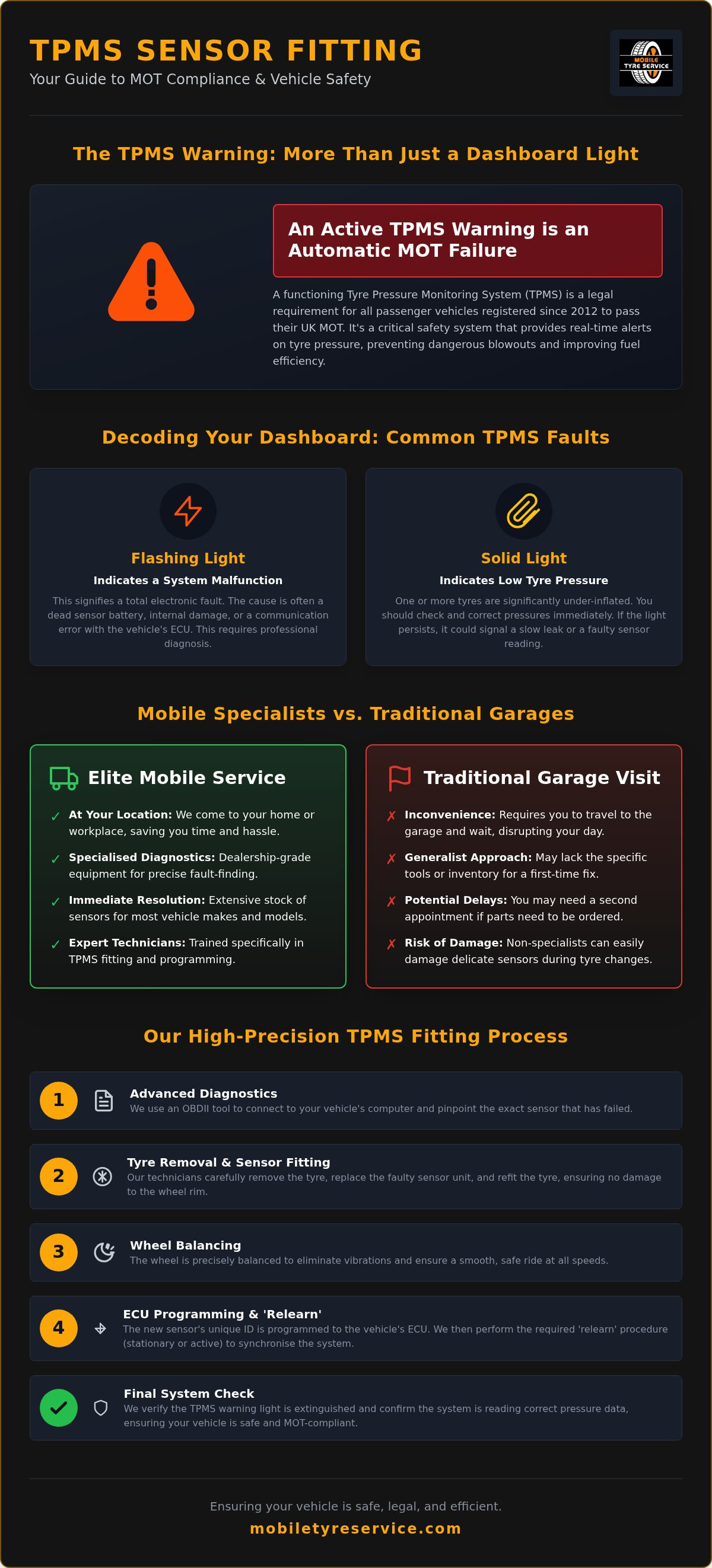
A Tire-pressure monitoring system (TPMS) represents a sophisticated layer of electronic protection for the modern motorist. It isn't merely a convenience feature; it's a critical safety mechanism designed to provide immediate alerts the moment tyre pressure deviates from safe parameters. Since 2014, a functioning TPMS has been a mandatory requirement for passing a UK MOT test for all passenger vehicles registered from 2012 onwards. A faulty sensor or a persistent warning light results in an automatic failure, grounding your vehicle until a professional intervention occurs.
Precise TPMS sensor fitting ensures your vehicle remains safe and efficient. Correct tyre inflation reduces the risk of catastrophic blowouts and optimises fuel consumption by minimising rolling resistance. Whilst DIY attempts or generalist garage repairs might seem tempting, they often lack the technical depth required for high-precision calibration. Our specialised mobile units act as a tactical intervention force. We bring dealership-grade diagnostic tools directly to your location, ensuring every sensor is programmed to your vehicle's specific ECU protocols without delay.
Direct vs. Indirect TPMS: Why Fitting Matters
Direct TPMS relies on physical sensors mounted inside each wheel, whereas indirect systems use the vehicle's ABS to estimate pressure through wheel speed. Direct systems offer superior accuracy but require specialised hardware for physical replacement. The fitting process demands extreme precision. Amateur tyre changes frequently result in snapped sensor bodies or compromised seals. Our technicians use specific mounting techniques to protect these delicate electronic components during the tyre installation process, preventing costly damage.
The Anatomy of a TPMS Sensor
A standard sensor unit consists of a robust sensor body, a lithium-ion battery, and a dedicated valve stem. These internal batteries typically last between five and seven years and are non-replaceable; this necessitates a complete TPMS sensor fitting once the power cell expires. The transponder acts as the critical communication bridge, transmitting real-time data directly to the vehicle's ECU. We replace the entire unit to ensure long-term reliability and system accuracy, preventing the recurrence of dashboard errors caused by failing hardware.
Elite Mobile TPMS Sensor Replacement vs. Valve Servicing
Many generalist garages offer a basic valve service as a low-cost add-on during tyre changes. This typically involves replacing only the rubber seals, nuts, and plastic caps to prevent slow air leaks. Whilst this maintenance is useful for preventing pressure loss, it doesn't address the core electronic failures that trigger dashboard warnings. A comprehensive TPMS sensor fitting is required when the internal components of the unit expire or sustain physical damage. Our elite mobile units carry a diverse inventory of universal and OE-specific sensors. This ensures we can provide an immediate on-site resolution for almost any vehicle make or model without the need for a return visit.
When a Valve Service Isn't Enough
Corrosion on the valve stem is a frequent cause of system failure that a simple seal kit cannot fix. Because many stems are manufactured from aluminium, they are highly susceptible to galvanic corrosion, particularly when exposed to road salt and winter conditions in Essex and Cambridge. This degradation often leads to the stem snapping during routine inflation attempts. Drivers should also monitor their dashboard alerts closely for specific patterns. A solid light usually indicates low pressure, but a flashing light signifies a total electronic fault within the system. Our technicians use advanced diagnostic equipment to pinpoint whether the issue is a physical leak or a terminal electronic failure before commencing work.
Programming and 'Relearning' the ECU
Installing the hardware is only half the technical process. Every new unit requires a specific 'relearning' procedure to synchronise its unique identification code with the vehicle's Engine Control Unit (ECU). Global safety standards for Tire pressure monitoring systems demand these high levels of accuracy to ensure the driver receives reliable data.
We perform two primary types of relearn procedures depending on your vehicle's specific requirements. A stationary relearn involves using an OBDII tool or a specific sequence of dashboard commands whilst the vehicle is parked. Conversely, an active relearn requires the vehicle to be driven at a consistent speed for a set duration to allow the ECU to map the new sensor positions. Our specialised technicians carry high-precision diagnostic tools to complete these complex calibrations at your home or workplace. This eliminates the frustration of a dealership visit. If you've encountered a persistent system error, our TPMS sensor mobile specialists can resolve the fault today.
The Advantages of On-Site TPMS Calibration in Essex and Cambridge
Traditional garage visits often result in "garage day" fatigue, forcing motorists to wait in sterile rooms whilst technicians work through a backlogged queue. Our mobile service eliminates this inefficiency by bringing the workshop directly to you. We prioritise the needs of busy professionals who cannot afford to lose hours to a dealership service centre. By choosing an elite mobile unit, you receive a high-precision TPMS sensor fitting at your home or workplace, making us the favourite choice for motorists who value their time. This model provides the logistical superiority required to maintain modern vehicle safety standards with minimal disruption.
Our operation functions as a specialised intervention force across the region. We provide premium care for high-end vehicles, offering a level of bespoke attention that large-scale dealerships frequently fail to deliver. Dealerships often apply significant markups to electronic components and labour. Our mobile fitting service avoids these heavy overheads, passing the cost-efficiency directly to the customer without compromising on technical quality. Every Tire-Pressure Monitoring System (TPMS) we service receives the same rigorous calibration protocols used by major manufacturers.
Local Expertise in Essex and Cambridge
Our technicians possess an intimate knowledge of the Essex and Cambridge road networks. We navigate primary routes like the M11, A14, and A12 with precision to ensure we reach your driveway or office car park promptly. This local readiness reduces the time drivers spend operating vehicles with active safety faults. For example, we recently resolved a complex TPMS failure for a Cambridge-based professional at their place of work. The client discovered a warning light during their morning commute; by lunchtime, our unit had completed the TPMS sensor fitting and cleared the dashboard errors, all whilst the client remained in their office.
Safety Protocols for Roadside Interventions
Roadside interventions demand a disciplined approach to safety. We treat every location, whether a private driveway or a public space, with the same level of professional rigour. Our mobile units are equipped with specialised levelling and security hardware to ensure vehicle stability during the fitting process. We maintain a strict perimeter whilst working, protecting both the vehicle and the surrounding environment. Our technicians are trained to handle complex electronic installations in diverse weather conditions, ensuring that your system's integrity is never compromised by the external setting. This controlled, methodical approach guarantees a result that is technically beyond reproach.
Identifying Faults: When Your Vehicle Requires Professional Sensor Fitting
A persistent dashboard alert represents a technical failure that standard inflation cannot resolve. Whilst many motorists attempt to clear these errors by resetting their on-board computer, a recurring light indicates an underlying hardware issue. Our mobile response units specialise in diagnosing these high-stakes electronic errors at the roadside. Identifying the specific nature of the fault is the first step in our specialised intervention process. Several factors typically necessitate a professional TPMS sensor fitting:
- Physical Damage: Sensors are frequently compromised during amateur tyre changes where the technician fails to account for the internal hardware position.
- Battery Depletion: Internal power cells eventually expire; this often manifests as a signal that disappears and reappears unpredictably.
- Transponder Failure: 'Ghost' warnings or intermittent data loss suggest the electronic transponder can no longer communicate with the vehicle's ECU.
- Seal Compromise: Micro-cracks in the sensor body can allow moisture to enter the circuitry, leading to immediate electronic failure.
Decoding the TPMS Dashboard Light
Your vehicle communicates the severity of a system fault through specific lighting patterns. A solid amber light usually suggests that at least one tyre has dropped below the recommended pressure threshold. Conversely, a flashing light indicates a more significant system malfunction that requires immediate technical attention. The TPMS warning light typically flashes for a period of 60 to 90 seconds upon vehicle ignition before remaining solid to indicate a definitive system malfunction. This specific sequence confirms that the ECU has lost contact with one or more sensors, making a professional TPMS sensor fitting a legal and safety priority.
The Impact of Weather and Corrosion
British winters pose a significant threat to the integrity of tyre pressure hardware. Road salt used across Essex and Cambridge accelerates galvanic corrosion on metal valve stems, often causing the protective caps to seize. Forcing a seized cap can snap the entire stem, leading to instant deflation. Our technicians employ specific anti-seize protocols during every installation to prevent this degradation. We ensure that every component is treated to withstand the local environmental conditions, protecting your premium alloy wheels from long-term damage. If you've noticed a flashing alert or a corroded valve, you can book an expert TPMS sensor mobile intervention to restore your system's integrity today.
Booking Your Expert Mobile TPMS Sensor Fitting Service
Scheduling a specialised technician shouldn't be a complex ordeal. We've streamlined our booking process to ensure a rapid response that respects your schedule. When you contact our team, we require your vehicle registration and a brief description of the dashboard alert pattern. This data allows our intervention unit to arrive fully prepared with the correct dealership-grade sensors for your specific model. For owners of premium marques such as BMW, Mercedes, and Audi, this level of technical precision is non-negotiable. We provide high-precision hardware that mirrors original equipment specifications, ensuring your vehicle's sophisticated safety systems remain uncompromised.
Our 'Elite Intervention' guarantee ensures that every TPMS sensor fitting we perform meets the exact standards of a main dealership. We don't use generic, low-quality components that trigger recurring errors. Instead, we utilise specialised programming tools to ensure a permanent resolution. Restore your vehicle's safety monitoring systems today by scheduling a visit from our expert technicians. We bring the solution to your driveway, providing the confidence that only high-precision engineering can deliver.
Seamless Integration with New Tyres
Choosing to perform a TPMS sensor fitting alongside a tyre replacement is a strategic decision for long-term vehicle maintenance. When the tyre is already removed from the rim, our technicians can access the sensor body with zero risk of additional labour costs or logistical delays. This proactive approach ensures your new investment is protected by accurate, real-time pressure data from the moment you drive away. You can coordinate this through our Professional Mobile Tyre Fitting in Essex and Cambridge service, creating a comprehensive safety overhaul for your vehicle in a single, efficient visit.
Our Service Area and Availability
We maintain a dedicated presence amongst the communities of Essex and Cambridge, operating as a mobile-only force for maximum agility. Our fleet is strategically positioned to provide rapid response times for urgent sensor faults, particularly for motorists facing an imminent MOT deadline. We understand the high-stakes nature of a failed safety system; therefore, we prioritise technical mastery and logistical speed. For detailed insights into the investment required for these specialised interventions, consult our Mobile Tyre Repair Cost: The Complete 2026 Professional Guide. We remain ready to deploy to your home or workplace at a moment's notice.
Securing Your Road Safety with Elite Technical Precision
Maintaining a fully operational Tyre Pressure Monitoring System is a legal necessity that directly impacts your vehicle's MOT status and road safety. We've explored how technical failures, from battery depletion to environmental corrosion, demand more than a simple reset. A professional TPMS sensor fitting requires specialised mobile programming equipment to ensure the new hardware synchronises perfectly with your vehicle's ECU. Our elite roadside technicians provide dealership-level precision at your driveway, eliminating the need for disruptive garage visits or costly dealership markups.
By choosing a specialised intervention force, you protect your vehicle's integrity and your own peace of mind. We remain ready to deploy across Essex and Cambridge to resolve your dashboard errors with surgical accuracy. Don't let a persistent warning light compromise your next journey or MOT result. Take decisive action to restore your system's functionality today. Our team is perpetually prepared to deliver the high-precision service your vehicle requires.
Book Your Specialist TPMS Sensor Fitting in Essex or Cambridge Now
Frequently Asked Questions
Will a faulty TPMS sensor cause my car to fail its MOT?
An illuminated warning light indicating a system malfunction results in an automatic MOT failure for all passenger vehicles registered after 1 January 2012. This legal requirement ensures that safety monitoring systems remain functional for all road users. Our mobile technicians provide the necessary technical intervention to clear these faults before your test date. We operate across Essex and Cambridge to ensure your vehicle meets these strict safety standards.
How long does a mobile TPMS sensor fitting take to complete?
A standard mobile TPMS sensor fitting typically takes between 30 and 45 minutes to complete per wheel. This duration includes the physical installation of the hardware and the subsequent electronic 'relearn' procedure required to synchronise the unit with your vehicle's ECU. Our elite units are equipped with high-precision diagnostic tools that allow us to perform these complex calibrations rapidly at your home or workplace, ensuring minimal disruption to your schedule.
Do I need to replace all four sensors if only one is faulty?
You aren't legally required to replace all four sensors if only one has failed. However, because these units were likely installed at the same time, the internal batteries in the remaining sensors often expire shortly after the first failure. We recommend a full system diagnostic to assess the battery health of the remaining units. Many clients in Essex and Cambridge choose to replace all sensors simultaneously to avoid multiple call-outs.
Can you program TPMS sensors for premium brands like BMW and Mercedes on-site?
We specialise in on-site programming for premium marques including BMW, Mercedes, Audi, and Jaguar. Our mobile response units carry advanced diagnostic hardware capable of replicating specific OE protocols and frequencies. This ensures that the new sensors communicate perfectly with your vehicle's sophisticated safety systems. We provide a dealership-level service at your driveway, maintaining the technical integrity of your high-performance vehicle without the logistical inconvenience of visiting a service centre.
What is the typical lifespan of a TPMS sensor battery?
The internal lithium-ion batteries within a TPMS unit typically last between five and seven years. These batteries are sealed within the sensor body and cannot be replaced independently. Once the power cell expires, a complete TPMS sensor fitting is necessary to restore functionality. Factors such as extreme temperature fluctuations and high mileage can accelerate battery depletion, leading to the intermittent 'ghost' warnings often reported by motorists in the region.
Why is my TPMS light still on after I have inflated my tyres?
If your warning light remains active after inflating your tyres to the correct pressure, the system likely requires a manual reset or a technical relearn procedure. In many cases, a persistent light signifies a terminal sensor fault rather than a pressure issue. This often happens when the internal battery has failed or the transponder has sustained physical damage. Our technicians can perform an on-site diagnostic to determine the exact cause.
Can I drive my vehicle safely with a TPMS sensor fault?
Whilst your vehicle remains physically drivable with a sensor fault, it is not recommended for long-term use. A faulty system cannot alert you to sudden pressure drops or slow punctures, significantly increasing the risk of a high-speed blowout. Driving with a known safety fault can also lead to legal complications or insurance disputes. We treat these faults with professional urgency, deploying our mobile units across Essex and Cambridge to restore system integrity.
Is it possible to replace just the valve rather than the whole sensor?
It is possible to replace just the valve stem and seal kit if the electronic sensor remains fully functional. This 'valve service' is an effective solution for minor leaks or external corrosion. However, if the dashboard warning light is flashing or the internal battery has expired, a full sensor replacement is the only viable resolution. Our technicians assess each unit individually to determine whether a simple valve refresh or a comprehensive fitting is required.
Need a mobile tyre service?
We cover Harlow, Bishop's Stortford, Cambridge and all surrounding areas — 24/7.
Call: 01279 881234