Mobile Tyre Support for Essex Businesses: Buying Guide
A tyre issue can disrupt a full business schedule, not just one vehicle. Missed appointments, delayed deliveries and time spent coordinating garage visits can affect work across Essex and Cambridge. Mobile tyre support for businesses Essex gives teams a way to arrange tyre fitting, repair assessment…

A tyre issue can disrupt a full business schedule, not just one vehicle. Missed appointments, delayed deliveries and time spent coordinating garage visits can affect work across Essex and Cambridge.
Mobile tyre support for businesses Essex gives teams a way to arrange tyre fitting, repair assessments and TPMS sensor services at a suitable vehicle location. Instead of planning a separate trip for tyre attention, you can organise the work at business premises or where the vehicle has stopped.
This guide explains what mobile support can cover and how to report a tyre issue clearly. It covers the details to share, how to coordinate vehicle access and how to plan work around business operations. A consistent process helps your team respond calmly when a tyre problem arises.
Key Takeaways
- On-site tyre support brings fitting or repair assessment to a suitable vehicle location.
- Match the request to the need: replacement, repair assessment and TPMS sensor support address different issues.
- Consider the vehicle’s location, the reported problem and its schedule when planning mobile tyre support for businesses Essex.
- Share clear vehicle, issue and access details to help coordinate on-site work.
- Use a central contact or fleet record to make tyre issue reporting consistent across your business.
Why mobile tyre support matters for Essex businesses
A tyre problem can take a vehicle out of use when it is needed most. An appointment may need rearranging, a delivery route may change, or staff may have to find another way to move people or goods. For businesses in Essex and Cambridge, the challenge is to organise appropriate tyre attention without adding an unnecessary garage journey to an already disrupted day.
Mobile tyre support for businesses Essex brings tyre work to a suitable location for the vehicle, such as business premises or a roadside setting. This gives operations teams another way to organise work around vehicle use. Planned fitting or repair assessment can be coordinated with the vehicle’s schedule, while an issue that occurs on the road needs a response based on the vehicle’s location and condition.
How tyre downtime affects day-to-day business operations
One unavailable vehicle can create knock-on changes. A staff member may need to cover an appointment, or a delivery route may need reorganising. At a busy business site, locating the vehicle, arranging access and finding a workable time for tyre work can also take attention away from other tasks.
A simple plan helps make these decisions clearer. Consider when the vehicle is next needed, where it will be parked and whether the issue can be addressed at its regular location. General tyre maintenance practices, such as inspection and monitoring, can help teams notice developing concerns and distinguish them from a sudden roadside problem.
What on-site tyre support can address
Mobile tyre fitting, mobile tyre repair and TPMS sensor support serve different needs. Fitting is for replacing a tyre at a suitable location. A repair assessment determines whether a tyre issue is appropriate for repair or whether replacement is needed. TPMS sensor installation or maintenance addresses the vehicle’s tyre pressure monitoring system. Reporting what the driver has noticed helps identify the relevant service.
For example, a vehicle parked at business premises may be suitable for planned fitting, while a tyre problem during a journey may need attention at the vehicle’s roadside location. In either case, the work can be arranged where the vehicle is rather than around a separate garage visit. This service covers tyres and TPMS, not general mechanical repair. A clear reporting process gives the operations team a practical starting point.
What mobile tyre support for businesses in Essex can include
Mobile tyre support for businesses Essex can address three distinct needs: replacing a tyre, assessing a tyre for repair, or dealing with a tyre pressure monitoring system (TPMS) sensor issue. Identifying the need helps your team report the problem clearly and plan work at a suitable vehicle location.
| Service | Business need | What it involves |
|---|---|---|
| Mobile tyre fitting | A tyre needs replacing | Arrange fitting at a suitable vehicle location. |
| Mobile tyre repair | A tyre may be damaged or losing pressure | Assess whether repair is appropriate or replacement is needed. |
| Mobile TPMS sensor support | A warning or sensor issue needs attention | Support for sensor installation or maintenance. |
Mobile tyre fitting and repair for business vehicles
Fitting and repair assessment are different requests. If a tyre needs replacing, mobile fitting allows the work to be arranged where the vehicle is, without first coordinating a trip to a garage. If the damage or its extent is unclear, request a repair assessment. The assessment determines whether repair is suitable or replacement is needed, so don’t assume a tyre is repairable before it has been assessed.
For an operations team, making this distinction helps shape the next steps. Share the vehicle’s location and the known tyre issue so the work can be organised around its use. On-site support can avoid moving the vehicle elsewhere for tyre attention. For businesses operating HGVs, buses or trailers, the UK Commercial Vehicle Tyre Regulations publication provides official guidance on tyre defects and damage.
When a business may need mobile TPMS support
TPMS monitors tyre pressure and alerts the driver to potential pressure issues. A persistent warning, suspected sensor fault or need for sensor replacement may call for mobile TPMS support. This is separate from fitting or repairing the tyre itself: it concerns the system that monitors pressure. Include the warning shown and any known sensor history in your report. A guide to mobile TPMS sensor service can help your team understand this support in more detail.
Keeping fitting, repair and TPMS requests distinct makes coordination more precise. For on-site mobile tyre support, organise the request around the vehicle’s location and the issue identified.
How to assess mobile tyre support for your Essex operation
Assess a mobile tyre service against three practical factors: where the vehicle is, what the tyre or sensor issue appears to be, and when the vehicle can be accessed. This helps your team describe the need and plan on-site work around the vehicle’s actual use. Mobile tyre support for businesses Essex is most useful when the request is clear and matched to the issue.
| Business scenario | Relevant support | What to establish |
|---|---|---|
| Visible tyre damage or pressure loss | Mobile tyre repair assessment | Where the vehicle is and whether it can be accessed safely |
| A worn or damaged tyre needs replacing | Mobile tyre fitting | Tyre details, vehicle location and a workable time |
| A TPMS warning or sensor concern appears | Mobile TPMS sensor support | Warning details and any known sensor issue |
Match the tyre issue to the right service
Start with safety. If a driver notices visible damage or pressure loss, they should stop in a safe place and avoid continuing if the vehicle may be unsafe to drive. A professional assessment can determine whether the tyre is suitable for repair or needs replacing. If the tyre is known to need replacement, mobile fitting is the relevant option. A TPMS warning or suspected sensor fault points to mobile TPMS support, which addresses the monitoring system rather than the tyre itself.
The initial description guides the request, but it does not replace an assessment. Distinguish what the driver observed from what is known for certain, rather than reporting a symptom as a confirmed diagnosis.
Prepare the details needed to coordinate support
Clear information helps organise work at the vehicle’s location. Record the vehicle registration and tyre-size information if available, then describe the issue plainly, such as visible damage, pressure loss or a dashboard TPMS warning. Include whether the vehicle is parked safely and can be accessed without disrupting site activity.
For a business premises, note access arrangements and the best point of contact. Share when the vehicle is likely to be on site, taking its operating schedule into account. These details help coordinate the work at a practical time and place.
Use this information to assess whether the service addresses the tyre need, can be arranged at a practical location and fits the vehicle’s schedule. A consistent record for each request also gives the team a clearer basis for coordinating future tyre issues.
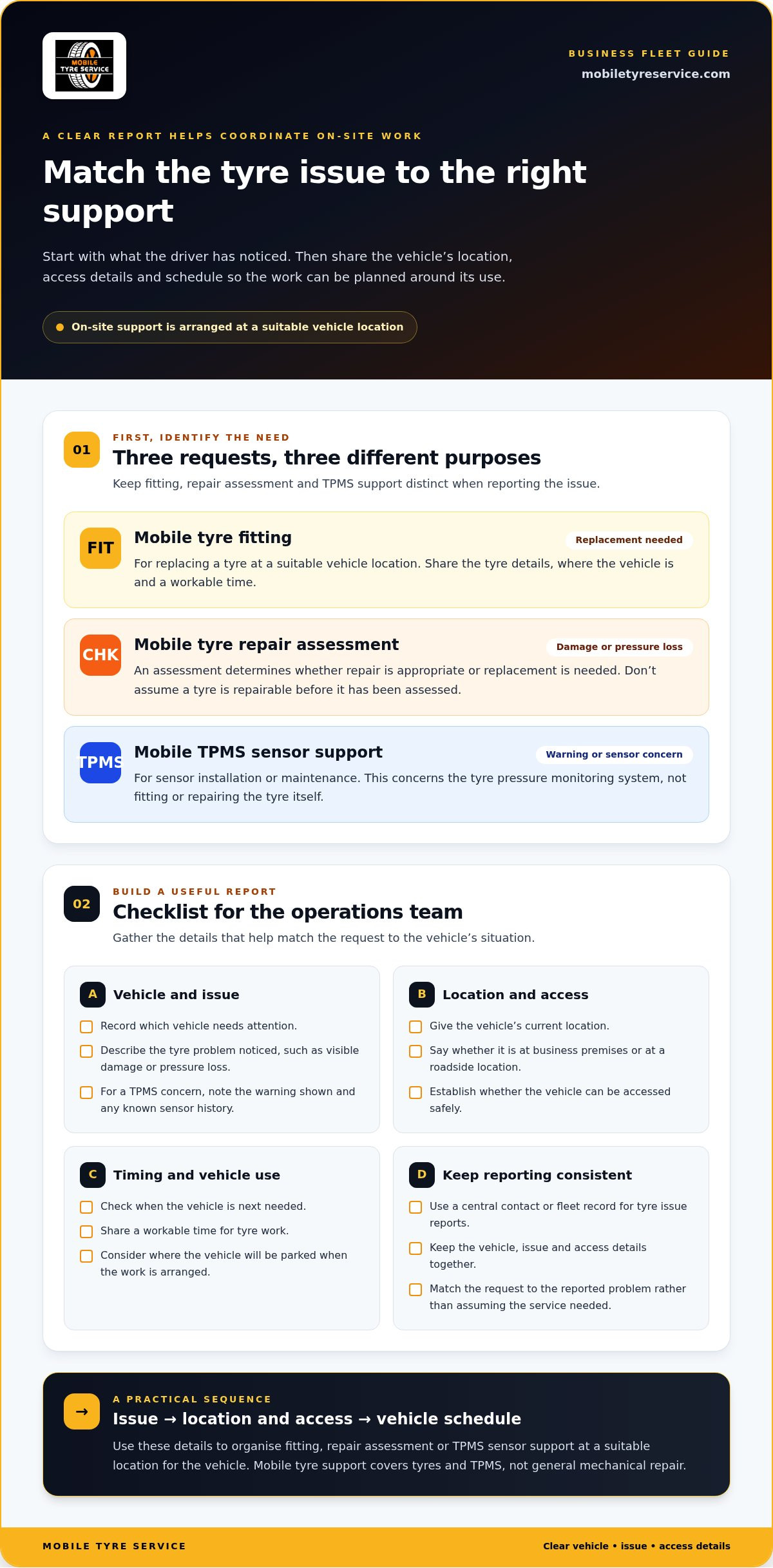
How to organise mobile tyre support across an Essex business
A consistent process makes tyre issues easier to report and coordinate across business vehicles. Assign a central contact, such as an operations lead or fleet coordinator, to collect essential details and record what has been arranged. Staff then have a clear route for reporting an issue, and the team can avoid gathering the same information repeatedly.
A practical process from tyre issue to on-site service
Use four steps to move from the first report to completed on-site tyre work:
- Identify: Record which vehicle is affected, where it is and what the driver has noticed. If there is visible damage or pressure loss, prioritise a safe place to stop and do not ask the driver to continue if the vehicle may be unsafe.
- Report: Pass on the vehicle registration, tyre-size details if available and a clear description of the issue. Include any TPMS warning or sensor concern without treating it as a confirmed tyre diagnosis.
- Coordinate: Share site-access instructions, a useful contact on arrival and when the vehicle is expected to be accessible. Consider its schedule so work can be arranged at a practical time and location.
- Complete: Record the fitting, repair or TPMS sensor work once completed, along with relevant follow-up information for the vehicle record.
This sequence keeps the request focused and helps distinguish an urgent safety concern from planned tyre work.
Build tyre support into business routines
A shared record can include the vehicle identifier, reported issue, date, location and work completed. Give drivers and staff straightforward instructions on whom to notify and what information to provide. A central contact can review the record when arranging further support, rather than collecting the same details from several people.
Regular visual checks and clear reporting habits can help a business notice tyre concerns earlier, though they cannot prevent every fault. For mobile tyre support for businesses Essex, organised vehicle records and access details make it easier to coordinate on-site work around operating schedules.
Put these steps into practice by arranging mobile tyre support at a suitable vehicle location.
Arrange mobile tyre support for your business in Essex
On-site mobile tyre fitting, repair and TPMS sensor support help businesses arrange tyre work where a vehicle is located, rather than planning a separate garage visit. The right next step depends on the issue: whether the tyre needs replacing, needs an assessment or the vehicle’s pressure monitoring system needs attention. A clear request gives the work a practical starting point and helps your team coordinate around vehicle use.
What to include when arranging business tyre support
Have the key details ready before arranging support. A concise, accurate report helps identify the vehicle, understand the request and plan access at the location.
- Vehicle details: Provide the registration and tyre size if known. Include the vehicle’s make or model if useful.
- Tyre issue: Describe what the driver has observed, such as visible damage, pressure loss, a worn tyre or a TPMS warning. Separate symptoms from any confirmed diagnosis.
- Location and access: Give the vehicle’s exact location and explain site-entry arrangements, access restrictions or where the vehicle will be positioned.
- Schedule: Share when the vehicle is expected to be available and any operational constraints that affect access. This helps coordinate the work around the vehicle’s use.
For example, a vehicle usually parked at business premises may be easier to coordinate there if it can be accessed safely. If the issue arises elsewhere, report the vehicle’s current location and condition so the request reflects where support is needed.
Choose the right next step for the vehicle
Use mobile fitting when a tyre needs replacing at a suitable location. If a tyre appears damaged or punctured and it is unclear whether repair is appropriate, request a repair assessment. The assessment determines whether repair or replacement is the next step. For a TPMS warning or sensor concern, describe the alert and request mobile TPMS sensor support. This keeps the request aligned with the issue without treating a warning as a definitive diagnosis.
For cost planning, first identify the type of work required and gather the vehicle and tyre details. This gives your business a clearer basis for understanding the scope of the request than relying on a generic estimate for an unassessed issue.
For mobile tyre support for businesses Essex, arrange on-site tyre fitting, repair assessment or TPMS sensor support at a suitable vehicle location. Arrange mobile tyre support for your Essex business with the vehicle, location and issue details ready.
Keep your business vehicles moving with a clear plan
Effective mobile tyre support for businesses Essex starts with matching the service to the need and arranging work at a practical vehicle location. On-site tyre fitting handles replacement, while a repair assessment determines whether a damaged tyre can be repaired or needs changing. Mobile TPMS sensor installation or maintenance addresses sensor-related needs.
A straightforward reporting process helps your team coordinate each request. Have the vehicle details, location, access arrangements and a clear description of the tyre issue ready. This gives the service team useful information to organise fitting, repair or TPMS support at your preferred location, without adding an unnecessary garage visit to the plan.
Mobile Tyre Service provides on-site fitting, repairs and TPMS sensor support for businesses in Essex and Cambridge. Arrange mobile tyre support for your Essex business and take the next step towards a more organised response when a vehicle needs tyre attention.
With clear details and the right on-site support, your team can approach tyre issues with greater confidence and keep work moving.
Frequently Asked Questions
Can a mobile tyre service support businesses in Essex?
Yes. Mobile Tyre Service provides on-site tyre fitting and repair, along with TPMS sensor services, for customers in Essex and Cambridge. Work can be arranged at the vehicle’s preferred location, such as suitable business premises or a roadside location. This helps businesses organise tyre attention where a vehicle is, rather than automatically planning a garage visit. Share the vehicle’s location and issue when arranging support.
What does mobile tyre support for a business include?
Mobile tyre support can include tyre fitting, tyre repair assessment and TPMS sensor installation or maintenance. Fitting is relevant when a tyre needs replacing. If a tyre is damaged or losing pressure, an assessment determines whether repair is suitable or replacement is needed. TPMS support addresses a sensor or monitoring-system concern. These are distinct needs, so describing the issue clearly helps organise the appropriate on-site service.
Can mobile tyre fitting take place at business premises?
Yes. Mobile tyre fitting can be arranged at a suitable business location where the vehicle can be accessed for the work. Provide the site address, any entry or parking instructions, and a contact who can coordinate access. It is also useful to explain when the vehicle is expected to be available, so the arrangement can take its work schedule into account. This avoids planning a separate garage journey for fitting.
How can a business reduce vehicle downtime caused by tyre problems?
Set a clear reporting process so drivers know whom to notify and what details to provide. Record the vehicle, location, symptoms and any TPMS warning, then coordinate tyre work around when the vehicle can be accessed safely. A central contact or shared record can reduce repeated information gathering. Routine visual checks may help staff identify concerns sooner, but they cannot prevent every tyre problem or guarantee a particular outcome.
Can a mobile tyre service repair every puncture?
No. Not every puncture or damaged tyre is suitable for repair. A professional assessment is needed to determine whether repair is appropriate or whether the tyre should be replaced. Report what the driver has observed, including pressure loss or visible damage, without assuming the cause or outcome. If the vehicle may be unsafe to drive, prioritise stopping somewhere safe and explain its location and condition when arranging tyre support.
What information should a business provide when arranging mobile tyre support?
Provide the vehicle registration and tyre-size information if available, along with a clear description of the issue. State the vehicle’s current location, whether it can be accessed safely, and any site-entry or parking instructions. Explain when it is likely to be available and share relevant schedule constraints. For a TPMS concern, describe the warning or sensor issue. These details help organise on-site support around the vehicle and the business’s operations.
Can mobile tyre support help with TPMS sensors?
Yes. Mobile Tyre Service provides TPMS sensor installation or maintenance at the vehicle’s location. A TPMS monitors tyre pressure and can alert the driver to a pressure concern; a warning may also relate to a sensor issue. Tell the team what alert appeared and whether the vehicle has had previous sensor work. This information helps distinguish a monitoring-system request from a tyre fitting or repair need.
Need a mobile tyre service?
We cover Harlow, Bishop's Stortford, Cambridge and all surrounding areas — 24/7.
Call: 01279 881234