Mobile Tyre Replacement: A Professional Comparison and Selection Guide
Driving a vehicle with a compromised tyre to a traditional fitting centre is often the most dangerous decision a motorist can make. You likely recognise the frustration of a sudden puncture or the anxiety of a thinning tread, yet the standard response involves risking a roadside failure or wasting h…

Driving a vehicle with a compromised tyre to a traditional fitting centre is often the most dangerous decision a motorist can make. You likely recognise the frustration of a sudden puncture or the anxiety of a thinning tread, yet the standard response involves risking a roadside failure or wasting hours in a stagnant garage waiting room. A professional mobile tyre replacement service eliminates these risks by bringing a high-precision workshop directly to your location. This elite intervention ensures your vehicle returns to the road without the logistical burden of a recovery truck or the hazards of driving on damaged rubber.
You deserve a solution that respects your schedule whilst maintaining the highest safety standards. This guide provides a technical comparison between specialised on-site services and traditional garages to help you make an informed, safety-first decision. We will examine the specific criteria for legal puncture repairs under BS AU 159, the critical importance of TPMS sensor maintenance, and the systematic approach used by mobile units to ensure your vehicle's longevity. Discover how a specialised response team provides the technical mastery required to keep you moving safely with zero disruption to your daily operations.
Key Takeaways
- Understand the technical distinction between routine fitting and urgent mobile tyre replacement to ensure a high-precision intervention for your vehicle.
- Evaluate tyre damage against British Standard BS AU 159 to distinguish between a safe, legal repair and a necessary full replacement.
- Reduce vehicle downtime and eliminate the risks of driving on compromised rubber by choosing on-site specialist services over traditional garages.
- Master the essential steps for accurately identifying tyre specifications and securing an optimal site for mobile roadside assistance.
- Leverage regional expertise in Essex and Cambridge for professional locking wheel nut removal and TPMS sensor maintenance.
What is Mobile Tyre Replacement and Why Does it Matter?
Mobile tyre replacement represents a shift from reactive breakdown recovery to a proactive, precision-engineered service. It involves dispatching a fully equipped workshop to a client’s precise location to execute a tyre swap or repair. This model is rapidly becoming the benchmark for premium vehicle care. It prioritises the structural integrity of the vehicle and the safety of its occupants over the traditional, often hazardous, requirement of driving a compromised car to a fixed location. For motorists in Essex and Cambridge, this service ensures that a mechanical setback doesn't escalate into a safety crisis.
We must distinguish between mobile tyre fitting and urgent replacement. Fitting typically refers to the scheduled installation of new rubber due to standard wear. Replacement often signifies a critical intervention following a puncture, sidewall damage, or an MOT failure. By choosing a mobile unit, you eliminate the high-stakes risk of driving on a tyre that may suffer a catastrophic failure en route to a garage. This approach maintains the vehicle’s safety profile whilst protecting the alloy wheels from the stresses of being driven on a deflated carcass.
The Evolution of Roadside Tyre Services
Roadside assistance has progressed significantly from basic towing operations. Modern mobile units now mirror the technical capabilities of high-end, static workshops. This transition is partly driven by changes in vehicle design. Looking back at the history of the spare tire, we see that most vehicles once carried a full-sized replacement. Today, many modern cars lack a spare entirely, making professional on-site intervention an essential requirement rather than an optional luxury. Consumer behaviour has shifted towards on-demand, high-precision services that integrate seamlessly with a busy professional schedule.
Mobile vs. Static Tyre Fitting: The Primary Distinction
The primary advantage of the mobile model is the total elimination of the waiting room culture found in traditional garages. Instead of navigating traffic and losing productive hours, you receive a personalised service where a dedicated technician focuses exclusively on your vehicle. This ensures every bolt is torqued correctly and every TPMS sensor is calibrated with undivided attention. Mobile tyre replacement is a precision logistical solution for modern motorists. It transforms a disruptive mechanical failure into a controlled, efficient maintenance event that occurs at your driveway or workplace.
Puncture Repair vs. Full Replacement: The Technical Comparison
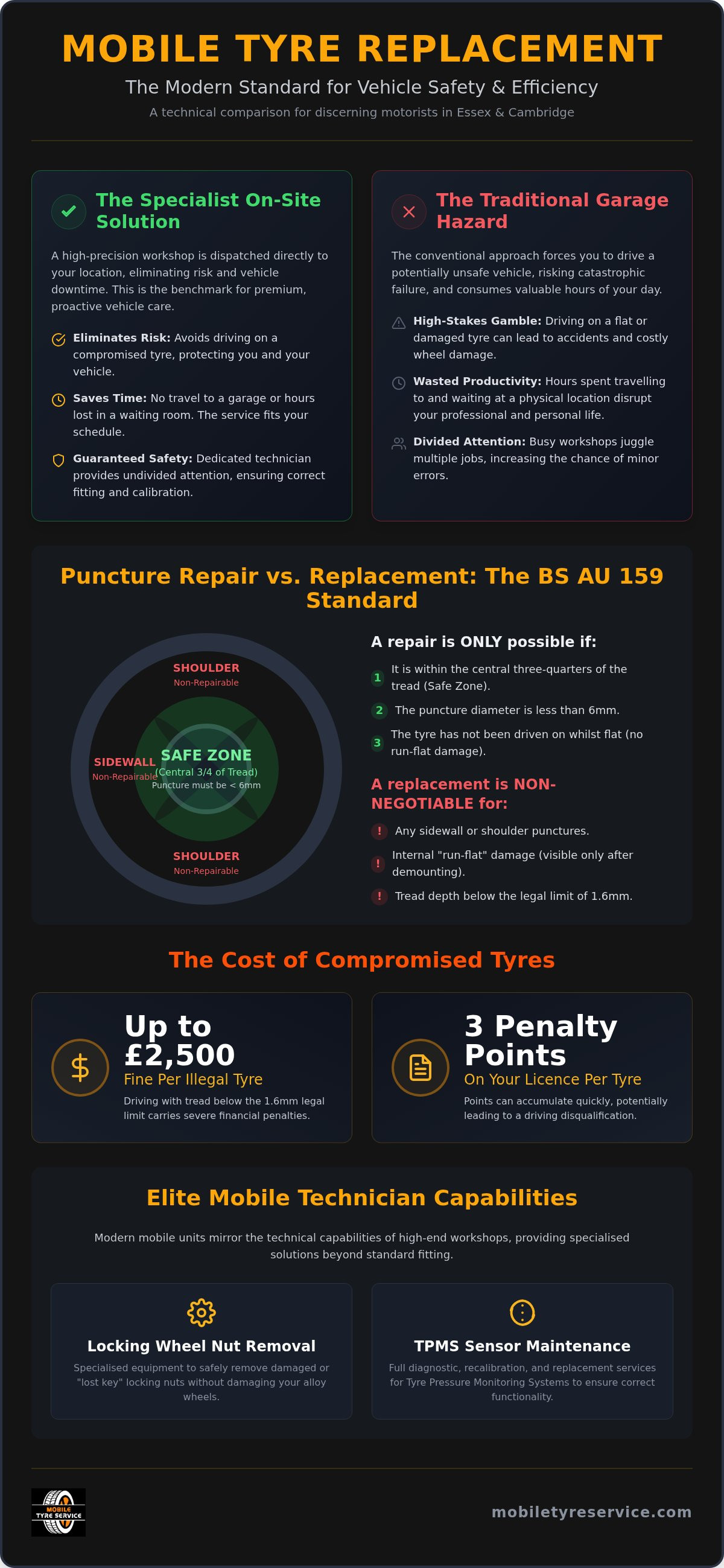
Decision-making during a roadside intervention requires more than a cursory visual check. Professional technicians adhere strictly to British Standard BS AU 159. This regulation dictates that a puncture is only repairable if it resides within the central three-quarters of the tread area, known as the "Safe Zone". Any perforation exceeding 6mm or located in the sidewall or shoulder renders the unit structurally unsafe. High-performance vehicles with high speed ratings often face even stricter limitations. A repair might compromise the tyre's ability to handle extreme thermal stress at high speeds. Whilst a repair is initially cost-effective, long-term safety must remain the absolute priority. If the damage falls outside these rigid parameters, a mobile tyre replacement is the only responsible course of action.
When a Tyre Must Be Replaced: Non-Negotiable Safety Criteria
Certain types of damage are non-negotiable. Sidewall punctures are fundamentally unrepairable because this area lacks the reinforcing steel belts found under the tread. If a motorist drives on a flat tyre, even for a short distance, the internal structure often suffers "run-flat" damage. This manifests as a dark ring of heat-damaged rubber or exposed cords inside the casing. Additionally, if the tread has reached the 1.6mm legal limit, any repair is prohibited by law. Driving on tyres below this limit can result in a fine of up to £2,500 and 3 penalty points per tyre. Adhering to NHTSA tire safety guidelines ensures that you don't compromise your vehicle's stability or braking performance during emergency manoeuvres.
The Mobile Technician’s Assessment Process
A professional on-site assessment is rigorous and systematic. The technician must remove the tyre from the wheel rim to conduct a full internal inspection. External checks alone cannot detect structural delamination or hidden heat damage within the casing. This level of scrutiny distinguishes an elite specialist from a generic roadside fix. Mobile tyre replacement units carry the specialised equipment required to perform these checks at your home or workplace. Our specialists provide transparent advice based on these findings, ensuring you understand why a mobile tyre repair may or may not be viable for your specific situation. This expert guidance ensures a safe vehicle return to the road with zero compromises on technical integrity.
Mobile Tyre Replacement vs. Traditional Garages: An Efficiency Analysis
Traditional garage visits often incur significant hidden costs that motorists overlook. Beyond the retail price of the rubber, you must account for fuel consumption and the loss of billable hours or personal time. A mobile tyre replacement eliminates these variables by integrating the service into your existing schedule. Rather than navigating congested routes to a static centre in Essex or Cambridge, the specialist workshop arrives at your driveway or office. This removes the logistical burden of recovery trucks or the danger of driving on a failing tyre.
The environmental impact of this model is equally compelling. Logistics data suggests that a single service van following an optimised route to five clients significantly reduces the cumulative carbon footprint compared to five individual vehicles travelling to a central garage. High-precision, van-mounted tyre changers and electronic balancers now mirror the performance of static machinery. This ensures no compromise on technical quality whilst delivering a superior, on-demand experience.
Logistical Superiority of the Mobile Model
For Cambridge professionals, maximising efficiency is an operational necessity. A mobile intervention at the workplace allows you to continue your tasks whilst a technician secures your vehicle. This flexibility transforms a disruptive event into a background process. Understanding the mobile tyre repair cost and value proposition is vital for making an informed decision. Our dedicated units operate with the clockwork efficiency of a rapid response team. We ensure your vehicle is ready for the road precisely when you are.
Precision and Care: The Specialist Advantage
Mobile technicians are elite specialists who focus exclusively on tyre-related interventions. Unlike generalist garage mechanics who manage multiple vehicle systems simultaneously, a mobile expert provides undivided attention to your wheels. This focus is critical for maintaining safety standards advocated by groups like the U.S. Tire Manufacturers Association. Every mobile tyre replacement follows a rigorous protocol. We ensure wheel bolts are torqued to exact manufacturer specifications using calibrated tools. Tyre pressures are set with digital accuracy to match the specific load requirements of your vehicle. This systematic approach guarantees that high-stakes mechanical work is executed with surgical precision.
Preparing for Your On-Site Tyre Change: A Practical Guide
Successful mobile tyre replacement relies on precise logistical coordination between the motorist and the technician. Accurate preparation ensures the specialist unit arrives with the exact specifications required for your vehicle. Your first priority is identifying the tyre size correctly by reading the sequence on the sidewall, such as 225/45 R17. Providing this data alongside the load index and speed rating prevents delays and ensures the correct rubber is allocated to your intervention. This systematic approach eliminates the risk of an aborted call-out and guarantees a rapid return to the road.
Once you've identified your requirements, you must select a suitable location for the work to be performed. A mobile unit requires approximately one car-width of clearance to operate safely. This space allows the technician to deploy the hydraulic jacking system and navigate the tyre-changing machinery around the vehicle's perimeter without obstruction. Ensuring this clearance before the specialist arrives maximises efficiency and maintains a safe working environment.
Site Requirements for Mobile Fitting
Surface conditions are critical for mechanical safety. We require flat, solid ground, such as tarmac or concrete, to ensure the vehicle remains stable whilst lifted. Jacking on soft verges, loose gravel, or steep inclines is prohibited due to the risk of vehicle slippage. For roadside interventions, we prioritise safety zones that provide adequate distance from live traffic lanes. If you're unsure about the suitability of your location, please inform our dispatch team during the booking process so we can assess the environment for a safe intervention.
Technical Considerations: TPMS and Locking Nuts
Modern vehicles often feature complex Tyre Pressure Monitoring Systems (TPMS). You must disclose any existing TPMS warnings or sensor damage before the technician arrives. These components require specialised handling and calibration to maintain the vehicle's electronic safety profile. If you believe your damage is minor, you might be considering a mobile puncture repair, but the technician will still require the locking wheel nut key to remove the wheel for the mandatory internal safety inspection.
Locate your locking wheel nut key before the specialist arrives. These are typically stored in the glovebox or with the vehicle's toolkit in the boot. If your locking nut is damaged or the key is missing, we provide specialist locking wheel nut removal services to resolve the issue on-site. Precision preparation ensures your schedule remains undisrupted. To secure a high-precision intervention today, book your mobile tyre replacement with our expert team.
Elite Mobile Tyre Solutions in Essex and Cambridge
Navigating the diverse geography of Essex and Cambridge requires a deep understanding of regional logistics. From the congested arteries of the M11 and A14 to the secluded lanes of rural East Anglia, our response units operate with surgical precision. We don't rely on generic routing software; we utilise local expertise to bypass congestion and reach your location within established timeframes. This commitment to regional mastery ensures that your mobile tyre replacement occurs without the delays often associated with national service aggregators. Our technicians arrive prepared for the specific environment, whether it's a high-density urban centre or a remote roadside verge.
Rapid response protocols are the foundation of our operation. When a vehicle is immobilised, every minute represents a loss of productivity and a potential safety risk. We treat every call-out as a high-stakes intervention, deploying a fully equipped workshop to your precise coordinates. This disciplined approach guarantees that the technical integrity of your vehicle is restored using the same standards you'd expect from a premium manufacturer's facility. We maintain a constant state of readiness to ensure that motorists across these counties are never left stranded.
Serving the Essex and Cambridge Communities
Our coverage extends from suburban driveways in Chelmsford to the rural outskirts of Ely. We recognise that a puncture on a quiet B-road presents different logistical challenges than a scheduled fitting at a Cambridge business park. By maintaining a fleet of dedicated mobile units across these counties, we ensure a service rhythm that is both urgent and controlled. Motorists benefit from a local specialist who understands the terrain and can secure the vehicle's position safely, regardless of the environment. This local focus allows us to provide a level of reliability that national chains simply cannot match.
The Mobile Tyre Service Difference
We distinguish ourselves by remaining elite tyre specialists rather than generalist mechanics. Our technicians focus exclusively on the technical integrity of your wheels, specifically targeting TPMS sensor health and specialist locking wheel nut removal. This specialised focus ensures that high-precision tools are always calibrated and ready for deployment. We avoid the distractions of general mechanical repairs to provide a service that mirrors the standards of a high-end workshop. Our commitment to technical mastery means we don't just change rubber; we ensure your entire wheel assembly is safe and balanced.
- On-site TPMS maintenance: We ensure your electronic safety systems are fully operational after every tyre change.
- Locking nut integrity: Our specialists handle complex removals without compromising the structural integrity of your alloys.
- Premium inventory: We provide access to high-performance brands that meet the exact load and speed requirements of your vehicle.
Securing a professional mobile tyre replacement is a streamlined process designed for maximum efficiency. Our dispatch team coordinates the deployment of a specialist unit to your home or workplace, ensuring zero disruption to your daily operations. You can trust our team to deliver a safe, high-precision return to the road. To secure your intervention, contact our specialists today and experience the elite standard of mobile tyre care.
Secure Your Roadside Safety Today
Choosing a professional on-site service transforms a high-stakes mechanical failure into a controlled, technical intervention. You now understand the rigorous standards of BS AU 159 and the critical importance of a full internal casing inspection before any repair is sanctioned. By prioritising on-site specialist care, you eliminate the hazards of driving on compromised rubber and the hidden costs of traditional garage visits. Our elite response units provide dedicated expertise in specialist TPMS sensor replacement and expert locking wheel nut removal across Essex and Cambridge. This ensures your vehicle returns to the road with manufacturer-level precision and zero disruption to your daily schedule.
Don't leave your safety to chance or waste productive hours in a waiting room. Book your professional mobile tyre replacement in Essex or Cambridge now to experience the efficiency of a specialised response unit. We are ready to restore your mobility with surgical precision and technical mastery. Your journey continues safely from the moment our technician completes the final torque check.
Frequently Asked Questions
Is mobile tyre replacement as safe as a garage?
Mobile tyre replacement is statistically as safe as a garage intervention because it utilises the same industrial-grade machinery mounted within a specialised vehicle. Technicians follow identical safety protocols for jacking, fitting, and balancing. We prioritise your safety by eliminating the risk of driving on a damaged tyre to reach a centre. Every bolt is torqued to manufacturer specifications using calibrated tools. This ensures the mechanical integrity of your wheel assembly remains beyond reproach.
How much space does a mobile tyre fitter need?
A mobile unit requires approximately one car-width of clearance around the vehicle to operate safely. This allows the technician to deploy the hydraulic jacking system and navigate the tyre-changing machinery without obstruction. We require a flat, solid surface like tarmac or concrete for maximum stability. Providing this space ensures the intervention proceeds with the clockwork efficiency of a specialised unit. Please secure this environment before the specialist arrives at your location.
Can you replace a tyre if I have lost my locking wheel nut key?
We provide specialist locking wheel nut removal services for motorists who've lost or damaged their security key. Our technicians carry dedicated master removal tools designed to extract these bolts without damaging your alloy wheels. You don't need to arrange a separate garage visit or a recovery truck. Inform our dispatch team of the missing key during booking so the technician arrives prepared with the necessary high-precision extraction equipment for your vehicle.
Do I need to be present while my tyres are being replaced?
You don't need to be physically present at the vehicle during the entire process, provided we have access to the locking wheel nut key. Many professionals continue their tasks whilst we perform the mobile tyre replacement at their workplace or home. We require a brief handover to confirm the vehicle's location and collect the security key. Once the intervention is complete, we'll provide a digital confirmation that your vehicle is ready for the road.
Will a mobile tyre service replace my TPMS sensors?
Our mobile units are fully equipped to perform on-site TPMS sensor maintenance and replacement. These electronic safety systems require technical mastery to ensure the sensors are correctly calibrated to your vehicle's ECU. We carry a range of replacement sensors and diagnostic tools to resolve TPMS warnings during the tyre fitting process. Maintaining these sensors is vital for your vehicle's safety profile and prevents future MOT failures or unexpected pressure drops.
How long does a mobile tyre replacement take on average?
A single mobile tyre replacement typically takes between 30 and 60 minutes to complete from the moment the technician arrives. This timeframe includes the removal of the old casing, fitting the new tyre, precision electronic balancing, and a final torque check. More complex interventions involving multiple tyres or locking wheel nut removal may require additional time. Our systematic approach ensures every stage is executed with surgical precision to minimise your downtime.
Can you fit tyres on a busy roadside in Essex?
We perform roadside interventions across Essex, provided the location offers a safe working environment for our technicians. Safety is our absolute priority; we must ensure there's adequate distance from live traffic lanes to deploy our equipment safely. If a location is deemed too hazardous, we'll coordinate with you to move the vehicle to a more secure site. Our local expertise allows us to navigate Essex traffic patterns for a rapid, controlled response.
What happens if my tyre is unrepairable when the technician arrives?
If a technician determines that a tyre is unrepairable under BS AU 159 standards, we'll proceed with a full replacement. We carry a range of premium tyres to ensure we can resolve the issue immediately on-site. Our assessment process is transparent; we'll explain exactly why a repair is unsafe, such as sidewall damage or internal heat degradation. This professional advice ensures you make a safety-first decision for your vehicle's return to the road.
Need a mobile tyre service?
We cover Harlow, Bishop's Stortford, Cambridge and all surrounding areas — 24/7.
Call: 01279 881234