Mobile TPMS Sensor Service: The Complete Professional Reference Guide 2026
A single illuminated dashboard icon can instantly transform a routine commute into an immediate MOT failure. You've likely felt that specific surge of frustration when the Tyre Pressure Monitoring System (TPMS) light refuses to extinguish, even after you've manually checked every tyre. This persiste…

A single illuminated dashboard icon can instantly transform a routine commute into an immediate MOT failure. You've likely felt that specific surge of frustration when the Tyre Pressure Monitoring System (TPMS) light refuses to extinguish, even after you've manually checked every tyre. This persistent warning often signals a sensor battery failure or a physical fault that requires more than just a blast of compressed air. Securing a professional mobile TPMS sensor service is the most efficient way to diagnose and rectify these technical issues at your home or workplace.
Our comprehensive 2026 reference guide equips you with the technical knowledge to master your vehicle's monitoring system. You'll gain a clear understanding of TPMS technology, from valve-mounted sensors to complex OBDII programming requirements. We'll explore why on-site intervention is now the industry standard for time-poor motorists who require exactness and speed. This article covers everything from technical diagnostics to the benefits of specialised mobile sensor replacement. By the end, you'll have the assurance of MOT compliance and the confidence that your vehicle's safety systems are operating with high-precision accuracy.
Key Takeaways
- Understand the technical distinction between Direct and Indirect TPMS and how these systems impact your vehicle's real-time safety monitoring.
- Ensure strict MOT compliance for vehicles registered after 1st January 2014 to avoid immediate failure due to malfunctioning sensor hardware.
- Discover the logistical and financial advantages of a mobile TPMS sensor service compared to the significant waiting times and premiums at main dealerships.
- Learn how elite technicians utilise professional-grade OBDII diagnostic equipment to perform high-precision sensor programming at your home or roadside.
- Recognise the rapid intervention protocols available for motorists in Essex and Cambridge to resolve persistent dashboard warning lights with total efficiency.
The Fundamentals of Tyre Pressure Monitoring Systems (TPMS)
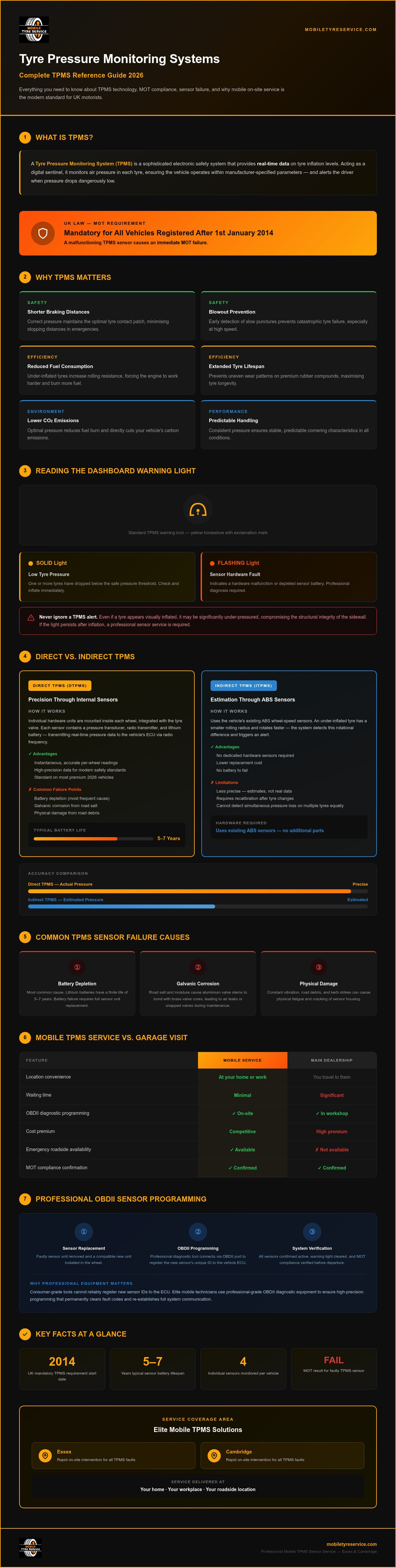
A Tyre Pressure Monitoring System (TPMS) is a sophisticated electronic safety system designed to provide real-time data regarding the inflation levels of your tyres. This high-precision technology acts as a constant digital sentinel; it monitors the air pressure within each tyre to ensure the vehicle operates within the manufacturer's specified parameters. TPMS is a mandatory safety feature for all UK passenger vehicles registered after 1st January 2014. By providing an early warning of pressure loss, the system significantly reduces the risk of catastrophic tyre blowouts and maintains optimal vehicle stability during high-speed manoeuvres.
In 2026, the role of these sensors extends beyond immediate safety. Correct tyre inflation is a critical factor in vehicle efficiency. Under-inflated tyres increase rolling resistance, which forces the engine to work harder and consumes more fuel. By maintaining precise pressure, TPMS contributes to lower CO2 emissions and reduced operational costs. When a fault occurs in this delicate network, a specialised mobile TPMS sensor service provides the technical intervention required to restore these efficiency gains without the need for a garage visit.
How TPMS Protects Your Vehicle and Safety
The primary function of TPMS is the prevention of accidents through early detection. It provides real-time alerts for slow punctures that often remain undetected by even the most experienced drivers until the tyre is beyond repair. Maintaining the correct pressure ensures an optimal tyre footprint on the road surface. This precise contact patch is vital for several performance factors:
- Minimising braking distances in emergency situations.
- Preventing uneven tyre wear to extend the lifespan of premium rubber compounds.
- Ensuring predictable handling characteristics during cornering.
Identifying the TPMS Warning Light on Your Dashboard
The system communicates via a standard yellow icon on your instrument cluster, which resembles a horseshoe with an exclamation mark in the centre. Understanding the behaviour of this light is essential for accurate diagnostics. A solid light typically indicates that one or more tyres have dropped below the safe pressure threshold. Conversely, a flashing light often points towards a hardware malfunction or a depleted sensor battery. You should never ignore a TPMS alert. Even if a tyre looks visually inflated, it may be significantly under-pressured, which compromises the structural integrity of the sidewall. If the light persists after inflation, it's time to request a professional mobile TPMS sensor service to identify the underlying technical fault.
Direct vs. Indirect TPMS: Understanding the Technology
Vehicle manufacturers employ two distinct methodologies for monitoring tyre pressure, each with specific technical requirements and failure modes. Whilst both systems aim to alert the driver to pressure loss, the underlying hardware differs significantly. Most modern vehicles, particularly premium models, now utilise Direct TPMS (dTPMS) because it provides the high-precision data necessary for 2026 safety standards. Understanding which system your vehicle uses is essential when diagnosing a persistent warning light or preparing for a mobile TPMS sensor service intervention.
Direct TPMS (dTPMS): Precision Through Internal Sensors
Direct systems rely on individual hardware units mounted inside each wheel, typically integrated with the tyre valve. These sophisticated devices contain a pressure transducer, a radio transmitter, and a dedicated lithium battery. The sensor measures the actual air pressure within the tyre cavity and transmits this data via radio frequencies to the vehicle's central ECU. This method provides instantaneous, accurate readings for each specific wheel.
These sensors are highly effective but remain vulnerable to the harsh environment of the wheel well. Constant vibration and road debris can cause physical fatigue. However, the most frequent cause of failure is simple battery depletion. Most internal batteries have a finite life cycle of 5 to 7 years. Once the battery fails, the entire sensor unit requires replacement. Galvanic corrosion is another critical failure point; this occurs when road salt and moisture cause the aluminium valve stem to bond with the brass valve core, leading to air leaks or snapped valves during routine maintenance. If you suspect a hardware failure, a specialised mobile TPMS sensor service can perform an on-site diagnostic to confirm the sensor's health.
Indirect TPMS (iTPMS): Software-Based Monitoring
Indirect TPMS does not use physical pressure sensors inside the tyres. Instead, it leverages the existing Anti-lock Braking System (ABS) and wheel speed sensors to calculate pressure changes. The system operates on the principle that an under-inflated tyre has a smaller diameter and rotates at a different speed than a correctly inflated one. The ECU interprets these rotational variances as a loss of pressure.
While cost-effective, iTPMS has notable technical limitations. It cannot provide a specific pressure reading in PSI or Bar; it only detects relative changes. Crucially, if all four tyres lose pressure at a similar rate, such as during a seasonal temperature drop, the system may fail to trigger an alert because the relative wheel speeds remain synchronised. This system also requires a manual reset through the vehicle's dashboard menu every time you adjust your tyre pressures or fit new rubber. Without this recalibration, the software cannot establish a correct baseline for safety monitoring.
TPMS and UK Law: MOT Requirements and Safety Standards
The regulatory landscape for tyre safety in the UK is stringent. Since 1st January 2014, all M1 category vehicles—essentially standard passenger cars—must be equipped with a functional pressure monitoring system to remain road legal. This isn't a discretionary safety feature; it's a legal mandate that ensures vehicles operate within safe parameters. Any car first used after 2014 must have a working TPMS to pass its annual inspection. Failure to maintain this system doesn't just compromise road safety; it directly impacts your vehicle's legal status and resale value.
Beyond the inspection centre, system functionality carries significant weight for insurance validity. In the event of an accident caused by tyre failure, an active TPMS warning light can be used as evidence of negligence. Insurers may argue that the vehicle was kept in an unroadworthy condition, potentially voiding your policy or complicating a claim. Using a professional mobile TPMS sensor service to rectify faults before they escalate is a critical step in professional risk management. It ensures that your vehicle's safety record remains impeccable and your coverage stays secure.
Why a Faulty TPMS Sensor Leads to MOT Failure
The DVSA classifies TPMS as a primary safety system, placing it in the same critical category as braking and steering components. During the MOT test, the technician follows a specific diagnostic sequence to verify system integrity. The tester will look for the following behaviours:
- The dashboard icon must illuminate during the initial ignition cycle to demonstrate the bulb and circuit are functional.
- The warning light must extinguish shortly after the engine starts, indicating that all sensors are communicating correctly.
- A persistent or flashing alert will result in an immediate "Major" failure, preventing the issuance of a new MOT certificate.
Attempting to bypass the system by removing bulbs or interfering with the vehicle's software is a futile strategy. Testers are specifically trained to identify these interventions. Such actions can lead to even stricter penalties and an automatic failure for system tampering.
The Legal Mandate for TPMS in the UK
The transition to these standards began in 2012, but the hard requirement for MOT testing only applies to vehicles registered from 2014 onwards. Older vehicles that were factory-fitted with TPMS before this date are currently exempt from this specific check, though maintaining them remains a vital safety practice. For modern vehicle owners, future-proofing your car involves proactive maintenance rather than reactive repairs. A specialised mobile TPMS sensor service ensures your hardware remains compliant with evolving DVSA standards. This high-precision intervention provides on-site recalibration that keeps you legal and safe without the inconvenience or cost of an MOT retest.
Professional Mobile TPMS Sensor Replacement vs. Garage Visits
Traditional garage visits for sensor maintenance involve significant logistical friction. You must coordinate transport, endure a sterile waiting room, and often pay a premium for basic diagnostic labour. A specialised mobile TPMS sensor service bypasses these inefficiencies by bringing a high-precision workshop directly to your location. Mobile units are configured as elite rapid-response vehicles. They carry the exact OBDII diagnostic tools required to interface with your vehicle's electronic control unit (ECU) on your driveway. The fix is immediate.
The Technical Advantages of On-Site Programming
The 'relearn' procedure is the most critical phase of sensor replacement. Many motorists assume a new sensor will work automatically. It won't. The hardware must be electronically 'introduced' to the vehicle. Technicians use handheld triggers to wake up the sensor's internal transmitter. This process broadcasts a unique ID that is then written to the ECU via the OBDII port. This ensures the vehicle correctly identifies which sensor is on which corner. This prevents confusing 'nearside-front' alerts when the fault is actually on the offside-rear. Performing this intervention at your home allows for immediate verification through a diagnostic check. The technician confirms the repair before they depart.
Avoiding the Dealership Premium for Sensor Maintenance
Main dealers frequently charge inflated prices for OEM-branded sensors and high hourly labour rates for routine technical swaps. Modern universal sensors offer identical performance and a 5-7 year battery life that matches original equipment. By opting for a dedicated mobile TPMS sensor service, you avoid the 'dealership premium' and significantly reduce vehicle downtime. There is no need to organise alternative transport or lose a half-day of productivity. If you require a rapid, professional resolution, you can book a TPMS sensor mobile intervention to restore your vehicle's safety systems with minimal disruption. Technical excellence and customer convenience are no longer mutually exclusive.
Elite Mobile TPMS Solutions Across Essex and Cambridge
Motorists in Essex and Cambridge require a mobile TPMS sensor service that understands the specific logistical challenges of the region. National generalists often lack the technical focus needed for high-precision sensor calibration. Our response protocols are built on a foundation of elite technical mastery and local geographical knowledge. We position our units strategically to ensure rapid intervention along the M11, A12, and A14 corridors. Every mobile appointment, whether for fitting or repair, includes a mandatory TPMS integrity check. This disciplined approach ensures your vehicle's safety systems are fully operational before the technician departs your location.
Specialist Equipment for Mobile Diagnostics and Fitting
The Mobile Tyre Service fleet operates as a network of specialised technical units. Each vehicle is equipped with professional-grade OBDII diagnostic tools and handheld activation triggers. This hardware allows our technicians to service an extensive range of vehicles, from standard family hatchbacks to high-performance premium SUVs. We don't rely on guesswork. We use exact data to program and relearn sensors to your vehicle's ECU. For a comprehensive analysis of service pricing and technical value, you can review our Mobile Tyre Repair Cost: The Complete 2026 Professional Guide.
Our commitment to technical excellence means we only utilise sensors that meet or exceed OEM specifications. This ensures a reliable battery life cycle and perfect communication with your dashboard display. By bringing this level of garage-quality equipment directly to your driveway, we eliminate the need for costly dealership visits and long waiting times.
Rapid Roadside and Home Intervention Protocols
We organise our fleet with the precision of a first-responder unit. Technicians are trained to handle complex sensor faults in diverse environments, from quiet residential streets in Cambridge to busy roadside locations across Essex. The priority is always technical accuracy and site safety. We follow a methodical process to identify the root cause of a TPMS alert, ensuring that we don't just clear the code, but resolve the underlying hardware or software issue.
Proactive maintenance is essential for modern vehicle owners. Waiting for a sensor battery to fail often leads to an inconvenient MOT failure or a stressful roadside warning. Our mobile TPMS sensor service encourages residents to address sensor health during routine tyre changes. This high-precision intervention provides peace of mind and ensures your vehicle remains compliant with all UK safety regulations throughout the year. We act as your dependable technical partner, delivering elite service with clockwork efficiency.
Securing Your Vehicle's Technical Integrity for 2026
Maintaining a functional Tyre Pressure Monitoring System is no longer a discretionary task; it's a fundamental requirement for MOT compliance and road safety. You now understand the critical distinction between direct and indirect systems and the legal implications of ignoring a persistent dashboard warning. Proactive maintenance prevents the logistical failure of a failed annual inspection and ensures your vehicle operates with maximum fuel efficiency. Our elite mobile TPMS sensor service eliminates the friction of traditional garage visits by delivering high-precision diagnostics directly to your location.
Our fleet operates with the disciplined efficiency of a specialist response unit across Essex and Cambridge. We equip every mobile unit with professional-grade OBDII diagnostic hardware to perform immediate on-site sensor programming. Our technicians are highly trained specialists who ensure your safety systems are calibrated to exact manufacturer specifications. Don't let a faulty sensor compromise your vehicle's safety or legal status. Book Your Expert Mobile TPMS Sensor Service Today and experience the reliability of a premium technical intervention. Your safety is our priority.
Frequently Asked Questions
Is it okay to drive with the TPMS light on?
You shouldn't continue to drive for extended periods with an active TPMS warning light. This alert signifies that at least one tyre is significantly under-inflated or a sensor has failed completely. Driving with incorrect pressures compromises vehicle handling, increases braking distances, and risks a catastrophic blowout. If the light is flashing, the system cannot monitor your safety at all. Immediate technical intervention is required to diagnose the fault accurately.
How much does a mobile TPMS sensor service cost?
The cost of a mobile TPMS sensor service depends on your vehicle's specific make and the type of hardware required. Universal high-performance sensors are often more cost-effective than main dealer alternatives. Factors such as the number of sensors requiring replacement and the complexity of the OBDII programming influence the final service fee. We provide transparent technical value by performing the entire diagnostic and relearn procedure at your preferred location.
Can a TPMS sensor battery be replaced without changing the whole unit?
It's not possible to replace the battery in isolation. TPMS sensors are sophisticated, sealed units designed to withstand extreme centrifugal forces and moisture within the wheel. The lithium battery is encased in a protective potting compound during manufacture to ensure durability. Once the battery reaches the end of its 5 to 7 year life cycle, the entire sensor assembly must be replaced and reprogrammed to ensure continued system integrity and safety.
Will a new TPMS sensor need to be programmed to my car?
Yes, every new sensor requires high-precision programming to communicate with your vehicle's ECU. A new unit is essentially 'blank' until a technician uses a specialised handheld trigger to assign it a unique ID. This process ensures the car's computer recognises the specific pressure data from each corner. Without this essential relearn procedure, the dashboard warning light will remain active despite the new hardware being physically installed in the wheel.
Why has my TPMS light come on in cold weather?
Air pressure naturally drops as ambient temperatures decrease. When the air inside your tyres cools, it becomes denser and occupies less volume, which may trigger the sensor if the pressure falls below the manufacturer's threshold. Whilst this is often a seasonal occurrence, you should still verify the pressures manually. If the light persists after you've corrected the inflation levels, a technical fault or a slow puncture may be present in the system.
Can I replace a TPMS sensor myself at home?
Replacing a sensor is a complex technical task that requires specialist equipment and knowledge. The process involves de-beading the tyre to access the internal valve area without damaging the rubber or the rim. You also need professional OBDII diagnostic tools to perform the mandatory relearn procedure. Most DIY enthusiasts lack the high-precision calibration equipment necessary to code the new hardware to the vehicle's electronic control unit correctly on their own.
Does a mobile tyre service carry sensors for all car makes?
Our mobile units carry a comprehensive range of high-quality universal sensors that are compatible with the vast majority of UK passenger vehicles. These units can be programmed on-site to mirror the protocols of almost any vehicle make, from family hatchbacks to premium SUVs. This readiness ensures that we can resolve most sensor faults during a single intervention, regardless of whether your car uses a specific manufacturer-branded system or an aftermarket alternative.
What happens if I ignore a faulty TPMS sensor before my MOT?
Ignoring a faulty sensor will result in an immediate "Major" failure during your MOT inspection. For all vehicles registered after 1st January 2014, a functional TPMS is a legal requirement. A persistent warning light or a system that fails to complete its initial startup sequence is a breach of DVSA safety standards. You'll be unable to secure a valid MOT certificate until the sensor is professionally replaced and the system is recalibrated.
Need a mobile tyre service?
We cover Harlow, Bishop's Stortford, Cambridge and all surrounding areas — 24/7.
Call: 07535 899956