Mobile TPMS Sensor Replacement in Essex: Checks, Faults and Next Steps
A TPMS warning doesn’t automatically mean a sensor needs replacing. A pressure check can identify an inflation issue, while further assessment can help establish whether a sensor may be involved. Our mobile TPMS sensor replacement Essex service brings TPMS sensor support to a suitable location, so y…

A TPMS warning doesn’t automatically mean a sensor needs replacing. A pressure check can identify an inflation issue, while further assessment can help establish whether a sensor may be involved. Our mobile TPMS sensor replacement Essex service brings TPMS sensor support to a suitable location, so you can address the warning without arranging a workshop visit.
If the alert is unresolved, it’s natural to wonder whether the vehicle is safe to drive or what to do next. Replacing a sensor won’t correct a tyre pressure problem, so it’s useful to separate what you’ve observed from what still needs assessment.
This guide explains what a TPMS warning can indicate, how a pressure check differs from sensor replacement and when a sensor may need attention. You’ll also find practical advice on the vehicle details and access information to have ready for a mobile visit in Essex or Cambridge.
Key Takeaways
- A TPMS warning doesn’t prove that a sensor has failed. Checking tyre pressures is a useful first step.
- The warning pattern, pressure readings and vehicle details can help guide the next step.
- Sensor procedures can vary depending on the vehicle and TPMS design.
- Prepare for mobile TPMS sensor replacement Essex by sharing accurate vehicle details and a clear, suitable location.
- Mobile TPMS sensor services are available at customers’ preferred locations in Essex and Cambridge.
TPMS warning or pressure check: what does your car need in Essex?
A TPMS warning light doesn’t automatically mean a sensor has failed. It indicates that the tyre pressure monitoring system has detected a concern, which could relate to tyre pressure, a sensor or another part of the system. For Essex drivers, checking the tyre pressures and noting how the warning behaves are useful first steps before deciding whether mobile TPMS sensor replacement Essex may be needed.
TPMS monitors tyre pressure and alerts the driver when it detects a concern. Vehicles use different systems and warning patterns, so the light alone isn’t a diagnosis. This Tire-pressure monitoring system (TPMS) overview explains the distinction between direct and indirect systems and can help put the warning in context.
What does the TPMS warning light tell you?
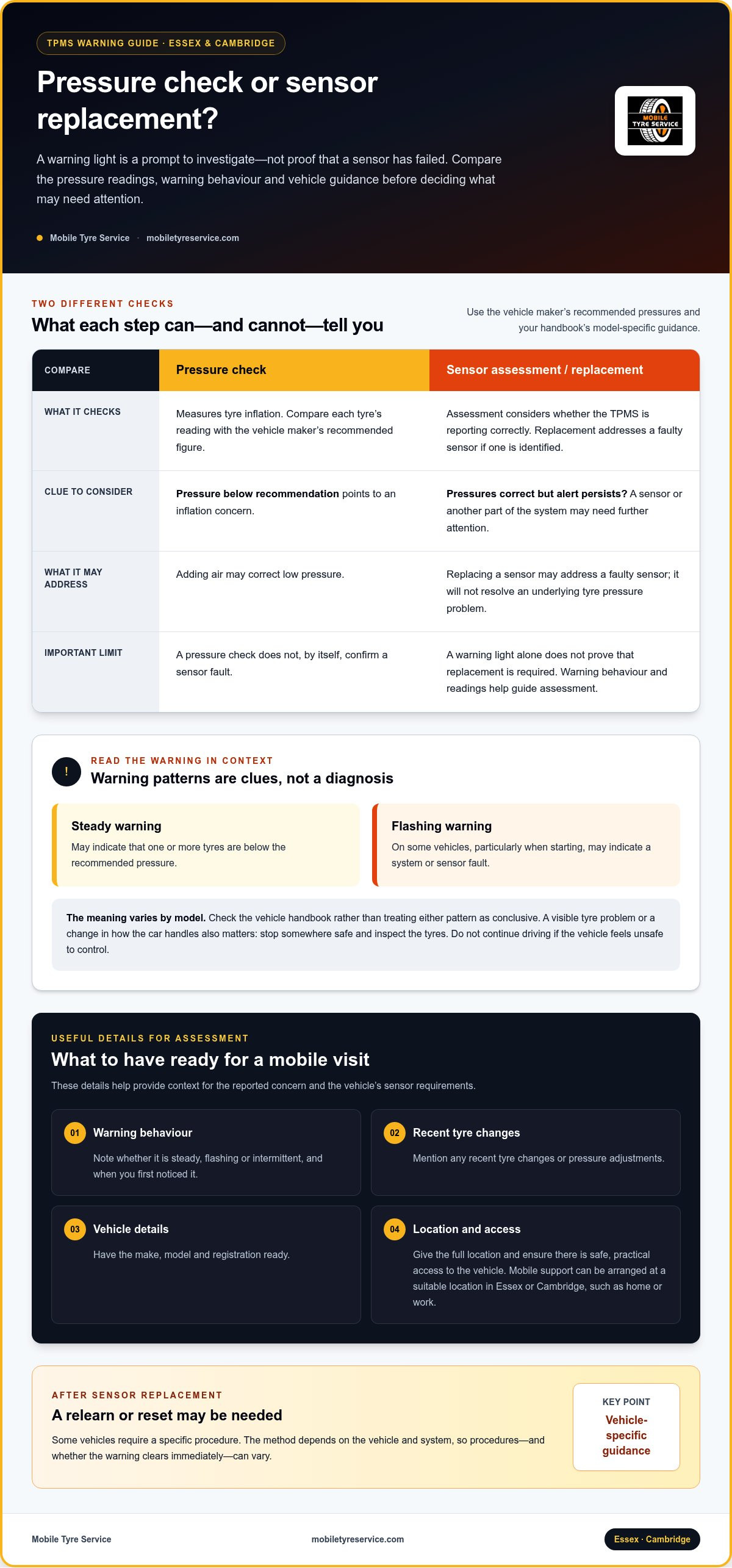
A steady warning may indicate that one or more tyres are below the recommended pressure. On some vehicles, a flashing light, particularly when the car starts, may indicate a system or sensor fault. The meaning varies by model, so use your vehicle handbook to interpret the warning rather than treating either pattern as conclusive.
If the warning appears with visible tyre damage, a tyre that looks unusually low or a change in how the car handles, stop somewhere safe and inspect the tyres. Don’t continue driving if the vehicle feels unsafe to control. If there’s no visible damage, the warning still deserves attention, but it won’t identify the cause on its own.
Why a pressure check is not the same as sensor replacement
A tyre pressure check measures inflation; sensor assessment looks at whether the TPMS is reporting correctly, and replacement addresses a faulty sensor. Compare each tyre’s pressure with the vehicle maker’s recommended figures. If a tyre is underinflated, that points to a pressure concern. If pressures are correct but the alert persists, a sensor or another part of the system may need further attention.
These steps address different problems. Adding air may correct low pressure, but it won’t repair a faulty sensor. Replacing a sensor won’t resolve an underlying pressure issue. The warning’s behaviour, pressure readings and vehicle-specific guidance all help establish a sensible next step. The guide Mobile TPMS Sensor Service: The Complete Professional Reference Guide 2026 provides further background on the service and common TPMS concerns.
Mobile TPMS sensor service in Essex gives you a practical way to address a sensor concern at a suitable location. Mobile Tyre Service provides TPMS sensor installation and maintenance on-site. Considering the pressure readings alongside the warning helps keep the response focused on the likely issue, not the warning light alone.
How mobile TPMS sensor replacement works in Essex
Mobile TPMS sensor service brings installation or maintenance to your location, whether that’s at home, at work or somewhere suitable for the vehicle. The process starts with the warning and vehicle details, followed by assessment of the reported issue. If a sensor fault is identified, replacement may be the appropriate next step. The procedure can vary by vehicle and sensor type.
To prepare, explain what the warning is doing and share the vehicle details. The vehicle and reported issue can then be assessed, and the appropriate sensor service carried out where needed. The warning alone doesn’t establish that replacement is necessary. Pressure readings and vehicle-specific information help distinguish a sensor concern from low pressure or another system issue.
What information helps assess a TPMS fault?
Before arranging mobile TPMS sensor replacement Essex, note whether the warning is steady, flashing or intermittent and when you first noticed it. Mention any recent tyre changes or pressure adjustments. Have the vehicle’s make, model and registration ready. These details help identify the vehicle and its sensor requirements, and provide useful context for the service.
Mobile support can be arranged at a suitable customer location in Essex or Cambridge, such as home or work. Provide the full location and make sure there is safe, practical access to the vehicle. Clear directions and access details help the mobile service reach the vehicle and understand the reported concern.
What happens after a sensor is replaced?
Some vehicles may require a specific relearn or reset procedure after sensor replacement. The method depends on the vehicle and system, so don’t assume that every car follows the same steps or that the warning will clear immediately. Your vehicle handbook may provide model-specific instructions on warning behaviour and system procedures.
The UK Government discusses TPMS as a legally mandated safety technology in the context of Great Britain’s vehicle safety requirements. A persistent warning deserves attention, but accurate assessment is still important before deciding what action is needed.
For Essex drivers, a mobile visit is a convenient way to deal with a TPMS concern at a suitable location. When arranging mobile TPMS sensor service, share the warning behaviour and vehicle details so the service can take account of the relevant information.
Pressure check or sensor replacement: how can Essex drivers tell the difference?
The warning pattern can help you decide what to check, but it can’t identify the fault by itself. A pressure reading below the vehicle maker’s recommendation suggests an inflation concern. If pressures are correct and the alert remains, the TPMS may need further assessment.
A warning light alone is not proof that sensor replacement is required. Symptoms guide the next steps, but don’t confirm a failed sensor. Use the comparison below as a starting point, and follow the vehicle handbook for model-specific guidance.
| Symptom | Possible explanation | Sensible next action |
|---|---|---|
| Warning appears after a change in temperature | Tyre pressure may have changed with conditions. | Check each tyre’s pressure against the vehicle maker’s recommendation. |
| A tyre looks low or a pressure reading is below the recommended level | The tyre may be underinflated or losing pressure. | Inspect safely and address the pressure concern. If damage is visible, don’t treat inflation alone as a diagnosis. |
| Pressures are checked and corrected, but the warning persists | A sensor fault or another TPMS issue may be involved. | Arrange an assessment of the vehicle and system before deciding whether a sensor needs replacing. |
| The warning flashes, behaves intermittently or differs from the handbook description | The vehicle’s system may be signalling a fault, but behaviour varies by model. | Check the handbook and share the warning pattern and vehicle details for further assessment. |
When does a pressure check make sense?
A warning after a temperature change is a reason to check tyre pressures, not to assume a sensor has failed. The same applies if a tyre looks low or you notice possible pressure loss. Refer to the handbook or the vehicle’s pressure information for the correct figures. If you adjust the pressure, follow the vehicle maker’s guidance on when to check it again.
When might the TPMS sensor need attention?
If the tyres are at the recommended pressures but the warning remains, further assessment can help establish whether the sensor or another part of the system needs attention. Warning behaviour and sensor design differ between vehicles, so a persistent alert is a reason to investigate, not a diagnosis in itself.
For drivers considering mobile TPMS sensor replacement Essex, the practical distinction is between a pressure reading that indicates an inflation concern and a warning that persists despite correct pressures. That helps direct the next step towards assessment instead of assumption.
Prepare for a mobile TPMS visit in Essex
A little preparation can make a mobile TPMS visit more focused. Whether the vehicle is at home, at work or in a safe roadside location, provide accurate vehicle and location details when arranging support. Explain what the warning is doing and mention any recent tyre work or pressure checks. This gives useful context before the vehicle is assessed.
What should you have ready before the visit?
Use this checklist to share the key information and prepare a suitable place for the work:
- Vehicle details: make, model and registration.
- Exact location: address or clear roadside location, with access details that will help identify the vehicle.
- Warning behaviour: whether the light is steady, flashing or intermittent, and when you first noticed it.
- Recent changes: pressure readings or adjustments, visible pressure loss and any recent tyre work.
- Access: park where the vehicle can be reached safely, with practical space to work around it.
Specific observations are more useful than a general description such as “the tyre light is on”. For example, say whether the alert appeared after a pressure check or following tyre work. Don’t guess at the fault; report what you noticed. Accurate information gives the mobile service useful context for the vehicle assessment.
What should you do while the warning is active?
Follow your vehicle handbook for model-specific instructions. If a tyre appears damaged or the vehicle’s handling changes, stop somewhere safe and inspect it. Don’t continue if the car feels unsafe to control. Even if the vehicle feels normal, don’t dismiss an active warning. Check the tyre pressures and arrange an appropriate assessment if the alert remains.
For a roadside visit, choose a location that is safe and practical for the vehicle to be accessed. At home or work, make sure the vehicle is easy to identify and provide accurate access details. The warning could relate to pressure, a sensor or another system concern, so describing what you observed supports a considered next step without assuming the cause.
With the vehicle and location details ready, arranging mobile TPMS sensor replacement Essex is more straightforward. The mobile TPMS support service in Essex brings TPMS sensor help to a suitable location. Share the warning behaviour, recent checks and any tyre work when arranging the visit.
Arrange mobile TPMS sensor replacement in Essex with confidence
You don’t need to diagnose the fault before arranging support. A clear description of the warning and accurate vehicle details help establish a useful starting point. The appropriate next step depends on assessment, not the warning light alone. Mobile Tyre Service provides mobile TPMS sensor installation and maintenance at customers’ locations in Essex and Cambridge, making it practical to address the concern at home, at work or somewhere suitable for the vehicle.
What details should you include when arranging service?
Have these details ready to explain the issue clearly:
- Vehicle: make, model and registration.
- Location: the Essex or Cambridge address, or precise location where the vehicle can be accessed.
- Warning: whether the light is steady, flashing or intermittent, and when you first noticed it.
- Checks already made: any pressure readings or adjustments, and whether the warning remained afterwards.
- Recent tyre work: mention a tyre change, repair or other relevant work if the warning began around the same time.
Keep the description factual. For instance, say that the warning appeared after a pressure check and is still showing, rather than assuming a sensor has failed. These details separate what you’ve observed from what still needs assessment.
What should you expect from a clear service conversation?
Explain the warning in plain language and share the vehicle information when discussing the suitable mobile TPMS service. A pressure concern and a possible sensor fault call for different responses. Vehicle-specific sensor requirements can also affect the procedure, so the exact approach depends on the vehicle and assessment. Not every model follows the same process, and replacement isn’t automatically required just because a warning has appeared.
To move forward, keep the decision simple:
- Describe the warning and when it began.
- Share the vehicle make, model, registration and Essex or Cambridge location.
- Arrange mobile TPMS service at a suitable place for the vehicle.
With the key details ready, you can arrange mobile TPMS sensor replacement Essex support with a clearer understanding of the issue and next step. Arrange mobile TPMS assistance in Essex.
Take the next step towards resolving your TPMS warning
A TPMS alert doesn’t confirm that a sensor has failed. Check tyre pressures using your vehicle’s recommended guidance, and note whether the warning persists or behaves unusually. That information, along with your vehicle details, helps establish what to do next.
Mobile Tyre Service provides TPMS sensor installation and maintenance at customers’ preferred locations across Essex and Cambridge. For drivers searching for mobile TPMS sensor replacement Essex, a mobile visit is a practical way to address the concern without arranging a workshop trip.
When arranging service, share the warning behaviour, vehicle make and model, registration, location, and any recent pressure checks or tyre work. A clear account helps focus the assessment on the vehicle rather than relying on the warning light alone.
Arrange mobile TPMS sensor service in Essex and take a considered step towards resolving the alert.
Frequently Asked Questions
Can a mobile technician replace a TPMS sensor in Essex?
Yes. Mobile Tyre Service provides TPMS sensor installation and maintenance at customers’ locations in Essex and Cambridge. If you’re searching for “mobile TPMS sensor replacement Essex”, a mobile visit brings support to a suitable location, such as home or work. Share the warning behaviour, vehicle details and exact location when arranging service. Assessment helps establish whether sensor replacement is the appropriate next step.
Does a TPMS warning always mean the sensor needs replacing?
No. A TPMS warning can indicate low tyre pressure, a sensor fault or another system concern, so the light alone can’t confirm what has failed. Check tyre pressures against the vehicle maker’s guidance and consult your handbook for the meaning of the warning pattern on your model. If the alert remains after the pressures are checked, arrange an assessment before deciding on replacement.
How do I know if my tyre pressure is low or the TPMS sensor is faulty?
Check each tyre’s pressure using the figures in your vehicle handbook or the vehicle’s pressure information. A reading below the recommended level points to an inflation concern. If pressures are correct but the warning persists, the sensor or another part of the TPMS may need assessment. Warning patterns differ between vehicles, so note whether the light is steady, flashing or intermittent instead of relying on the light alone.
Can I drive with the TPMS warning light on?
It depends on the tyre’s condition and how the vehicle is handling. Follow your handbook’s instructions, and stop somewhere safe if a tyre looks damaged or the vehicle’s handling changes. Don’t dismiss the warning just because the car feels normal. Check the tyre pressures and arrange an assessment if the alert remains. If you’re unsure whether the vehicle is safe to continue driving, avoid taking risks and seek appropriate assistance.
What information should I provide when booking mobile TPMS sensor replacement?
Provide the vehicle make, model and registration, plus the exact Essex or Cambridge location where the vehicle can be accessed. Describe whether the warning is steady, flashing or intermittent and when it began. Include any pressure readings or adjustments, and mention recent tyre work if it may be relevant. These details give useful context for the mobile TPMS service and help establish an appropriate next step.
Does a replacement TPMS sensor need to be reset or relearned?
Some vehicles may require a reset or relearn procedure after a sensor is replaced, but the process varies by vehicle and TPMS design. Check your handbook for model-specific guidance, and don’t assume that every vehicle follows the same steps or that the warning will clear immediately. Vehicle details help establish what procedure may apply. If you need mobile TPMS sensor support in Essex or Cambridge, arrange a service visit.
Need a mobile tyre service?
We cover Harlow, Bishop's Stortford, Cambridge and all surrounding areas — 24/7.
Call: 01279 881234