Mobile TPMS Repair Cambridge: Professional On-Site Sensor Solutions 2026
Is that amber warning light a simple pressure drop or a terminal electronic failure that will cost you your MOT certificate? For many drivers in Cambridgeshire, an active tyre pressure monitoring system alert brings immediate frustration and the dread of a wasted afternoon at a local garage. You lik…

Is that amber warning light a simple pressure drop or a terminal electronic failure that will cost you your MOT certificate? For many drivers in Cambridgeshire, an active tyre pressure monitoring system alert brings immediate frustration and the dread of a wasted afternoon at a local garage. You likely suspect a sensor fault but shouldn't have to sacrifice your working day to confirm it. Our elite mobile TPMS repair Cambridge service treats your vehicle's electronics with the precision they require, arriving at your home or office to eliminate the guesswork and restore system integrity.
We understand that your time is a premium commodity and that vehicle safety is non-negotiable. This guide explains how to identify sensor failure, why these components are critical for 2026 MOT compliance, and how our specialised mobile units provide a technical solution on-site. You'll discover the difference between direct and indirect systems; you'll also learn how our rapid-response team restores your vehicle's safety systems without you ever leaving your driveway. By the end of this article, you'll have total clarity on why your light is active and how to fix it with zero disruption to your schedule.
Key Takeaways
- Understand the 2026 MOT implications of an active warning light and how to distinguish between a minor pressure drop and a critical electronic sensor failure.
- Discover how our professional mobile TPMS repair Cambridge service utilises laboratory-grade diagnostic equipment to identify and resolve sensor faults at your home or workplace.
- Learn the specific dashboard protocols, such as the difference between flashing and solid warning lights, to determine the urgency of your technical intervention.
- Maximise your productivity by replacing traditional garage visits with a high-precision mobile service that operates whilst you remain focused on your professional duties.
- Recognise the five-to-seven-year lifespan of TPMS sensor batteries to anticipate failures before they result in a vehicle safety compromise or a major MOT defect.
Understanding TPMS Faults and Why Cambridge Drivers Need Rapid Solutions
The Tire-Pressure Monitoring System (TPMS) is not a luxury feature; it's a critical safety architecture designed to provide real-time data on your vehicle's tyre integrity. There are two distinct technologies used to achieve this. Direct systems utilize physical sensors mounted within each wheel to measure pressure and temperature with high precision. Indirect systems, by contrast, rely on the vehicle's Anti-lock Braking System (ABS) to estimate pressure changes based on wheel rotation speed. For those seeking mobile TPMS repair Cambridge, understanding which system your vehicle utilizes is the first step toward a successful technical intervention.
Cambridge professionals frequently commuting via the A14 or M11 encounter specific stressors that trigger system alerts. Constant high-speed vibrations and rapid temperature fluctuations on these arterial routes can lead to sensor fatigue or battery depletion. Under the 2026 MOT regulations, any malfunctioning TPMS is classified as a "Major" defect for vehicles first registered on or after 1 January 2012. This means an active warning light results in an automatic failure. We ensure your vehicle remains compliant by providing rapid, on-site diagnostics that address the root cause immediately.
The Consequences of Ignoring the TPMS Warning Light
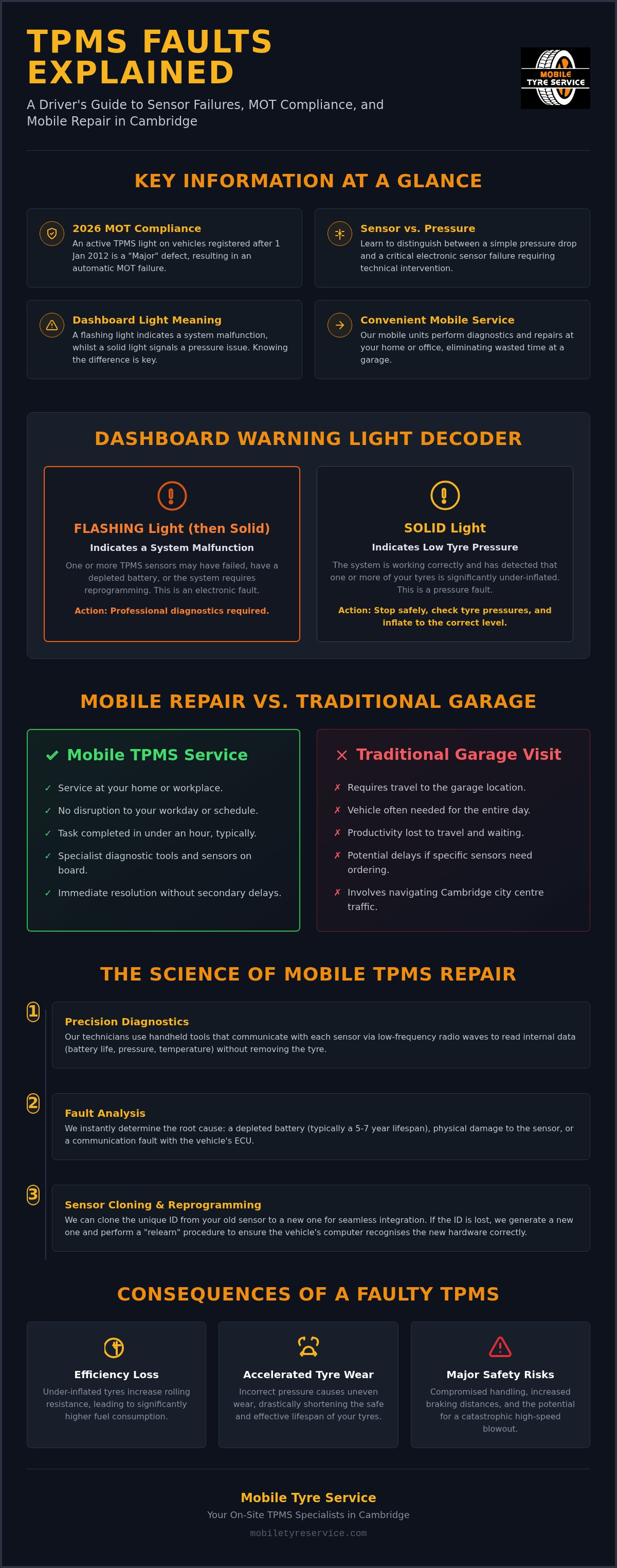
An active warning light is an urgent signal that your vehicle's handling is compromised. Driving with incorrect tyre pressure alters the contact patch with the road, significantly affecting stability whilst cornering and increasing braking distances. The risks extend beyond simple handling:
- Efficiency Loss: Under-inflated tyres create higher rolling resistance, leading to increased fuel consumption.
- Accelerated Wear: Incorrect pressure causes uneven wear patterns, shortening the lifespan of your tyres.
- Safety Risks: A faulty sensor can mask a genuine slow puncture, potentially causing a high-speed blowout.
Why Traditional Garage Visits Disrupt Your Day
Navigating the logistical bottleneck of Cambridge city centre to reach a traditional garage is a significant drain on your productivity. Most garages require you to drop your vehicle off for the entire day, often for a task that takes our specialised units under an hour. Generalist workshops often do not maintain a comprehensive inventory of specific sensors, leading to secondary delays whilst parts are ordered. Our mobile TPMS repair Cambridge service operates as a first responder unit. We arrive at your location with the necessary diagnostic equipment and replacement sensors already on board, allowing you to remain at your desk whilst we restore your vehicle to peak safety standards.
The Science of TPMS: How Professional Mobile Technicians Diagnose Failure
Effective mobile TPMS repair Cambridge requires more than a standard toolkit; it demands a high-precision mobile laboratory. Our technicians utilise specialised handheld diagnostic tools that communicate with each wheel's sensor through low-frequency radio waves. This equipment allows us to read internal data without removing the tyre. We can instantly determine if a fault is caused by a depleted battery, which typically lasts 5 to 7 years, or a physical fracture in the sensor body. Many budget services fail to diagnose these nuances, leading to unnecessary replacements or recurring dashboard alerts.
A critical distinction exists between resetting a system and reprogramming it. Whilst a reset simply clears the warning light, reprogramming involves writing a specific protocol to the sensor's internal chip. We offer sensor cloning, where we copy the unique ID of your failing sensor onto a new unit. This prevents the vehicle's Electronic Control Unit (ECU) from detecting a change, maintaining system stability. If the original ID is lost, we generate a new one and perform a technical relearn procedure. This ensures the car's computer correctly acknowledges the new hardware. For a reliable, technical solution at your location, you can book a specialist TPMS mobile technician today.
Precision extends to the physical installation. Sensor valves are delicate components that require torque-sensitive handling. We use calibrated torque wrenches to secure the retaining nut to the manufacturer’s exact specifications, usually between 4 and 8 Newton-metres. Over-tightening can crack the sensor housing, whilst under-tightening leads to slow air leaks. This methodical approach ensures the mechanical seal is as robust as the electronic programming.
On-Site Sensor Programming and Calibration
Our mobile units are equipped to handle the entire software handshake on your driveway. This calibration ensures all four sensors operate with perfect parity, preventing false triggers. We verify that the pressure and temperature data being transmitted matches the actual conditions within the tyre assembly. This level of technical exactness is what separates a professional intervention from a basic roadside fix.
High-Precision Care for Premium and Electric Vehicles
Vehicles frequently seen around the Cambridge Science Park, including high-performance German marques and modern Electric Vehicles (EVs), require specific TPMS protocols. EVs often use tyres with specialised internal foam for noise reduction, which can interfere with standard sensor placement. We use premium, vehicle-specific components rather than generic alternatives that often fail to communicate with sophisticated onboard computers. Our technicians understand the sensitive electronics in EV tyre assemblies and treat every component with the required technical discipline.
Comparing Mobile TPMS Repair vs. Traditional Garage Visits in Cambridge
Choosing mobile TPMS repair Cambridge shifts the logistical burden from the driver to the technician. Traditional garage models require you to navigate the congested radial routes into the city centre, often resulting in a minimum two-hour commitment for a simple sensor replacement. By contrast, our mobile intervention force eliminates the transit phase entirely. You avoid the specific bottleneck of the Trumpington high street or the slow-moving traffic around Cherry Hinton. We perform the technical work on your driveway or in your office car park, ensuring your vehicle is safe without interrupting your professional obligations.
The Cambridge Commuter Advantage
Our service is strategically positioned to support the city’s primary employment hubs. Whether you are based at the Cambridge Science Park, Addenbrooke’s Hospital, or within the central business district, we provide a seamless technical response. You don't need to brave the M11 and A14 interchange for a minor electronic fault. This flexible scheduling allows you to attend board meetings or manage school runs whilst we execute the repair. The "waiting room" experience is replaced by continued productivity in the comfort of your own environment.
Cost-effectiveness involves more than just the service fee. When you factor in the fuel consumed during city centre transit and the value of your billable hours, the mobile approach is the superior financial choice. There is also a significant transparency benefit. At a traditional garage, your vehicle disappears into a workshop bay. With our mobile TPMS repair Cambridge service, you observe the precise diagnostic and installation process at your own location. This visibility builds confidence that the work meets our elite technical standards.
Specialised Equipment: The Mobile Laboratory
Our vehicles are not merely delivery vans; they are fully equipped mobile laboratories. We carry a comprehensive inventory of multi-protocol sensors that cover the vast majority of the UK car parc. This readiness ensures we can resolve faults for diverse marques on the first visit. Static garage bays often lack the specific handheld diagnostic tools required for rapid TPMS interrogation. Our mobile units possess the same, and often superior, diagnostic accuracy as fixed facilities. We arrive prepared to programme, fit, and relearn your system in a single, high-precision operation.
Identifying TPMS Symptoms: When to Call an Elite Mobile Technician
Your dashboard provides specific visual cues that dictate the urgency of a technical response. Understanding these protocols is vital for maintaining vehicle safety and avoiding mobile TPMS repair Cambridge delays. A solid amber icon typically signals a critical pressure variance. If the alert remains active after manual inflation at a petrol station, the sensor likely suffers from a calibration fault. A flashing light signals a system malfunction. This sequence usually flashes for 60 to 90 seconds before remaining solid, indicating the vehicle’s computer has lost contact with one or more sensors. This is a technical failure that requires immediate diagnostic intervention.
Intermittent warnings are a classic symptom of a failing sensor battery. These batteries are sealed units and cannot be replaced independently. Once the voltage drops below a functional threshold, the sensor transmits erratic signals to the ECU. You might also notice inaccurate pressure readings where your manual gauge contradicts the dashboard display. Physical damage is another common trigger. Kerbing incidents, which are frequent in the narrow streets of the city centre, often fracture the brittle aluminium valve stems found on many premium vehicles. If you suspect physical or electronic damage, request a mobile diagnostic inspection to prevent further system degradation.
Pre-MOT TPMS Health Checks
Scheduling a technical review 48 hours before an MOT is a strategic move for any Cambridge driver. Since a malfunctioning TPMS is a Major defect, an active light guarantees an immediate failure. Our mobile TPMS repair Cambridge service identifies and resolves these issues at your location, saving you from the frustration of a failed test. We also clear ghost codes; these are historical error messages stored in the vehicle's ECU that can keep a warning light active even after the physical fault is rectified. This proactive approach ensures your vehicle passes the inspection without unnecessary re-test fees.
Post-Tyre Change Complications
It's common for a warning light to appear immediately after a standard tyre fitting if the technician was not trained in TPMS protocols. Sensors can be physically bumped during the bead-breaking process, or the system might require a manual recalibration if the tyres were rotated to different corners. Our mobile TPMS sensor service ensures your safety systems are flawlessly synchronised. We perform the necessary relearn procedures to ensure the ECU understands the new position of every sensor. This high-precision approach guarantees that your dashboard accurately reflects the real-world condition of your tyres, providing the peace of mind required for long-distance commuting.
Specialist Mobile TPMS Services by Mobile Tyre Service: Your Cambridge Response Unit
Mobile Tyre Service operates as a dedicated technical unit, specifically engineered to provide on-site excellence. We don't function as a generalist workshop; we are a specialised intervention force for electronic tyre systems. Our mobile TPMS repair Cambridge service bridges the gap between complex vehicle electronics and the need for immediate, roadside resolution. Every technician is trained to execute high-precision sensor installations with the clockwork efficiency of a first responder. We eliminate the need for traditional garage infrastructure by bringing a complete diagnostic suite directly to your vehicle's location.
Our rapid response capability ensures that urgent sensor failures are addressed with minimal delay. We understand that a "Major" MOT defect or a flashing dashboard alert is a high-stakes situation for any driver. By maintaining a constant state of readiness, we provide a premium experience that prioritises technical mastery over social pleasantries. You receive an authoritative solution that restores your vehicle's safety architecture whilst you remain in control of your day. This systematic approach ensures that every intervention is final, precise, and technically beyond reproach.
Serving the Greater Cambridge Area
Our logistical reach covers the entire Greater Cambridge region, extending from the technology hubs in Newmarket to the residential developments in Cambourne. We provide comprehensive support to all surrounding villages, ensuring that rural drivers receive the same high-tier technical service as those in the city centre. This regional dominance extends into Essex, where our mobile units maintain a consistent standard of elite performance. Booking your technical intervention is a streamlined process designed for efficiency. You can secure a specialist technician in under two minutes, initiating a rapid deployment to your home or workplace.
The Mobile Tyre Service Guarantee of Precision
Precision is the core of our operation. We utilise a systematic approach to sensor programming, ensuring that every electronic handshake between the sensor and the ECU is verified. This commitment to accuracy is why we are the preferred choice for Cambridge’s most discerning drivers, particularly those operating premium marques and electric vehicles. We do not compromise on hardware quality or diagnostic depth. Our technicians ensure that every retaining nut is torqued to specification and every sensor ID is correctly mapped. Ensure your vehicle’s safety systems are functioning perfectly today by engaging our specialised response unit for your next mobile TPMS repair Cambridge.
Restore Your Vehicle's Electronic Integrity Today
Maintaining your vehicle's safety architecture shouldn't require a compromise on your professional productivity. We've established that an active TPMS light is a major MOT defect in 2026; it also signals a critical failure in your tyre's real-time monitoring system. Our technicians eliminate this risk by providing a technical solution at your home or workplace. By choosing a specialised mobile TPMS repair Cambridge service, you gain access to laboratory-grade diagnostic equipment and expert calibration without the logistical burden of a city centre garage visit.
Our response units are perpetually prepared to handle complex sensor programming and MOT-compliant sensor calibration for all modern marques, including high-performance and electric vehicles. We provide a systematic, high-precision intervention that ensures your vehicle remains safe and legally compliant on the A14 and M11. Don't let an amber warning light disrupt your schedule or jeopardise your next inspection. Our expert technicians serving Cambridge and Essex are ready to restore your system with absolute accuracy and technical mastery. Secure your site visit today to ensure your vehicle is road-ready and technically beyond reproach.
Book Your Professional Mobile TPMS Repair in Cambridge Now
Frequently Asked Questions
Is it legal to drive with the TPMS light on in the UK?
It is not strictly illegal to drive with the light on, but it is a Major defect for vehicles registered after 1 January 2012. This results in an automatic MOT failure. Beyond the legalities, the light signifies a compromise in your vehicle's safety architecture. Ignoring the warning leaves you vulnerable to slow punctures or sudden blowouts on routes like the A14. We recommend a technical intervention as soon as the alert activates.
Can a mobile tyre fitter replace a TPMS sensor on my driveway?
Our specialised mobile units are equipped with the handheld diagnostic tools required to perform this task at your home or workplace. We don't just fit the hardware; we programme the sensor to your vehicle's ECU on-site. This eliminates the need for a city centre garage visit. Our mobile TPMS repair Cambridge service handles the entire process, including the technical relearn procedure, whilst your car remains parked on your driveway.
How much does a mobile TPMS sensor replacement cost in Cambridge?
Costs for a mobile intervention vary based on your vehicle's specific make and the complexity of the required sensor programming. Factors such as whether you require a single sensor replacement or a full set of four also influence the final investment. Whilst we don't provide fixed pricing here, our service includes the sensor hardware, professional on-site fitting, and electronic calibration. This approach is often more cost-effective than taking time off work for a garage visit.
How long does it take to repair or replace a tyre pressure sensor?
A standard sensor replacement typically takes between 30 and 45 minutes per wheel. This duration includes the physical installation of the new valve and the subsequent electronic handshake with your vehicle's onboard computer. More complex systems that require a driving relearn might take slightly longer to fully synchronise. Our technicians work with disciplined efficiency to ensure your vehicle is safe and MOT-compliant without causing significant disruption to your daily schedule.
Will a new TPMS sensor need to be programmed to my car?
Every new direct TPMS sensor must be electronically introduced to the vehicle’s Electronic Control Unit (ECU). Without this programming, the car won't recognise the new hardware, and the warning light will remain active. We use specialised diagnostic tablets to clone your existing sensor ID or generate a new one. This ensures the dashboard accurately reflects the real-time pressure data from the specific wheel where the new sensor is installed.
Can I just replace the battery in my TPMS sensor?
TPMS sensor batteries are sealed within the unit's thermoplastic housing to protect them from moisture and centrifugal force. They are not designed to be serviceable. When the battery reaches the end of its five-to-seven-year lifespan, the entire sensor unit must be replaced. Attempting to cut open the casing to swap a battery usually destroys the delicate circuitry inside. We provide high-precision replacements that restore the full electronic integrity of your monitoring system.
Does my car have direct or indirect TPMS?
Direct systems use physical sensors mounted behind the tyre valve to measure pressure and temperature. Indirect systems calculate pressure estimates based on wheel rotation speed via the ABS sensors. You can often tell the difference by checking the valve stems; metal stems with a retaining nut usually indicate a direct system. Our mobile TPMS repair Cambridge technicians can instantly identify your system using a handheld scanner, ensuring the correct technical approach for your specific vehicle.
What happens if I ignore a faulty TPMS sensor before an MOT?
Ignoring a faulty sensor ensures your vehicle will fail its MOT test if it was registered after 2012. The DVSA classifies a malfunctioning monitoring system as a Major defect. Beyond the administrative failure, a faulty sensor might mask a genuine pressure loss, leading to accelerated tyre wear or a high-speed blowout. Resolving the fault on-site before your test date is the most efficient way to ensure your vehicle remains legal and safe for the road.
Need a mobile tyre service?
We cover Harlow, Bishop's Stortford, Cambridge and all surrounding areas — 24/7.
Call: 01279 881234