Is It Safe to Drive on a Slow Puncture? Risks and Expert Advice
Every time you top up a leaking tyre at a petrol station air pump, you are gambling against a catastrophic high-speed blowout. Many motorists treat gradual pressure loss as a minor nuisance, routinely asking: is it safe to drive on a slow puncture if you keep adding air? The technical reality is unc…
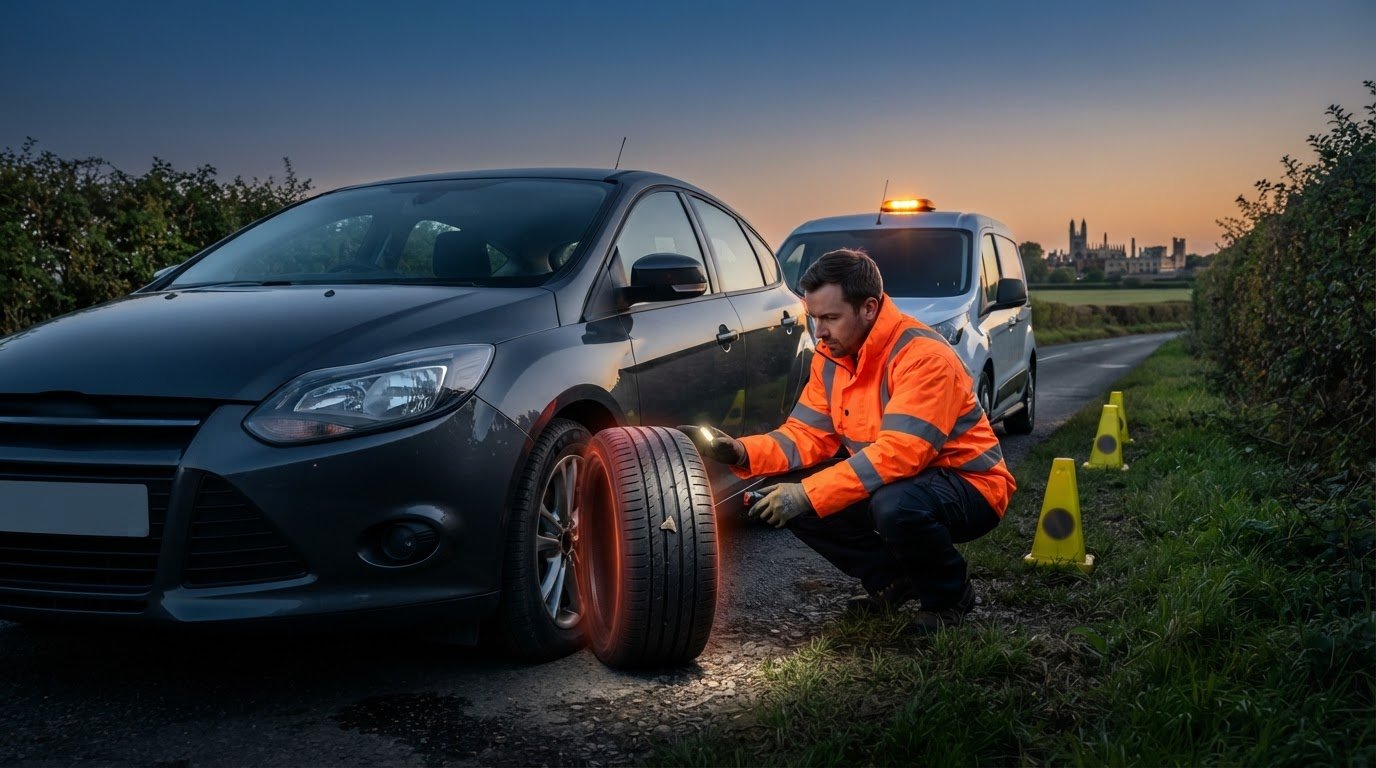
Every time you top up a leaking tyre at a petrol station air pump, you are gambling against a catastrophic high-speed blowout. Many motorists treat gradual pressure loss as a minor nuisance, routinely asking: is it safe to drive on a slow puncture if you keep adding air? The technical reality is uncompromising. A slow puncture isn't a stable condition; it's an active structural failure that progressively weakens the internal casing with every turn of the wheel.
We understand why drivers delay action. Nobody wants to lose productive work hours sitting in a conventional garage waiting room, especially when you are uncertain whether the puncture is legally repairable or demands an outright replacement. However, continuing to travel on an underinflated tyre quickly converts straightforward, mendable tread damage into irreparable sidewall degradation.
This guide explains the immediate structural hazards of driving on declining pressure, outlines the legal boundaries governing puncture repairs, and reveals convenient on-site resolution methods that restore road readiness without the hazard of driving to a workshop.
Key Takeaways
- Understand why driving on a slow puncture is fundamentally unsafe and how continuous pressure loss degrades vehicle braking and steering control.
- Discover the definitive answer to whether is it safe to drive on a slow puncture over distance, avoiding irreversible internal tyre damage.
- Learn to differentiate between embedded road debris, bead seat corrosion, and faulty valve stems to identify the precise origin of air leaks.
- Identify early warning indicators, including dashboard TPMS illuminations and directional tracking drift, before catastrophic casing failure occurs.
- Explore how dedicated on-site mobile tyre repairs and replacements eliminate the dangerous journey to a traditional garage depot.
Is It Safe to Drive on a Slow Puncture? The Critical Verdict
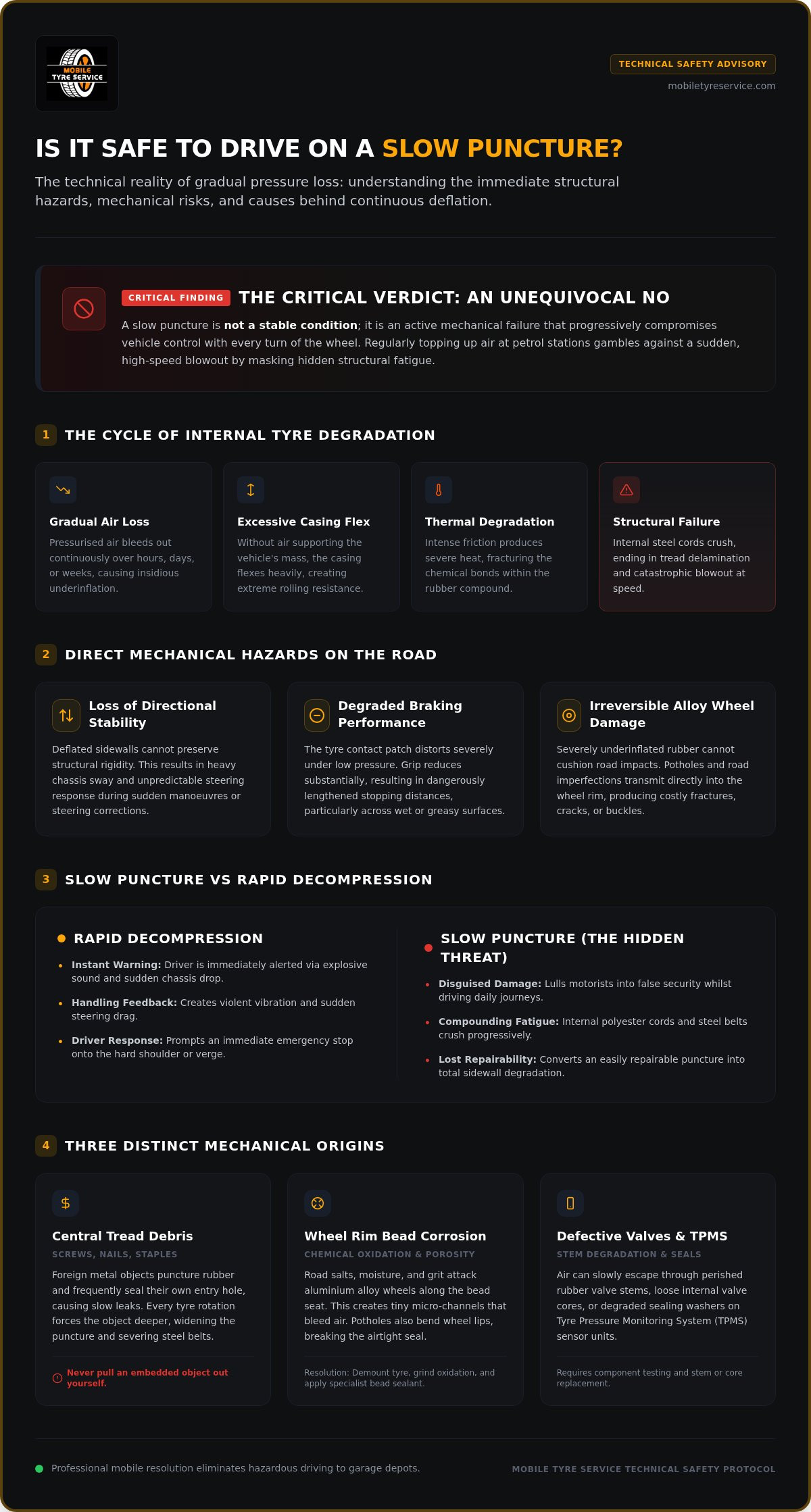
Driving on a slow puncture is fundamentally unsafe and immediately compromises vehicle control. A slow puncture is defined as a gradual, continuous escape of pressurised air that causes insidious tyre underinflation over hours, days, or weeks. Motorists often wonder: is it safe to drive on a slow puncture if the tyre appears visually intact? The answer is an unequivocal no. As internal pressure steadily drops, the tyre carcass deforms, impairing your vehicle's braking efficiency and unpredictable steering response on wet surfaces.
Operating a vehicle on underinflated rubber creates excessive friction and heat. That thermal stress fractures the rubber's chemical bonds, leading directly to sudden structural tread delamination at carriageway speeds. Routine tire maintenance standards require maintaining exact manufacturer pressure levels; failing to do so turns a minor mechanical issue into an active road hazard.
The Immediate Mechanical Dangers of Underinflated Motoring
Underinflated tyres generate extreme rolling resistance. Without adequate air pressure supporting the vehicle's mass, the casing flexes excessively, triggering dangerous thermal degradation across the internal structure. Consider these direct mechanical hazards:
- Loss of directional stability: Deflated sidewalls cannot maintain structural rigidity, causing severe chassis sway during sudden steering corrections.
- Degraded braking performance: The contact patch distorts, reducing tyre grip and lengthening stopping distances on wet or greasy road surfaces.
- Alloy wheel damage: Severely underinflated rubber allows road impacts to transmit directly into the wheel rim, causing costly cracks or buckles.
Slow Punctures vs Rapid Decompression: Understanding the Difference
Rapid decompression announces itself instantly. A sudden blowout alerts the driver through explosive noise, immediate steering drag, and violent vibration, forcing an immediate pull-over into the hard shoulder or verge. Slow punctures, by contrast, disguise their damage over extended journeys.
This subtle air leak lulls drivers into an unfounded sense of security. Whilst you continue normal daily driving, hidden structural fatigue compounds within the tyre's internal framework. Persistent flexing crushes the internal polyester cords and steel belts. By the time pressure falls low enough for you to notice handling changes, internal carcass damage is often total, transforming a repairable tyre into an irrecoverable safety liability.
Common Causes of Slow Punctures: From Debris to Valve Failure
Identifying the root cause of pressure loss is the first step toward restoring vehicle safety. Drivers dealing with gradual deflation often wonder is it safe to drive on a slow puncture if the tyre simply needs air every few days. The answer remains no. Driving on low pressure produces aggressive internal friction that crushes the sidewall structure within miles, quickly transforming a repairable leak into total tyre failure. Slow punctures originate from several distinct mechanical vulnerabilities across the wheel assembly.
Embedded Road Debris in the Central Tread Area
Screws, nails, and industrial staples discarded across Essex carriageways routinely impale the central tread. As the metal penetrates the rubber, it often seals its own entrance wound, allowing air to escape at a negligible rate. However, every tyre rotation forces the foreign object deeper into the carcass, expanding the internal hole. Safety authorities consistently warn about the dangers of underinflated tires caused by unaddressed punctures, as continuous tread movement weakens the surrounding steel belts. Crucially, never pull an embedded screw or nail out yourself; doing so triggers rapid depressurisation and immobilises your vehicle immediately.
Wheel Rim Bead Corrosion and Rim Porosity
Punctures do not always stem from foreign sharp objects. Winter grit, moisture, and road de-icing salts relentlessly attack aluminium alloy wheels, inducing chemical oxidation along the bead seat where the tyre lip seats against the rim. This bead corrosion creates tiny channels that allow air to bleed out continuously. Pothole strikes compound the issue by bending the wheel lip or causing hairline alloy fractures. Remedying this requires demounting the tyre, grinding away surface oxidation, and applying heavy bead sealant to re-establish an airtight mechanical join.
Defective Valves and Compromised TPMS Sensor Units
The valve assembly represents another common source of slow air escape. Standard rubber valve stems degrade over time through ultraviolet radiation and ozone exposure, developing microscopic stress cracks that open under centrifugal force. Alternatively, internal valve cores can corrode or loosen. Modern vehicles also utilise electronic tyre pressure sensors secured with delicate aluminium stems and rubber seals that perish with age. You can arrange a mobile TPMS sensor service to test, rebuild, or replace malfunctioning valve units on your driveway without risking your tyres on the road.
If your tyre loses pressure consistently, relying on weekly top-ups accelerates structural breakdown. Professional inspection via a dedicated mobile tyre service ensures the precise leak source is diagnosed safely before the tyre suffers irreversible internal damage.
Warning Signs: How to Spot a Slow Puncture Before Catastrophic Failure
Catching deflation early prevents irreversible wheel assembly failure. While modern dashboards alert drivers to systemic pressure loss, tactile feedback through the steering wheel often signals danger first. Motorists frequently ask themselves is it safe to drive on a slow puncture if the vehicle still handles smoothly on dual carriageways. Ignoring early physical cues turns an isolated repair into roadside structural collapse. Recognizing precise warning indicators safeguards your vehicle before internal sidewall cords shred completely.
A pressure variance between paired tyres on the same axle is your clearest indicator. Checking cold tyres before your first morning trip delivers true baseline readings. If one front tyre shows 32 PSI whilst the opposite corner drops to 28 PSI, you face an active slow puncture rather than ambient temperature fluctuations. Thermal expansion during travel disguises this pressure loss; hot motorway runs can temporarily elevate readings by 3 to 5 PSI, concealing critical morning deflation.
Interpreting Dashboard TPMS Alerts Accurately
Factory Tyre Pressure Monitoring Systems operate with conservative thresholds. Most dashboard TPMS lamps illuminate only after internal chamber pressure plunges by 20 to 25 percent below the vehicle's calibrated baseline. By the time that amber icon appears on your cluster, the tyre is severely compromised. Intermittent warnings on cold mornings reveal pressure hovering directly at the failure boundary. Never clear the TPMS light through the vehicle infotainment screen without physically inflating the tyre and inspecting the rubber. Resetting the sensor blinds you to escalating carcass deflation.
Physical and Tactile Vehicle Symptoms on the Road
Mechanical feedback through the chassis reveals structural loss long before a visual tyre bulge develops. Watch for these progressive warning signs during travel:
- Directional steering pull: The vehicle drifts toward the side with the compromised tyre on level, straight asphalt.
- Sluggish front-end steering: Low pressure on the front axle produces spongy, heavy steering input during low-speed cornering.
- Rear-axle instability: A soft rear tyre creates an unsettled, wandering sensation through fast corners, mimicking worn suspension bushes.
- Rhythmic acoustic ticking: Sharp metallic debris embedded in the outer tread blocks produces an audible, cyclic clicking that accelerates with road speed.
Persistent rhythmic vibrations through the floorboards or steering column indicate tyre carcass distortion under load. When these physical symptoms accompany pressure drops, continuous operation destroys the internal casing. At this stage, wondering is it safe to drive on a slow puncture to reach a distant workshop is moot; the mechanical integrity of the tyre is actively failing beneath you.
Suspected Slow Puncture: Step-by-Step Protocol
When you suspect tyre deflation, immediate triage protects both your vehicle and other road users. Pull over safely on firm, level ground away from live traffic lanes. Switch off the ignition, engage the handbrake, and locate your vehicle's tyre placard on the driver-side door pillar. Motorists frequently ask is it safe to drive on a slow puncture to reach the nearest forecourt air machine. Undertaking that short journey on an unverified tyre can cause the inner liner to pinch against the wheel rim, rendering an otherwise repairable casing scrap.
Emergency Assessment and Pressure Monitoring Steps
Follow a structured diagnostic process before making travel decisions:
- Take cold digital readings: Measure all four wheels with a calibrated gauge and record the figures.
- Conduct a stationary check: Allow the car to stand for 90 to 120 minutes, then re-measure. A drop exceeding 2 PSI indicates an active leak.
- Examine the tread face: Roll the car forward slowly to inspect the entire circumference for screws, glass shards, or visible sidewall bulges.
- Cease motorway travel: Never join high-speed dual carriageways or motorways with a tyre that cannot hold its specified cold pressure.
Understanding British Standard BS AU 159 Repair Feasibility
Tyre repairs in the UK must strictly comply with British Standard BS AU 159. This regulation ensures structural safety after an intervention. A tyre is legally repairable only if the entry hole sits within the central 60 to 70 percent of the tread width, known as the minor repair zone. Punctures located on the tyre shoulder or sidewall are unrepairable; these dynamic flex zones undergo extreme cornering stress that causes patches to delaminate.
Additionally, damage must not exceed 6 millimetres in diameter. Internal cords must remain completely intact without run-flat heat scorching or tread separation. Complying with these standards requires unmounting the tyre from the wheel to complete a mandatory internal carcass inspection. If you want to review the logistics of professional repairs without travelling, review our helpful mobile tyre repair cost guidance to explore compliant mobile solutions.
The Hazard of Tyre Sealant Gunk Cans
Aerosol emergency tyre inflator cans offer tempting convenience, but they carry significant drawbacks. The liquid sealant coats the inner carcass with sticky latex residue, often preventing technician cleaning and making standard vulcanised mushroom plug repairs impossible. Chemical sealants can also clog delicate sensor ports, turning a simple puncture into an expensive replacement job. Instead of contaminating your wheel assembly, book an emergency mobile tyre repair to resolve the issue correctly right at your location.
Professional Mobile Resolution: Safe Tyre Solutions at Your Doorstep
Forced journeys to static fitting bays represent the primary reason repairable slow punctures turn into scrapped tyres. When motorists question is it safe to drive on a slow puncture just a few miles down the road, they frequently overlook the mechanical reality. Rolling on a compromised carcass crushes the internal radial cords between the rim flange and the road surface, generating scorched rubber shavings inside the airtight chamber. Eliminating transit completely is the only reliable way to preserve the tyre for permanent restoration.
Specialised mobile tyre response units resolve this challenge by deploying workshop-grade tooling directly to your stationary vehicle. Rather than taking time off work or risking a motorway blowout, you receive expert intervention on your private driveway, office car park, or safe roadside location.
Why On-Site Puncture Repair Protects Your Tyre and Wheel
Stationary triage preserves structural viability. Mobile technicians demount the wheel assembly, separate the tyre from the alloy, and conduct an uncompromising internal casing inspection. Under British Standard BS AU 159 regulations, external plug repairs applied from the outside are unsafe and non-compliant. An on-site technical evaluation checks for:
- Internal liner integrity: Verifying zero rubber dust or scorch rings caused by low-pressure friction.
- Penetration trajectory: Ensuring the puncture angle allows an internal vulcanised mushroom patch to seal both the tread and steel belts.
- Alloy sealing surface health: Inspecting the wheel bead seats for salt corrosion or impact deformations that cause secondary air leaks.
If the puncture sits within legal parameters, the technician cleans, reams, and vulcanises the wound on-site. Should the tyre exhibit shoulder damage or run-flat casing fatigue, the technician transitions immediately to a new tyre fitting without stranding you.
Rapid Mobile Tyre Services Across Essex and Cambridge
Mobile Tyre Service maintains fully equipped mobile service vans operating across key transit routes and residential communities throughout Essex and Cambridge. Each custom-built unit functions as a self-contained fitting station, carrying heavy-duty pneumatic bead breakers, precision computerised dynamic wheel balancers, and a broad range of replacement tyres.
On-site visits cover complete technical execution. Technicians fit fresh rubber valves, re-balance the entire wheel assembly to eliminate steering shimmy, and carry out professional TPMS sensor diagnostics. Whether resetting electronic sensors, rebuilding corroded valve stems, or replacing unrepairable covers, mobile tyre intervention guarantees roadworthiness without demanding that you pilot a compromised vehicle through hazardous commuter traffic. The definitive answer to whether is it safe to drive on a slow puncture remains clear: leave the vehicle parked, preserve the internal carcass, and allow dedicated mobile specialists to handle the rectification on-site.
Protect Your Wheel Assemblies and Secure Your Journey
Operating a vehicle on declining air pressure invites active mechanical failure. While motorists persistently question whether is it safe to drive on a slow puncture just to complete their daily commute, running on underinflated rubber continuously grinds internal ply cords into scrap. Tolerating slow leaks also degrades stopping performance and risks sudden tread detachment at speed. Resolving pressure loss early protects your wheel rims, satisfies British Standard BS AU 159 compliance, and keeps you entirely clear of dangerous high-speed blowouts.
You don't need to risk driving a compromised vehicle to a traditional tyre depot or waste productive hours waiting in tyre bay lounges. Our fully equipped mobile response vans bring workshop-grade tooling straight to your home driveway or workplace, delivering prompt tyre fitting, precision puncture repairs, and electronic TPMS sensor diagnostics across Essex and Cambridge.
Keep your journey safe without unnecessary road hazards. Book our rapid mobile tyre technicians to inspect your tyre safely at home and restore complete road confidence right at your doorstep.
Frequently Asked Questions
Can I drive on a slow puncture if I pump it up regularly?
No, pumping up a punctured tyre regularly does not make driving safe. While reinflating restores lost pressure temporarily, structural degradation accelerates every mile you travel. Rolling resistance generates excessive internal friction, breaking down the rubber compound and steel cords. This cycle weakens the tyre casing until it suffers sudden delamination or complete depressurisation on high-speed dual carriageways.
How far can I safely drive with a slow puncture?
You should only drive a slow puncture as far as necessary to clear active traffic and reach an immediate place of safety. Driving multiple miles to a workshop ruins the tyre liner against the wheel rim. When wondering is it safe to drive on a slow puncture across routine commutes, remember that prolonged rotation transforms a repairable penetration into an unfixable structural write-off.
What happens if you ignore a slow puncture over several weeks?
Ignoring a slow puncture ruins the tyre casing, damages the alloy wheel, and compromises braking safety. Underinflation concentrates vehicle weight onto the outer tread shoulders, generating severe irregular wear. Continued road impacts bend bare rim lips without adequate air cushioning. Eventually, internal heat build-up causes the tread band to detach entirely, risking vehicle control on busy Essex and Cambridge transit routes.
Can a slow puncture turn into a sudden tyre blowout?
Yes, slow punctures frequently trigger explosive tyre blowouts. Deflated tyres flex excessively under load, generating extreme internal heat that weakens structural adhesives between the rubber and cord belts. Once internal pressure drops below critical operational limits, the thinned casing shears apart under high-speed motorway stress, inducing immediate decompression without advance tactile warning.
Is it illegal to drive with a slow puncture under UK law?
Driving on a severely underinflated tyre violates Regulation 27 of the Road Vehicles (Construction and Use) Regulations 1986. Under the Road Traffic Act 1988, operating a vehicle with defective or dangerously underinflated tyres carries fines of up to £2,500 and three penalty points per illegal wheel. Police officers can issue prohibitions immediately if structural cords are exposed or vehicle handling is compromised.
How much does it usually take for a slow puncture to go flat?
A slow puncture typically deflates a tyre over several hours to multiple weeks, depending on the leak source. An embedded screw might release only 1 to 3 PSI weekly, whereas bead corrosion or a failing valve core can purge 10 PSI overnight. Ambient temperature drops during cold mornings accelerate this pressure drop significantly.
Can all slow punctures be repaired instead of replaced?
No, punctures must strictly satisfy British Standard BS AU 159 criteria to qualify for repair. The damage must sit within the central 60 to 70 percent minor repair zone and measure under 6mm in diameter. Punctures located on tyre shoulders, sidewalls, or tyres run below minimum pressures must be replaced immediately. If you are unsure is it safe to drive on a slow puncture to a garage, on-site mobile inspection resolves the question safely.
Does emergency tyre foam permanently fix a slow puncture?
No, aerosol tyre sealant provides an emergency temporary measure designed solely to reach immediate assistance. The expanding liquid chemical coats the inner liner in sticky residue, which often prevents vulcanised mushroom plug bonding later. It can also clog valve stems and TPMS sensor apertures, turning an affordable repair into a complex component replacement.
Need a mobile tyre service?
We cover Harlow, Bishop's Stortford, Cambridge and all surrounding areas — 24/7.
Call: 01279 881234