How to Deal with a Flat Tyre with a Baby in the Car: A Safe 2026 Guide
The tyre can wait; your baby’s safety cannot. If you’re wondering how to deal with a flat tyre with baby in car, first focus on getting the vehicle and everyone inside away from moving traffic. A sudden loss of pressure is stressful, but you don’t need to decide whether to change the tyre until you’…

The tyre can wait; your baby’s safety cannot. If you’re wondering how to deal with a flat tyre with baby in car, first focus on getting the vehicle and everyone inside away from moving traffic. A sudden loss of pressure is stressful, but you don’t need to decide whether to change the tyre until you’ve assessed the location and immediate risks.
It’s natural to feel pressure to get moving again, especially if your baby is unsettled or the weather is poor. Don’t attempt a tyre change beside busy traffic with your baby on board. If you’re in immediate danger, contact the emergency services. Otherwise, arrange appropriate roadside assistance and follow current Highway Code guidance for your situation.
This guide explains what to do first, how to judge whether it’s safe to stay in the vehicle or move to a safer place, and when to call for help. You’ll also learn what vehicle, tyre and location details to provide when arranging mobile tyre assistance, so you can make a clear plan without taking unnecessary risks. If you’re in Essex or Cambridge, the same safety steps apply before you check whether mobile tyre help is available for your location.
Key Takeaways
- When deciding how to deal with a flat tyre with baby in car, put people and a safer stopping place before the tyre.
- Keep your baby away from traffic and never leave them unattended in the vehicle. Assess whether there’s a safe exit route before moving.
- Only consider changing the wheel if the vehicle, ground and location make it safe. Moving traffic and unstable ground can put everyone at risk.
- When arranging tyre help, give your exact location, vehicle details, tyre size if visible and a clear description of the damage. Mention your baby and any access or safety constraints.
- Once the location is safe, a mobile tyre professional may be able to assess repair or replacement on site, depending on access and availability.
Flat tyre with a baby in the car: what to do first
Prioritise people and the stopping place, not changing the tyre. If you’re working out how to deal with a flat tyre with baby in car, stay calm, keep both hands on the wheel and avoid sudden braking or steering. Your first aim is to bring the vehicle under control and stop somewhere safer, away from moving traffic if possible.
Take these steps in order:
- Slow down smoothly. Ease off the accelerator and steer steadily. Avoid abrupt movements that could make the vehicle harder to control.
- Move only as far as needed. If you can carefully reach a safer place off the carriageway, such as a nearby car park or other suitable stopping area, do so. Don’t continue driving on a visibly damaged or deflated tyre to reach a distant destination.
- Secure the vehicle. Once stopped, apply the parking brake and switch on the hazard warning lights when appropriate. Follow current official roadside instructions for your location.
- Assess the immediate risk. If anyone is injured, the vehicle is in a dangerous position, or you face an immediate threat from traffic, contact emergency services on 999 or 112.
How to stop safely when a tyre loses pressure
A stopping place away from the carriageway puts more distance between you and passing vehicles than a live lane or exposed roadside position. If you can safely reach a better place, avoid stopping somewhere that leaves the car vulnerable. The type and condition of the tyre matter too: check your vehicle handbook before relying on a spare, since spare tyres can have different uses and limitations. Don’t drive on a deflated tyre simply because the next exit or service area seems close.
What to do if you stop on a motorway
Motorway procedures depend on where you’ve stopped and the conditions around you. Follow the current Highway Code and National Highways guidance for your exact location, including instructions for a hard shoulder or emergency area. Check official guidance before deciding whether it’s safe to leave the vehicle or where to wait. If you can’t move to a safer position, or traffic puts you or your baby at immediate risk, call emergency services.
A roadside wheel change beside moving traffic isn’t an appropriate default. Even if the vehicle carries a spare, changing a wheel can expose you and your baby to passing vehicles or unstable ground. Don’t start until the location is confirmed safe and you can follow the relevant official guidance. If it isn’t safe, wait for appropriate help rather than taking unnecessary risks.
Keep your baby safe while you assess the roadside situation
Once the vehicle has stopped, keep your baby away from traffic and with a responsible adult. A car seat can restrain a child during a journey, but it isn’t a safe place to leave a baby unattended while you assess the situation or seek help. If you’re alone, don’t leave your baby in the vehicle to inspect the tyre or make a call from elsewhere.
A tyre problem never makes a live traffic lane safe. Don’t unbuckle or carry your baby beside moving traffic. Consider your exact position, nearby barriers, the weather and whether there’s a safe route away from the carriageway. If the vehicle is exposed or you’re uncertain what to do, follow instructions from emergency services or the relevant roadside authority.
Should you take the baby out of the car?
There’s no single answer for every breakdown. Leaving the vehicle may create risk if the exit opens towards traffic or there’s no protected place to go. Staying inside may also be unsafe in an exposed position. Don’t open a door or lift your baby out beside moving vehicles. Assess the exit side and route first, and follow current UK official guidance or direct instructions from emergency services if the vehicle is in danger.
Keeping a child secure and supervised
Keep your baby with you or another responsible adult, and away from the carriageway. Never treat the car seat as a reason to leave them alone. If a safe, protected place is available, move there only when the route is clear and it’s safe to do so. Once immediate traffic risks are addressed, check whether your baby needs warmth, a change of clothing or essentials such as nappies and wipes.
If you’re waiting for help, keep your attention on your baby and the surrounding conditions. Don’t start a wheel change simply to reduce the wait. Guidance from the American Automobile Association on how to change a tyre safely explains the general process, but it isn’t UK roadside guidance and doesn’t make an exposed location safe. Follow local official instructions and don’t work beside moving traffic.
When you and your baby are in a safe, accessible place, contact a provider to ask whether mobile tyre repair or fitting is suitable for your location and vehicle. Give clear access and safety details so the provider can assess the situation before agreeing next steps.
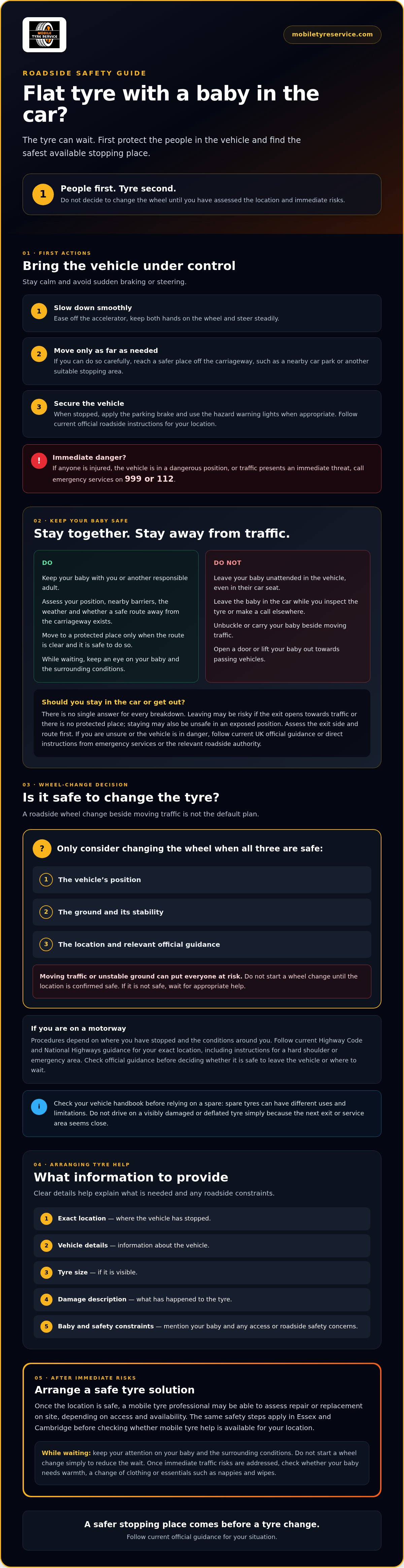
Can you change a flat tyre with a baby in the car?
Only consider changing the wheel when the location, vehicle and conditions make the job safe. Having a spare, jack or tyre repair kit doesn’t make an exposed roadside position safe. If you’re deciding how to deal with a flat tyre with baby in car, weigh the danger of working outside the vehicle against the benefit of getting the tyre changed immediately. If traffic, ground conditions or visibility create doubt, don’t begin.
A wheel change means working beside the vehicle and handling equipment on the ground. Passing traffic, a narrow verge or a slope can make it difficult to work securely. Your baby’s presence adds another practical concern: you must not leave them unsupervised or put them in a position exposed to traffic while you work. Follow the vehicle manufacturer’s instructions and official roadside guidance, and seek professional or emergency help if the car can’t be reached safely.
When not to attempt a roadside wheel change
Do not attempt a change beside moving traffic, on a narrow verge, on unstable or sloping ground, or where poor visibility makes the vehicle hard to see. Stop and seek help if you can’t position the jack as the handbook directs, or can’t keep yourself and your baby away from traffic. A general guide such as these child safety guidelines from the US National Highway Traffic Safety Administration may offer broader child-safety information, but it isn’t UK roadside guidance. Follow current UK instructions for your location.
A repair kit or sealant isn’t the same as a confirmed repair. Suitability depends on the product, the vehicle and the tyre damage, so check the vehicle handbook and kit instructions. A kit may not be appropriate for every puncture or tyre condition, and using it doesn’t establish that the tyre is safe for continued driving. Don’t rely on a temporary product to make an unsafe location safe.
How to judge whether the tyre can be driven on
Don’t continue driving if the tyre is visibly deflated or damaged, or if the vehicle handles unusually, such as pulling to one side or feeling unstable. Don’t assume a short journey or reduced speed is safe. There’s no distance allowance that applies to every damaged tyre. Stop in the safest available place and arrange an assessment.
Once the scene is safe and accessible, a qualified tyre professional can assess whether the tyre is repairable or needs replacement. A mobile tyre professional may be able to assess it at a suitable roadside location, subject to access and availability. Provide the vehicle and tyre details when arranging help, and describe the damage without inspecting it from an exposed position. When on-site tyre fitting isn’t feasible, professional recovery is the safest way to transport your vehicle; for example, drivers in Western Australia can check out Allout Towing for 24-hour car recovery.
Once you’re in a safe position, clear information helps a tyre provider assess whether the location and work are suitable. If you’re unsure how to deal with a flat tyre with baby in car, keep the call focused. Share details you can confirm without leaving your baby or approaching traffic to inspect the vehicle.
Details that help a mobile tyre provider assess the job
Have these details ready if available:
- Exact location: road name, nearby junction or landmark, direction of travel and, where possible, a map pin. Explain whether the vehicle is in a car park, lay-by or roadside position.
- Vehicle details: registration number, make, model and any relevant information from the vehicle handbook.
- Tyre details: size shown on the tyre or vehicle information, if you can read it safely. Mention the type of damage you’ve noticed and whether a spare is fitted, if known.
- Safety and access: say that a baby is with you, describe where the vehicle is stopped, and flag limited access, narrow roads or any other hazard.
Don’t stand in traffic, walk along a live carriageway or lean into an exposed roadside area to find a tyre size or photograph damage. Use information already available in the vehicle or on your phone, and tell the provider when a detail is unknown. An accurate location and an honest description of the scene are more useful than an inspection that puts you at risk.
Before arranging attendance, ask the provider to confirm that the location can be reached safely and that the requested tyre work is within their capability. Attendance and available work depend on the exact location and confirmation. A roadside position may not be suitable for a mobile visit, particularly if access is restricted or the scene remains unsafe. If on-site repair is not possible, arranging professional vehicle recovery becomes essential; for drivers in Queensland, Done Wright Towing & Transport offers reliable towing and vehicle transport when cars cannot safely be fixed at the roadside.
When to contact emergency services instead
A flat tyre without immediate danger is different from an incident involving injury or a vehicle in a dangerous position. If someone is injured, traffic presents an immediate threat, or you can’t reach the vehicle safely, contact the appropriate emergency service for your situation and location. In the UK, call 999 or 112 for an emergency. On a motorway, follow current official instructions and use the designated emergency contact route where applicable.
A tyre-fitting provider isn’t a substitute for emergency services or motorway-response support. Use tyre assistance for the tyre issue only once the scene is safe and the provider has confirmed the location and requested work. For mobile tyre fitting or repair in Essex or Cambridge, check service coverage and availability before relying on attendance.
After the immediate risk: arrange a safe tyre solution
Once your baby and vehicle are in a safer position, follow a clear sequence: protect everyone, secure the location, request suitable help, then deal with the tyre. Knowing how to deal with a flat tyre with baby in car also means resisting pressure to drive on or start a repair before the scene is safe.
A mobile tyre professional may be able to assess the tyre and determine whether repair or replacement is appropriate at a safe, accessible location. The outcome depends on the tyre’s condition and the service that can be confirmed for your vehicle and location. If you’re comparing service considerations, see the mobile tyre repair cost guide. Check current pricing and what’s included directly with the provider.
What happens when a mobile tyre professional arrives?
The technician needs a safe, accessible place to work before starting. They can assess the tyre and explain the available tyre-service options, but a repair, replacement or particular tyre being available can’t be guaranteed in advance. Mobile Tyre Service provides mobile tyre fitting and repair, including roadside work where the location is suitable. It doesn’t provide general mechanical repairs or wheel alignment.
Share relevant vehicle and tyre details, and describe access restrictions when arranging help. If the vehicle remains in a dangerous position or the location isn’t safe to approach, contact the appropriate emergency or roadside authority rather than asking a tyre professional to work in unsafe conditions.
Preparing for the rest of the journey
Before setting off, make sure the tyre issue has been assessed and that the vehicle is safe to move. Follow the technician’s instructions and any relevant authority guidance. Keep your baby supervised and securely restrained for travel, and don’t continue the journey if you’re unsure about the vehicle’s condition. Ask for clarification before leaving if you don’t understand what work has been completed or any limitations that apply.
Mobile Tyre Service’s stated coverage includes Essex and Cambridge, but location and availability must be confirmed. Once you’re in a safe, accessible place, check mobile tyre help for your location.
Keep safety at the centre of your next step
Knowing how to deal with a flat tyre with baby in car starts with one priority: protect your baby and yourself before dealing with the wheel. Stop somewhere safer if you can, follow official roadside instructions, and don’t attempt a change where traffic, poor visibility or unstable ground creates danger.
Once you’re in a safe, accessible place, share your exact location, vehicle details and any tyre information you can confirm when arranging help. A mobile tyre professional may assess the tyre and advise whether repair or replacement is suitable, but the location and service must be confirmed first.
Mobile Tyre Service provides mobile tyre fitting and repair at roadside locations where the work can be safely accessed. Its stated coverage includes Essex and Cambridge, but availability for your exact location needs checking. Check mobile tyre help for your location and confirm the service available for your vehicle.
A flat tyre can disrupt your plans, but a calm, safety-first decision gives you a clear way forward. Keep your baby supervised, follow the right guidance and take the next step only when it’s safe.
Frequently Asked Questions
What should I do first if I get a flat tyre with my baby in the car?
Slow down smoothly and steer towards the safest place you can reach without continuing on a visibly deflated or damaged tyre. Use your hazard warning lights when appropriate, secure the vehicle once stopped and assess immediate danger. Keep your baby supervised and away from traffic. If you’re deciding how to deal with a flat tyre with baby in car, address people and location safety before inspecting or changing the tyre.
Should I take my baby out of the car after a tyre puncture?
It depends on where you’ve stopped and whether there’s a safe exit route to a protected place. Don’t unbuckle or carry your baby beside moving traffic, and don’t leave them unattended in the vehicle. Consider the traffic, barriers, weather and which side of the car opens onto a safer area. If the vehicle is exposed, follow instructions from emergency services or the relevant roadside authority.
Can I change a flat tyre with my baby in the car?
Only consider changing the tyre if the vehicle, ground and location make it safe to work. Don’t attempt a wheel change beside moving traffic, on a narrow verge or on unstable ground. A spare wheel, jack or repair kit doesn’t make a dangerous position safe. Follow the vehicle handbook and official roadside guidance. If you can’t work safely while keeping your baby supervised and away from traffic, arrange appropriate help.
What should I do if I get a flat tyre with a baby on a motorway?
Follow current Highway Code and National Highways instructions for your exact location, such as a hard shoulder or emergency area. Don’t assume it’s safe to leave the vehicle or attempt a wheel change beside moving traffic. If the vehicle is exposed, follow official directions and contact the appropriate emergency or motorway-response service. If there’s immediate danger or someone is injured, call 999 or 112.
Can I drive slowly on a flat tyre to reach a safer place?
Don’t continue driving on a visibly deflated or damaged tyre, or if the vehicle handles unusually. There’s no general distance or speed allowance that makes this safe for every tyre and vehicle. If you can still control the car, move only as far as needed to reach a safer stopping place, without heading for a distant destination. If you can’t move safely, stop and seek suitable assistance.
Can a mobile tyre fitter help if my baby is in the car?
A mobile tyre professional may be able to assess or repair a tyre, or fit a replacement, at a safe and accessible location. Tell the provider that your baby is with you and explain your precise location, vehicle details and any access constraints. They must confirm whether the location and requested work can be served. Mobile Tyre Service covers Essex and Cambridge, but check availability for your exact location.
When should I call 999 for a flat tyre with a baby in the car?
Call 999 if someone is injured, the vehicle is in a dangerous position or you face an immediate threat from traffic or another hazard. A tyre fault alone, with everyone safe and no immediate danger, doesn’t automatically require an emergency call; arrange suitable tyre assistance instead. Give the operator your exact location, explain the danger and mention that a baby is in the car. Follow their instructions and stay on the line as directed.
Need a mobile tyre service?
We cover Harlow, Bishop's Stortford, Cambridge and all surrounding areas — 24/7.
Call: 01279 881234