How to Check Tyre Pressure After Fitting: A Practical Guide
A newly fitted tyre can look ready for the road, but its pressure still needs to match your vehicle’s requirements. Knowing how to check tyre pressure after fitting lets you confirm the reading with a gauge instead of relying on appearance or assumption. The correct figure depends on your vehicle an…
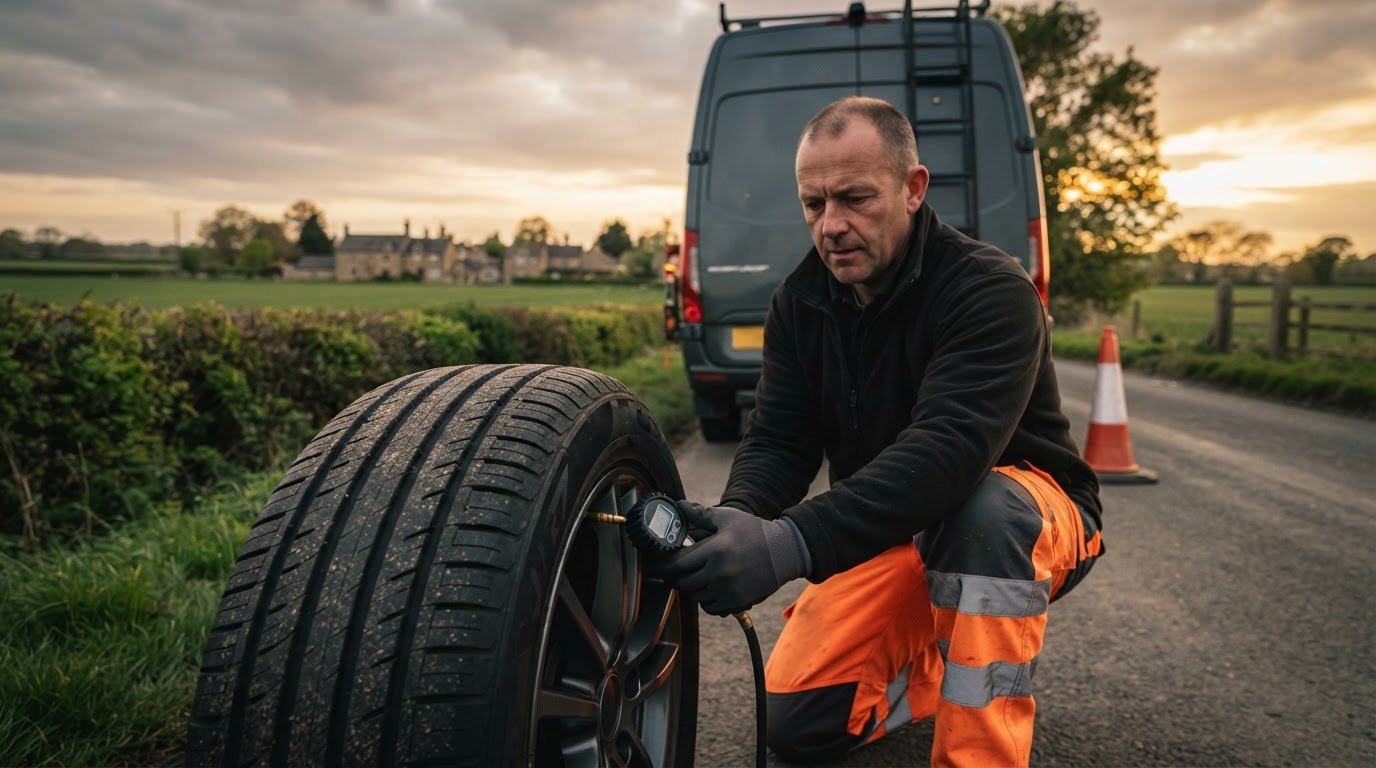
A newly fitted tyre can look ready for the road, but its pressure still needs to match your vehicle’s requirements. Knowing how to check tyre pressure after fitting lets you confirm the reading with a gauge instead of relying on appearance or assumption. The correct figure depends on your vehicle and its load, and a warm tyre can give a different reading from a cold one.
It’s common to be unsure when to check, which figures to use or what to do if a TPMS warning appears after a tyre change. For a reliable comparison, follow your vehicle handbook’s guidance on measuring pressure and use the recommended figure in the handbook or on the vehicle’s pressure label.
This guide explains how to use a suitable gauge, respond to an unexpected reading and interpret a persistent or flashing TPMS warning. It also covers when to seek help from a tyre professional rather than continue driving with an unresolved concern.
Key Takeaways
- Learn how to check tyre pressure after fitting with a suitable gauge and compare the result with your vehicle’s specified figure.
- Follow the handbook’s guidance on when and how to measure, so you can make a meaningful comparison before adjusting pressure.
- Check an unexpected reading under the right conditions before assuming the tyre was fitted incorrectly.
- If a TPMS warning appears, check the relevant tyre pressures before considering a reset. A persistent warning may need professional attention.
- Know when a routine check is enough and when a tyre concern at home or roadside calls for a mobile tyre professional.
Why check tyre pressure after fitting, even when a professional fitted the tyre?
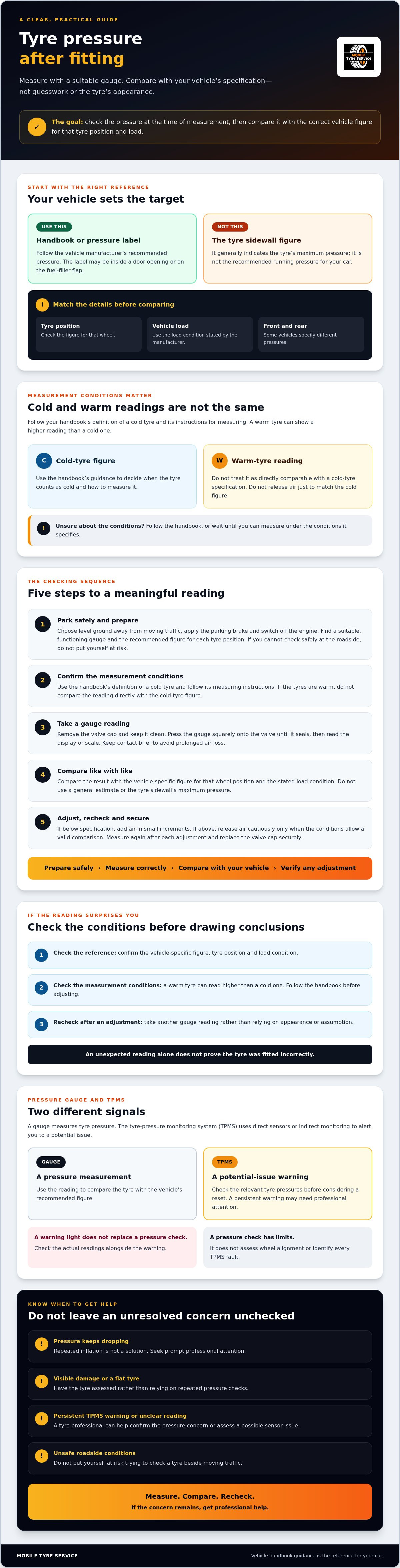
Checking a newly fitted tyre doesn’t mean repeating the fitting work or assuming something went wrong. It confirms whether the pressure matches your vehicle’s specification. A post-fitting pressure check compares a gauge reading with the vehicle specification, giving you a measurement rather than relying on appearance or a dashboard alert.
The figure on the tyre sidewall isn’t the recommended running pressure for your car. It generally indicates the tyre’s maximum pressure, so using it as your target could lead to incorrect inflation. Use the vehicle’s own guidance instead. A gauge reading and a TPMS warning also serve different purposes: the gauge measures pressure, while the Tire-pressure monitoring system (TPMS) uses direct sensors or indirect monitoring to alert you to a potential issue. Neither a pressure check nor a warning light assesses wheel alignment or identifies every TPMS fault.
Where to find the correct pressure for your car
Check the vehicle handbook or the manufacturer’s pressure label. Depending on the vehicle, the label may be inside a door opening or the fuel-filler flap. Match the recommended pressure to the correct tyre position and vehicle load. Some vehicles specify different pressures for the front and rear tyres, or for heavier loads.
Why a newly fitted tyre still deserves a check
A straightforward check gives you a useful baseline without suggesting that the fitter made an error. The reading shows the pressure at the time you measured it. A TPMS warning is a separate signal that needs interpreting alongside the actual readings. If pressure keeps dropping, or you notice visible damage or a flat tyre, don’t treat repeated inflation as a solution. Seek prompt professional attention.
If you’re unsure how to check tyre pressure after fitting, start with the vehicle specification and a suitable pressure gauge. A check can show that pressure needs correcting, but it can’t establish why pressure is being lost or confirm that a sensor is working properly. If a warning remains after you’ve checked the tyres, or the reading is unclear, contact a tyre professional. A persistent warning may involve the sensor, while a pressure concern may need the tyre itself assessed.
How to check tyre pressure after fitting: a step-by-step method
Follow these steps to check the fitted tyre and compare its pressure with your vehicle’s requirements. Use the handbook’s guidance for measuring pressure, particularly if the tyres have been driven on and are warm. Warm tyres can show a higher reading than cold tyres, so don’t release air simply to match a cold-tyre figure. For general background on inflation checks, see the NHTSA tire safety information. Your vehicle manufacturer’s figures remain the reference for your car.
- Park safely and prepare. Choose level ground away from moving traffic, apply the parking brake and switch off the engine. If you’re at the roadside and can’t check safely, don’t put yourself at risk. Take out a suitable, functioning pressure gauge and find the recommended pressure for each tyre position.
- Confirm the right measurement conditions. Follow the handbook’s definition of a cold tyre and its instructions for measuring. If the tyres are warm, don’t treat the reading as directly comparable with the cold-tyre specification or let air out just to reach that figure. If necessary, wait until you can follow the handbook’s stated conditions.
- Remove the valve cap and take a reading. Unscrew the cap carefully and keep it somewhere clean. Press the gauge squarely onto the valve until it seals, then read the display or scale. The gauge connects to the tyre valve and shows the air pressure inside the tyre. Keep the contact brief to avoid prolonged air loss.
- Compare like with like. Check the reading against the vehicle-specific figure for that wheel position and the load condition stated by the manufacturer. Don’t substitute a general pressure estimate or the maximum pressure marked on the tyre sidewall.
- Adjust, recheck and secure. If the reading is below specification, add air in small increments. If it’s above specification, release air cautiously, but only when the measurement conditions allow a valid comparison with the target. Measure again after each adjustment, then replace the valve cap securely. Repeat for each tyre that needs checking.
This is the practical method for how to check tyre pressure after fitting: prepare safely, measure under the right conditions, compare with the correct vehicle figure and verify any adjustment with another reading. If the gauge is difficult to use or the result remains unclear, a tyre professional can help confirm the pressure. For practical support with a tyre at home or roadside, explore mobile tyre fitting and repair.
What should you do if the new tyre pressure reading is wrong?
A reading that differs from the vehicle specification doesn’t automatically mean the tyre was fitted incorrectly. Before drawing a conclusion, check that you used the correct figure for that tyre position and load, followed the handbook’s measurement guidance and used a reliable gauge. Temperature matters too: a warm tyre can show a higher pressure than a cold one. The vehicle’s handling and load also affect how a reading should be interpreted. The NHTSA tire safety guide offers general guidance, but your vehicle handbook takes precedence for the correct pressure and measurement conditions.
If the reading is slightly above or below the specified figure, make a measured adjustment only when the tyres are in conditions that allow a fair comparison with the handbook’s target. Add or release air gradually, then check again with the same gauge. Don’t use a general pressure value or an adjustment rule that conflicts with the vehicle instructions.
| What you find | What to do |
|---|---|
| Below specification | Confirm the correct figure and measurement conditions, add air as directed by the vehicle guidance, then measure again. |
| Above specification | Check that the tyre isn’t warm before adjusting. If conditions are suitable, release air cautiously and recheck against the vehicle figure. |
| Pressure repeatedly falls | Arrange a professional assessment rather than relying on repeated inflation. |
If pressure is above or below the vehicle specification
Make one careful adjustment, then repeat the measurement with the same gauge. If the reading remains uncertain or the valve looks damaged, contact the fitter or a tyre professional for advice. One unexpected reading is a reason to verify the conditions and measurement, not proof of a fitting fault.
If the tyre keeps losing pressure
Repeated pressure loss needs investigation. Visible damage, rapid pressure loss or a tyre that looks deflated are reasons not to drive on it. Seek professional advice about a safe next step. Don’t keep topping it up and assume the underlying problem has been resolved. A qualified tyre professional can assess the tyre and advise whether it can be repaired or needs replacement.
If you’re in Essex or Cambridge and a tyre concern at home or roadside needs attention, consider mobile tyre fitting or repair. A professional can assess a persistent issue when a pressure check alone hasn’t resolved it.
How to interpret a TPMS warning after a tyre has been fitted
A TPMS warning after a tyre change is a prompt to check the tyres, not a pressure measurement. A tyre can look normal and still be under-inflated, so don’t rely on appearance or the warning light alone. Use a suitable gauge to check every relevant tyre against the vehicle’s specification before considering a system reset.
The light’s behaviour can offer a clue, but it can’t confirm the cause. A steady warning may indicate a pressure issue, while a flashing warning can point to a TPMS fault. These behaviours vary between vehicles, so consult the handbook for your model’s warning indicators and instructions.
Pressure warning or possible TPMS sensor issue?
Start by checking the pressures. If one or more readings are outside the specified figures, follow the vehicle guidance to correct them, then see whether the warning changes. If all readings match but the alert remains, the problem may involve the monitoring system or a sensor. That doesn’t establish that a sensor was damaged during fitting, and a pressure check alone can’t diagnose the fault. Follow the handbook’s next steps and seek a professional TPMS assessment if the warning persists.
What to confirm after the pressure check
Before resetting anything, work through these checks:
- Measure all relevant tyres, including those not replaced, and compare each with the correct vehicle figure for its position and load.
- Make sure the readings were taken under the measurement conditions stated in the handbook.
- Follow the handbook’s specific reset or relearning procedure, if one is required.
Reset procedures differ. Some systems may update automatically, while others require a manual action or a specific process. Don’t assume that driving a particular distance will clear every warning. If the handbook’s procedure doesn’t resolve the alert, arrange a professional assessment rather than repeatedly resetting the system.
This is the key principle in how to check tyre pressure after fitting: verify the actual readings first, then use the vehicle handbook to interpret and respond to the warning. If the pressures are correct but the alert remains, contact us about a mobile TPMS sensor service.
When to call a mobile tyre fitter after checking pressure
A routine pressure check is usually straightforward if the tyre looks intact, holds pressure and the gauge reading matches the vehicle’s specification. But the check has limits. It can’t establish why pressure is falling, confirm the tyre’s internal condition or resolve every TPMS warning. If the reading remains unclear after you’ve checked the handbook and repeated the measurement correctly, seek professional advice instead of guessing or repeatedly adjusting the pressure.
Signs a pressure check is not enough
Take visible damage, rapid pressure loss or a tyre that appears deflated seriously. Stop in a safe place and avoid further driving if the tyre may be unsafe. Arrange professional help instead. Repeated inflation isn’t a substitute for finding the cause. A tyre professional can assess whether the concern calls for tyre repair or replacement. Tyre fitting and repair are separate from mechanical repairs or wheel alignment, so contact the appropriate specialist for those issues.
Get local tyre support in Essex or Cambridge
For tyre concerns at home or roadside, Mobile Tyre Service provides mobile tyre fitting, mobile tyre repair and mobile TPMS sensor services in Essex and Cambridge. If you’re considering a repair, check the service details and ask about the mobile tyre repair cost for your situation. Not every tyre is suitable for repair. If the issue may involve a sensor, explain what the warning is doing and which pressure checks you’ve completed so the concern can be assessed appropriately.
Knowing how to check tyre pressure after fitting helps you identify a straightforward pressure adjustment, but it doesn’t replace an inspection when a tyre is damaged, losing pressure or still triggering a warning. If you need support with a tyre at home or roadside, Arrange mobile tyre support.
Make your next pressure check with confidence
A reliable post-fitting check brings together three things: a pressure reading from a suitable gauge, the correct vehicle specification and any TPMS warning. Follow the handbook’s guidance on measurement conditions and load, then investigate further if pressure keeps falling or a warning remains after you’ve followed the vehicle’s instructions.
Knowing how to check tyre pressure after fitting helps you spot a reading that needs attention. Visible damage, a rapidly deflating tyre or an unresolved sensor warning calls for professional assessment. Don’t continue driving if the tyre may be unsafe.
For tyre concerns at home or roadside, Mobile Tyre Service provides mobile tyre fitting and repair, as well as on-site TPMS sensor services in Essex and Cambridge. If practical support would help, arrange mobile tyre support in Essex or Cambridge. Use the right check, then seek help if a tyre or sensor concern remains unresolved.
Frequently Asked Questions
Should I check tyre pressure immediately after a tyre has been fitted?
You can check it, but follow your vehicle handbook’s instructions on when to measure for a comparable reading. Tyres that have been driven on may be warm, which can affect the result. For a reliable post-fitting check, use a gauge and compare the reading with the correct vehicle specification under the stated conditions. Don’t assume the fitting was incorrect because of one reading taken in unsuitable conditions.
How do I find the correct tyre pressure for my car?
Use the pressure information in your vehicle handbook or on the manufacturer’s label, which may be inside a door opening or the fuel-filler flap. Check the figures for the specific tyre position and load condition, as front and rear pressures or loaded-vehicle recommendations may differ. Don’t use the maximum pressure marked on the tyre sidewall as your car’s recommended running pressure.
Can I check tyre pressure when the tyres are warm?
Yes, but a warm-tyre reading may be higher than a cold-tyre reading. Follow your handbook’s measurement guidance before deciding whether pressure needs adjusting. Don’t release air simply to make a warm tyre match a cold-tyre target. If you can’t compare the reading reliably under the specified conditions, check again when those conditions are met, following the vehicle manufacturer’s instructions.
What should I do if a newly fitted tyre keeps losing pressure?
Arrange a tyre professional’s assessment rather than repeatedly adding air without investigating the cause. Check for visible damage, a damaged valve or a tyre that appears deflated, but don’t attempt to drive on a tyre that may be unsafe. If you notice rapid pressure loss or damage, stop somewhere safe and seek advice on the next step. A pressure reading alone can’t identify the cause.
Why is my TPMS warning light still on after tyre fitting?
First check the pressures of all relevant tyres with a gauge and compare each reading with the vehicle specification. If they’re correct, the warning may relate to the monitoring system or a sensor, but the light alone can’t confirm the cause. Follow your handbook’s instructions for any reset or relearning procedure. If the warning remains, seek professional TPMS assessment, including mobile sensor support in Essex or Cambridge if appropriate.
Can I drive with a low tyre pressure warning after fitting?
Don’t ignore the warning. Stop somewhere safe and check the tyre condition and pressures as soon as it’s safe to do so. If a tyre looks deflated, is visibly damaged or is losing pressure rapidly, don’t continue driving on it. Seek professional help. If there’s no visible concern, use the vehicle handbook to guide your next step and don’t rely on the warning light as a pressure measurement.
Does a tyre fitter check the pressure after fitting a tyre?
A fitter may inflate a tyre during fitting, but don’t assume what was checked or which vehicle setting was used. Ask the fitter if you’re unsure, then confirm the pressure against your vehicle handbook or manufacturer’s label. A gauge check gives you a reading to compare with the specified figure. Mobile Tyre Service provides mobile fitting, repair and TPMS sensor services in Essex and Cambridge.
Need a mobile tyre service?
We cover Harlow, Bishop's Stortford, Cambridge and all surrounding areas — 24/7.
Call: 01279 881234