Fleet Tyre Support Essex: The 2026 Commercial Fleet Guide
Bridgestone research reveals that whilst 90% of commercial operators routinely inspect their tyres, low pressure still triggers nearly 30% of all roadside breakdowns. When a commercial vehicle suffers sudden tread failure along critical freight corridors like the A12 or A127, the damage extends well…
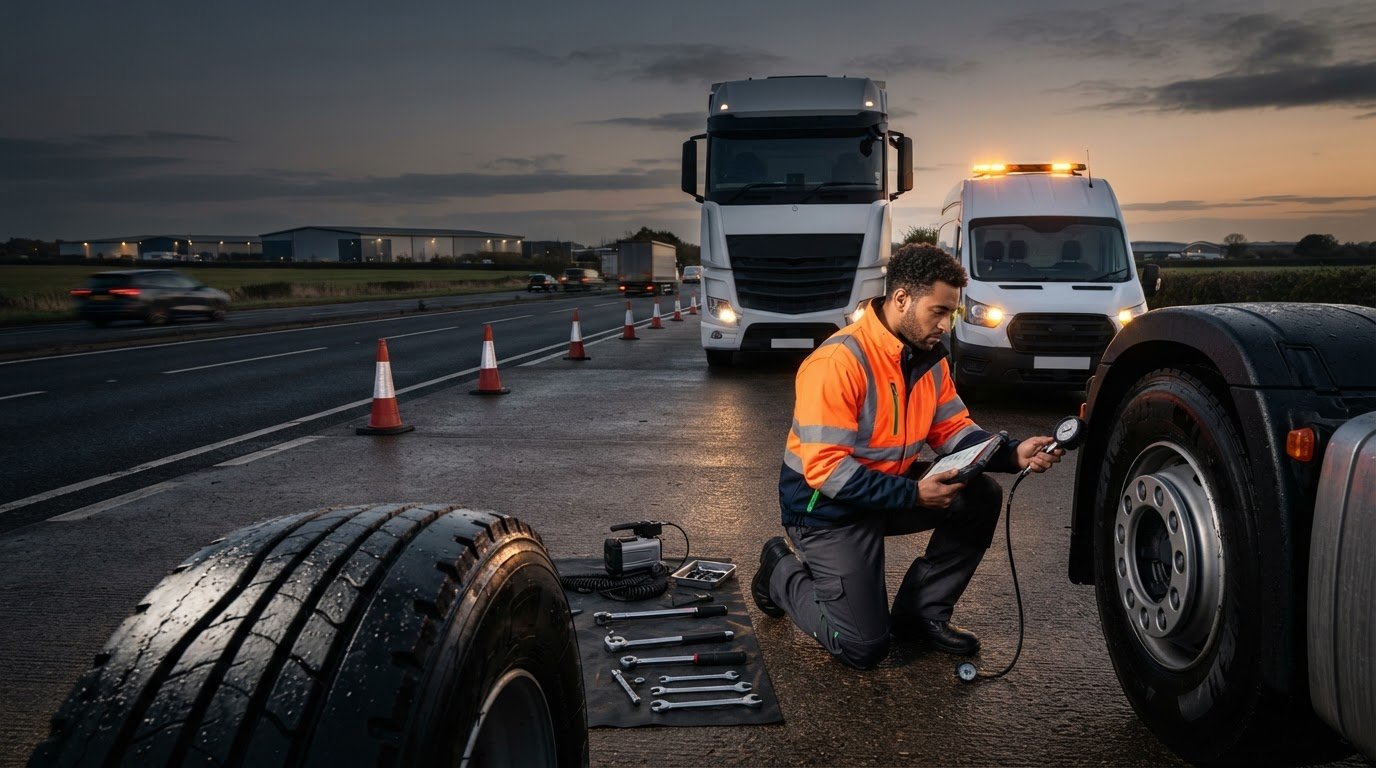
Bridgestone research reveals that whilst 90% of commercial operators routinely inspect their tyres, low pressure still triggers nearly 30% of all roadside breakdowns. When a commercial vehicle suffers sudden tread failure along critical freight corridors like the A12 or A127, the damage extends well beyond rubber; it instantly halts delivery operations and burns billable driver hours. Securing dependable fleet tyre support Essex transport managers can rely on has become vital for maintaining commercial resilience.
You already understand the frustration of losing valuable driver hours to static tyre-fitting centres, not to mention the operational stress of roadside compliance checks that risk fines of up to £2,500 per defective tyre. Discover how dedicated mobile fleet tyre support across Essex eliminates vehicle downtime and safeguards operational efficiency. This 2026 fleet guide examines scheduled yard maintenance, mobile TPMS sensor diagnostics, and rapid roadside dispatch strategies designed to keep your commercial assets moving.
Key Takeaways
- Learn how scheduled mobile tyre fitting directly at commercial yards eliminates wasted driver transit hours and preserves scheduled delivery slots.
- Identify the core technical standards required when evaluating fleet tyre support Essex providers to ensure uninterrupted freight transit along the A12 and A127.
- Review British Standard BS AU 159 criteria to determine whether commercial casing damage permits an on-site repair or mandates immediate replacement.
- Discover how on-site TPMS sensor diagnostics protect your commercial vehicles from fuel inefficiencies and costly roadside compliance penalties.
- Establish an organised preventative maintenance strategy that transforms sudden roadside failures into controlled, scheduled depot uptime.
Why Dedicated Fleet Tyre Support in Essex Is Vital for Modern Operations
Commercial transport operators face unrelenting schedule constraints across the regional logistics network. Dedicated fleet tyre support Essex operations rely on is not merely an on-call emergency service; it is a systematic programme combining scheduled depot maintenance with precision mobile response. Commercial vehicles navigating routes like the Dartford Crossing corridor or the port links around Harwich and Tilbury endure heavy axle loads, unpredictable debris, and stop-start congestion that accelerate casing wear. Unplanned tread failures trigger severe knock-on effects, converting single-vehicle delays into missed logistics windows and customer service penalties.
The True Operational Cost of Commercial Fleet Downtime
Static tyre workshops drain transport efficiency. Directing an operational van to a high-street tyre centre forces your business to swallow paid driver transit hours, unproductive fuel expenditure, and postponed drop schedules. Effective fleet management requires eliminating depot-to-garage transit entirely. Mobile technicians service commercial assets directly at your depot or during loading windows, preserving core operational time.
- Driver Productivity: Staff remain focused on distribution rather than queuing at fitting centres.
- Contract Security: Maintaining scheduled departure slots prevents late-delivery penalties and protects commercial relationships.
- Asset Utilisation: Routine yard audits catch casing splits and irregular wear patterns before vans leave the perimeter, converting breakdown crises into planned maintenance.
Duty of Care and Commercial Vehicle Compliance Standards
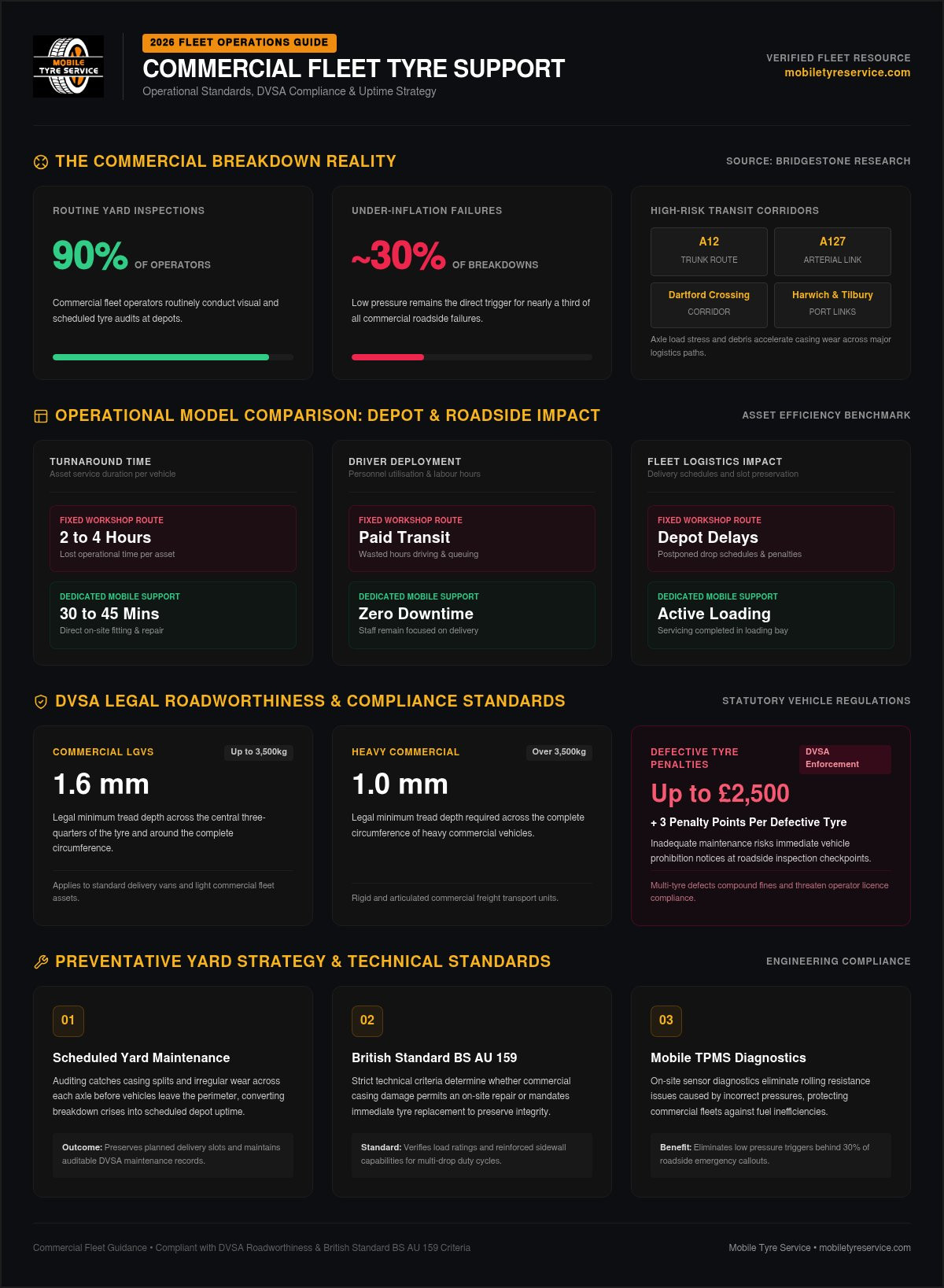
Roadworthiness compliance is a legal necessity overseen by the Driver and Vehicle Standards Agency (DVSA). Commercial vans and light goods vehicles up to 3,500kg must strictly maintain a legal minimum tread depth of 1.6mm across the central three-quarters of the tyre and around the complete circumference. For heavy commercial vehicles over 3,500kg, the legal threshold is 1mm. Inadequate maintenance risks immediate vehicle prohibition notices at roadside checkpoints, alongside severe fines reaching up to £2,500 and 3 penalty points per non-compliant tyre.
Dedicated fleet tyre support in Essex delivers systematic compliance auditing. Mobile technicians document tyre health, verify accurate tread wear across each axle, and maintain auditable records that protect operators against regulatory scrutiny and liability risks. For transport operators seeking broader support with statutory roadworthiness and vehicle audit processes, click here to learn more about fleet compliance management.
Key Criteria for Evaluating Essex Fleet Tyre Support Providers
Selecting an operational partner requires scrutinising technical readiness, technician credentials, and inventory depth rather than standard consumer services. Fleet operators must align maintenance regimes with the official Guide to Maintaining Roadworthiness, making verifiable service standards indispensable. Securing dependable fleet tyre support Essex logistics hubs require means assessing providers against strict operational benchmarks.
Mobile Capabilities vs Traditional Fixed-Garage Maintenance
Active loading bays cannot afford obstruction, yet traditional workshops introduce unacceptable logistical drag. High-specification mobile service vans operate self-sufficiently within commercial distribution yards, completing tyre replacements without disrupting site movements.
| Operational Metric | Fixed Workshop Route | Dedicated Mobile Support |
|---|---|---|
| Turnaround Time | 2 to 4 hours lost per asset | 30 to 45 minutes on-site |
| Driver Deployment | Paid driver transit required | Zero driver downtime incurred |
| Fleet Impact | Depot departure delays | Service completed during loading |
Commercial Tyre Inventory Availability and Rapid Sourcing
Commercial light goods vehicles demand high-load-index fitments with reinforced sidewalls capable of handling continuous multi-drop delivery cycles. Reliable mobile partners secure extensive stock profiles across premium, mid-range, and robust budget brands. Immediate inventory sourcing ensures matching tread patterns and correct load ratings are fitted to the correct axle, avoiding delays waiting on specialist parts.
Response Time Guarantees and Roadside Service Agreements
Unscheduled roadside failures require precise deployment protocols and transparent communications. Structured service level agreements define expected dispatch procedures, whilst live technician tracking gives transport coordinators accurate updates to reroute consignments efficiently. Integrating preventative mobile tyre fitting directly into scheduled yard rest periods resolves minor casing defects before roadside failures jeopardise your delivery timetables.
Essential Services: Mobile Tyre Fitting, Rapid Repair, and TPMS Support
High-tempo distribution schedules leave zero room for mechanical compromise. Delivering comprehensive fleet tyre support Essex operators require involves deploying purpose-built mobile units outfitted with precision tyre changers, electronic wheel balancers, and dedicated diagnostic equipment directly to your site. This unified mobile capability addresses routine maintenance, emergency punctures, and digital pressure calibration in a single targeted visit.
Depot and On-Site Mobile Tyre Fitting Protocols
Batch tyre fitments keep assets operational without interrupting active yard movements. Mobile technicians coordinate with yard marshals to service vehicles during scheduled downtime, loading windows, or shift changes. Every commercial tyre replacement follows strict manufacturer procedures; calibrated torque wrenches ensure exact wheel-nut tension, preventing over-tightening or catastrophic hub detachment on long-haul routes.
Safe Roadside Puncture Repairs Under British Standards
Structural integrity cannot be gambled with temporary roadside plugs. Technicians execute minor repairs strictly under British Standard BS AU 159, which defines permissible repair areas limited to the central 60% to 70% of the tyre's tread width. Casing splits or punctures situated on tyre shoulders or sidewalls fail this benchmark completely, requiring instant casing replacement to satisfy official government roadworthiness guidance. For an overview of maintenance considerations, operators can review mobile tyre repair cost factors that shape tyre longevity decisions.
- Central Tread Punctures: Inspected internally and permanently sealed using vulcanised combination plugs.
- Sidewall and Shoulder Perforations: Unsafe for repair under BS AU 159; replacement tyre dispatched immediately.
- Dynamic Wheel Balancing: Completed on-site after every fitting to eliminate vibration, shield wheel bearings, and reduce driver fatigue.
Specialist Mobile TPMS Diagnostics and Sensor Replacements
Tyre pressure discrepancies create silent operational losses. Research shows that significantly underinflated tyres elevate commercial fuel burn by over 2.5% whilst causing premature shoulder wear. Mobile units carry electronic programming tools to scan, reset, and fit direct replacements for failing valve sensors across diverse van architectures. You can assess complete sensor calibration procedures through our mobile TPMS sensor service to safeguard fleet fuel economy and eliminate dashboard warning faults before vehicles embark on delivery runs.
Strategic Essex Coverage: Keeping Commercial Corridors Moving
Essex serves as a vital logistics gateway connecting international shipping terminals and regional distribution centres directly to Greater London. Sustaining continuous movement across this dense transport network requires rapid deployment. Dedicated fleet tyre support Essex dispatchers rely on depends on local mobile technicians stationed near key freight arteries, ready to intervene before minor punctures cause widespread network gridlock.
Primary Transit Routes: M25, A12, A127, and A13 Arteries
Commercial traffic on South East arterial roads faces severe congestion and constant debris hazards. Technicians deploy targeted roadside interventions across these critical routes:
- M25 and Dartford Crossing Approaches: High-density orbital congestion leaves zero margin for disabled vehicles; rapid attendance clears breakdowns before severe tailbacks build.
- A12 Freight Artery: As the primary dual-carriageway connecting London, Brentwood, Chelmsford, and Colchester, high-speed transit increases heat build-up and blowout severity.
- A127 and A13 Logistics Corridors: Serving high-volume industrial estates across Basildon, Southend, and Thurrock, these routes generate frequent puncture hazards from industrial road debris.
Port Logistics and Distribution Hub Support: Tilbury, London Gateway, and Stansted
Maritime ports and air freight distribution hubs demand absolute schedule adherence. Facilities at the Port of Tilbury and DP World London Gateway generate heavy commercial traffic exposed to harsh operational terrain. Industrial dock surfaces and access roads often carry steel swarf, fragmented cargo strapping, and broken pallet hardware that penetrate commercial tread blocks. Simultaneously, courier operations serving London Stansted Airport require pinpoint timing to honour stringent flight-manifest deadlines.
Mobile support teams service commercial vehicles directly within freight consolidation yards, haulage compounds, and staging bays. Technicians complete casing swaps and pressure calibrations while vehicles undergo loading, preventing dispatch interruptions entirely. To eliminate transit delays and protect delivery slots across your operating routes, secure dedicated mobile tyre support for your commercial fleet today.
Partnering with Mobile Tyre Service for Professional Essex Fleet Care
Ad-hoc tyre replacements disrupt logistical control. Commercial transport operators require an organised mobile partner that treats tyre upkeep as a predictable operational science rather than an unplanned crisis. Mobile Tyre Service acts as an integrated field partner, providing dedicated fleet tyre support Essex businesses rely on to safeguard schedule integrity, driver hours, and operating margins.
The Mobile Tyre Service Fleet Partnership Process
Establishing an account transitions your commercial operation into a structured maintenance framework designed around vehicle availability:
- Step 1: Commercial Asset Audit: Technicians survey your fleet profile, logging exact tyre dimensions, commercial load indices, speed ratings, and operating duties across all light goods and commercial vehicles.
- Step 2: Service Protocol Configuration: Your account establishes clear service criteria, defining depot access windows for scheduled batch maintenance and priority response workflows for road emergencies.
- Step 3: Preventative Inspection Setup: Regular on-site evaluations identify irregular wear patterns, low tread depths, and faulty valve hardware during loading cycles or resting periods.
- Step 4: Precision Mobile Deployment: Purpose-built mobile units arrive directly at your yard, compound, or breakdown coordinate to complete fittings and repairs with zero disruption to warehouse operations.
Direct Commercial Benefits for Essex Fleet Operators
Partnering with a mobile specialist generates immediate operational returns across multiple business metrics:
- Zero Paid Transit Hours: Commercial assets stay on-site. Drivers never spend billable working hours navigating traffic to wait in public garage waiting rooms.
- Optimised Fuel Economy: Consistent tyre pressure checks and calibrated valve diagnostics ensure rolling resistance remains low, protecting heavy delivery routes from excessive diesel or battery burn.
- Priority Network Mobilisation: When road debris disables an asset along major transport links, dedicated mobile vans deploy promptly to restore vehicle mobility.
Operating a delivery fleet in Essex demands robust vehicle availability and total safety compliance. Contact Mobile Tyre Service today to schedule an initial commercial fleet assessment, streamline your tyre management programme, and keep your vehicles rolling without delay.
Safeguard Fleet Continuity Across Essex Distribution Networks
Maintaining an efficient commercial haulage operation leaves no margin for unexpected roadside blowouts or unpaid driver downtime at static tyre garages. Moving your maintenance strategy from reactive emergency calls to scheduled mobile interventions protects operational revenue, driver welfare, and statutory roadworthiness standards across every vehicle in your fleet. Dedicated mobile workshops deliver heavy commercial tyre fitting directly to your compound, whilst specialist on-site TPMS sensor diagnostic, replacement, and programming tools prevent minor pressure losses from escalating into costly roadside failures.
Our fleet technicians maintain comprehensive coverage across strategic logistics parks and critical transport arteries, including the M25, A12, and A127 corridors. Partner with Mobile Tyre Service for expert fleet tyre support across Essex to permanently eliminate depot-to-garage transit hours, secure commercial compliance, and keep your distribution schedule running with clockwork reliability.
Frequently Asked Questions
How quickly can a mobile tyre service attend an emergency fleet puncture in Essex?
Technician dispatch depends on your vehicle coordinates and traffic conditions across key corridors like the A12, A127, and M25. Fleet accounts establish priority dispatch criteria to minimise roadside downtime across regional distribution hubs. Mobile technicians receive direct location routing through operational control, ensuring response vans arrive promptly with the exact commercial replacement tyre size and load rating required.
Can mobile tyre technicians fit new tyres directly at our commercial depot or yard?
Yes, mobile tyre vans operate as self-contained fitting workshops that complete replacements directly at your operating compound. Technicians schedule batch tyre changes around your loading rotas, driver rest periods, or evening staging times. This on-site depot execution eliminates unproductive driver transit hours to static tyre bays, ensuring your delivery assets remain parked only when planned.
What types of commercial fleet vehicles do your mobile tyre units support?
Mobile units support a comprehensive range of commercial fleets across Essex and Cambridge, including car-derived delivery vans, commercial panel vans, and light goods vehicles up to 3.5 tonnes. Technicians carry heavy-duty commercial tyres specifically rated for high axle payloads, multi-drop stop-start cycles, and intensive courier delivery operations.
Is it possible to repair a commercial van puncture at the roadside instead of replacing the tyre?
Yes, technicians execute permanent repairs provided the casing damage adheres to British Standard BS AU 159. The technician removes the tyre to inspect internal belts and seals punctures situated within the central 60% to 70% of the tread face. Any punctures located on the tyre shoulder or sidewall cannot be safely repaired and require immediate tyre replacement.
Why is mobile TPMS sensor servicing necessary for commercial fleet vehicles?
Underinflated tyres increase commercial fuel consumption by over 2.5% and accelerate irregular shoulder wear. Mobile tyre technicians carry electronic diagnostic tools directly to your yard to test valve frequencies, reset warning lights, and programme new direct-fit TPMS sensors on-site. Routine sensor servicing prevents unexpected roadside tyre pressure loss and keeps digital vehicle telemetry fully compliant.
How does scheduled on-site mobile tyre maintenance reduce overall fleet running costs?
Investing in scheduled fleet tyre support Essex businesses rely on eliminates paid driver hours spent idling at high-street tyre centres. Periodic yard tyre audits identify slow punctures, valve corrosion, and improper inflation before they cause high-speed blowouts. Proactive on-site servicing extends commercial tyre lifespan, protects expensive wheel hubs, and significantly reduces fuel burn across all operational delivery routes.
Do commercial fleet tyres need to comply with different legal requirements than domestic car tyres?
Compliance depends strictly on commercial vehicle weight classifications. Vans and light commercial vehicles up to 3,500kg must maintain a minimum tread depth of 1.6mm across the central three-quarters of the tyre and around the entire circumference. Commercial vehicles exceeding 3,500kg operate under a 1.0mm minimum threshold. Operating below legal limits exposes commercial drivers and fleet owners to fines reaching up to £2,500 per tyre.
Need a mobile tyre service?
We cover Harlow, Bishop's Stortford, Cambridge and all surrounding areas — 24/7.
Call: 01279 881234