Flat Tyre at Home: What to Do Safely in 2026
Could moving your car just a few metres turn a manageable puncture into a damaged tyre or wheel? If you’re searching for “flat tyre at home what to do”, make safety your first decision, not whether the tyre looks repairable. Don’t drive on a flat tyre, even to reach a nearby garage. It’s understanda…

Could moving your car just a few metres turn a manageable puncture into a damaged tyre or wheel? If you’re searching for “flat tyre at home what to do”, make safety your first decision, not whether the tyre looks repairable. Don’t drive on a flat tyre, even to reach a nearby garage.
It’s understandable to feel unsure. You may be wondering whether the car can be moved, whether a repair is possible or how to get back on the road without making the damage worse. Start by securing the vehicle, then note what you can see without touching the tyre or putting yourself at risk.
This guide explains what to do first, which signs need professional assessment and how mobile tyre fitting and repair at home can help when the car shouldn’t be driven. Mobile Tyre Service provides on-site tyre fitting, repairs and TPMS sensor services in Essex and Cambridge.
Key Takeaways
- For flat tyre at home what to do, secure the vehicle and don’t drive on a visibly flat tyre.
- A low tyre, pressure warning or sound of escaping air can signal a problem, but won’t show whether the tyre is repairable.
- A temporary spare is only an option when it’s suitable for your vehicle and you can fit it safely. Otherwise, arrange a professional assessment.
- Note your vehicle’s make, model, tyre size and affected wheel, if known, to help prepare for mobile tyre assistance.
- A mobile technician can assess the tyre at your home and advise whether repair or replacement is appropriate.
Flat tyre at home: what to do first to stay safe
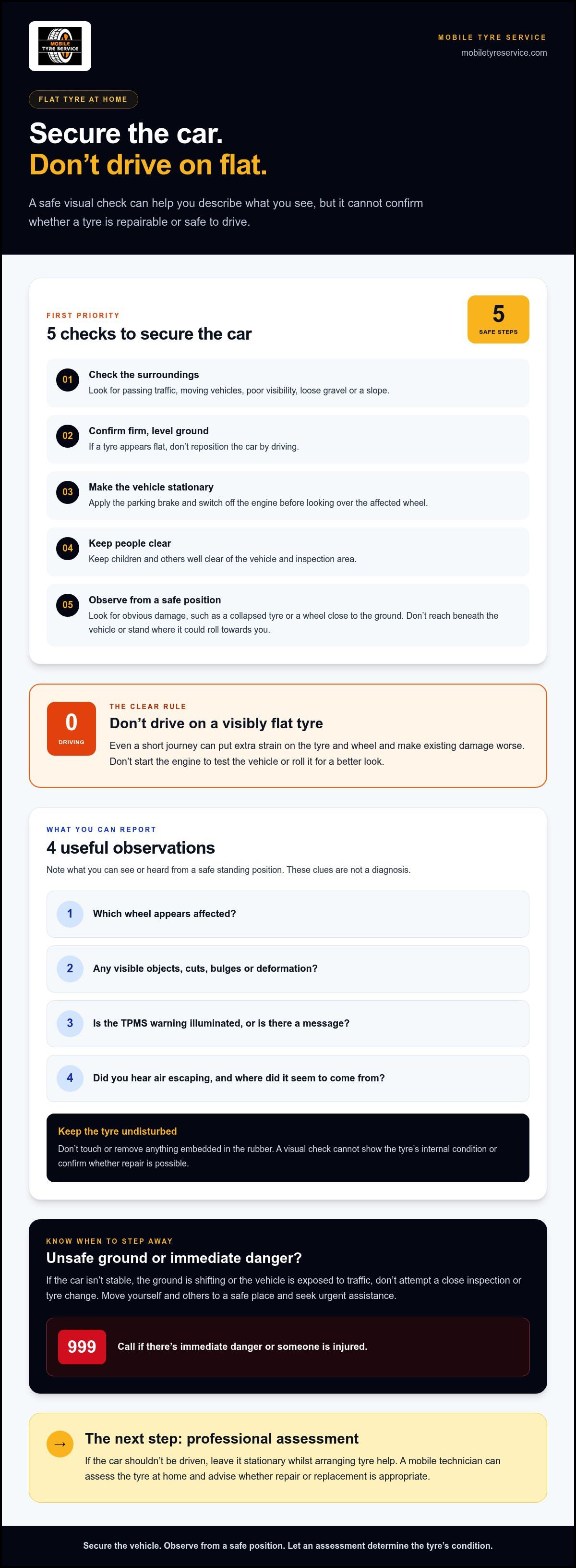
Secure the car and don’t drive on a visibly flat tyre. Even a short journey can put extra strain on the tyre and wheel and make existing damage worse. Keep the vehicle stationary, make the area safe and arrange an assessment before deciding whether it can be moved.
If you’re working out flat tyre at home what to do, separate a safe visual check from any decision to drive. A tyre may look deflated because of a puncture or another problem, but appearance alone can’t establish whether it’s safe to use. This Flat tire guide gives a general overview of flat tyres and their possible causes.
How to secure a car with a flat tyre on a driveway
Only inspect the vehicle if you can do so without stepping into traffic, standing on unstable ground or getting close to moving vehicles. If the car is already safely positioned, use this checklist:
- Check the surroundings first. Look for passing traffic, other moving vehicles, poor visibility, loose gravel or a slope.
- Confirm the car is on firm, level ground. Don’t try to reposition it by driving if a tyre appears flat.
- Apply the parking brake and switch off the engine before looking over the affected wheel.
- Keep children and other people well clear of the vehicle and inspection area.
- From a safe position, look for obvious damage, such as a collapsed tyre or a wheel close to the ground. Don’t reach beneath the vehicle or stand where it could roll towards you.
If the car isn’t stable, the ground is shifting or the vehicle is exposed to traffic, don’t attempt a close inspection or tyre change. Move yourself and others to a safe place and seek urgent assistance. Call 999 if there’s immediate danger or someone is injured. If the car is safely parked on a driveway, leave it stationary whilst arranging tyre help.
Should you drive on a flat tyre, even a short distance?
No, not if the tyre is visibly flat or the car feels unstable. Driving can cause further damage to the tyre and wheel, and affect how the vehicle handles. The extent of damage depends on the circumstances, so don’t assume a short distance will be harmless.
A stationary check means observing the car from a safe position. It doesn’t prove the tyre is repairable or make it safe to drive to a garage. Don’t turn on the engine to test the vehicle or roll it to get a better look. If the car needs an assessment but shouldn’t be driven, mobile tyre fitting or repair at home provides an on-site option. A technician can inspect the tyre and advise whether repair or replacement is appropriate.
What a flat tyre can tell you, and what it cannot
A deflated tyre tells you that something has changed, not why it happened or whether the tyre can be repaired. A puncture is one possibility, but a pressure warning, visible loss of shape or sound of escaping air won’t show how far the damage extends. Treat these clues as details to pass on, not as a diagnosis.
Noticing a flat is not the same as diagnosing its cause. A tyre can look intact from outside and still have damage that isn’t visible until a technician examines it. In some cases, the tyre needs to be removed from the wheel so its interior can be inspected. Don’t assume a small object or mark means a repair is possible.
What to look for without removing the wheel
From a safe standing position, observe the tyre and note useful details. Don’t touch, pull out or push at anything embedded in the rubber. Avoid crawling beneath the car or using a jack unless you have the appropriate equipment and competence to do so safely.
- Identify which wheel appears affected, such as the front passenger-side tyre.
- Look for visible objects, cuts, bulges or a section of tyre that appears deformed.
- Check whether the tyre-pressure monitoring system (TPMS) warning is illuminated and note any message shown.
- Notice whether you heard air escaping and whether the sound seemed to come from the tyre.
These observations can help explain what you noticed, but they don’t confirm the source of air loss or the condition of the tyre’s interior.
Why a visual check cannot confirm a repair
Repairability depends on the nature and position of the damage, as well as the tyre’s overall condition. Damage on the tread and damage near the sidewall may call for different assessments, but appearance alone can’t establish the right outcome. An inspection may reveal internal damage that an external check cannot show.
Don’t decide that a tyre is repairable simply because you can see a small puncture, or that it must be replaced based only on a pressure warning. A technician can examine the tyre and advise whether repair or replacement is appropriate. For detailed criteria, refer to a dedicated guide to puncture repair.
If you’re still weighing up flat tyre at home what to do, record the warning or visible signs and leave the tyre undisturbed. If the car shouldn’t be driven, a mobile tyre assessment at home offers an on-site next step. The technician can assess the tyre and advise on repair or replacement.
Repair, replacement or spare: compare your safe next steps
Once the car is secure, the practical choice depends on the tyre’s condition and what your vehicle is equipped to use. A suitable spare may provide a temporary replacement, whilst an assessment can establish whether the damaged tyre is repairable or needs replacing. Don’t choose based on appearance alone.
| Option | Purpose | Limitations |
|---|---|---|
| Temporary spare | Provides a temporary replacement for the affected wheel, if one is available and suitable for the vehicle. | It may have specific restrictions. Follow the vehicle handbook and the instructions supplied with the spare. |
| Professional repair assessment | Allows a technician to inspect the tyre and determine whether repair is appropriate. | A visible puncture or photograph alone can’t confirm that a repair is possible. |
| Replacement | Provides another tyre when assessment indicates that repair isn’t appropriate. | The correct replacement depends on the vehicle and tyre requirements. |
Professional inspection determines whether repair or replacement is the appropriate next step. This comparison is a guide, not a diagnosis. The vehicle handbook, the spare’s instructions and the tyre’s condition all matter.
When a spare wheel or space-saver may be an option
Not every car carries a spare, and a space-saver may have different restrictions from a full-size wheel. Check the vehicle handbook and the spare’s own instructions before relying on it. Don’t assume it’s suitable for your car or that you can fit it safely. If access is awkward, the ground is uneven or you’re unsure how to proceed, leave the wheel in place and seek professional assistance.
When to arrange a tyre repair assessment or replacement
Arrange an assessment if there’s no suitable spare, you can’t fit it safely or you don’t know whether the tyre can be repaired. A mobile technician can inspect the tyre at your location and advise on repair or replacement. Tread and sidewall damage can require different considerations. For detailed repair criteria, use a dedicated puncture-repairability guide rather than guessing from one visible sign.
If you’re searching for flat tyre at home what to do, don’t treat a temporary workaround as a confirmed repair. A spare is a short-term option only when your handbook and the spare’s instructions allow it. A professional assessment gives you a clearer basis for your next decision. A mobile tyre repair cost guide can provide further context about repair costs, but it can’t determine whether your particular tyre is repairable.
How to prepare for mobile tyre help at home
Once you’ve decided not to drive, a few accurate details can make arranging on-site tyre help more straightforward. Record what you know, describe the vehicle’s position and explain how a technician can reach it. You don’t need to diagnose the fault. When considering flat tyre at home what to do, preparation means sharing clear information and leaving the tyre assessment to a professional.
What information to have ready when arranging help
Gather the vehicle registration, make and model, your exact location and which wheel is affected, if known. If you can read the tyre size safely from the sidewall without leaning into traffic or reaching beneath the car, note it down. Don’t approach an unstable vehicle or move the car to get a better view.
Describe what you can observe rather than making a diagnosis. For example, say that the front left tyre looks low, the TPMS warning is on or you noticed a cut. Mention it if you heard air escaping. These details help explain the situation, but they don’t determine whether repair or replacement is appropriate. Leave that decision to an inspection.
Before arranging assistance, collect:
- The vehicle registration, make and model.
- The tyre size, if it’s safely visible.
- The affected wheel and any warning light or visible damage.
- Your full location and a contact number for access coordination.
How to make the home location ready for an on-site visit
Give the precise address, including details that help someone find the vehicle, such as a building name, flat number or clear driveway description. Explain access constraints in advance, such as a shared entrance, locked gate, narrow approach or difficult-to-identify parking area. If there’s a safe place to park near the vehicle, describe it without moving the car on the flat tyre.
Keep the vehicle stationary and, where possible, accessible for assessment. Clear the route of items or parked vehicles that could obstruct access. Don’t attempt to reposition the car to create a better working space. If the vehicle is in a shared parking area, provide relevant access instructions so the technician can locate it and reach the affected wheel.
Mobile tyre fitting and repair are available at customers’ locations in Essex and Cambridge. Share the exact service address when arranging help so the visit can be planned around where the car is parked.
Have these details ready and arrange mobile tyre help at home if your vehicle needs an on-site assessment.
What happens when a mobile tyre technician attends your home
A mobile visit brings the tyre assessment to you. The technician examines the affected tyre and its condition, then advises whether repair or replacement is appropriate. You don’t need to decide in advance which outcome applies. Damage may not be clear from the outside, so the recommendation follows an assessment rather than a guess based on a photograph or warning light.
If the tyre is suitable for repair, mobile tyre repair can be carried out at your location. If inspection indicates that repair isn’t appropriate, replacement may be the right route. The outcome depends on the tyre’s condition, so don’t assume a particular repair or replacement result before the assessment.
How the technician assesses the tyre and vehicle
The technician considers the affected tyre and its condition in the context of the vehicle. What you noticed, such as a pressure warning, visible damage or air loss, helps describe the problem, but doesn’t establish whether repair is suitable. The assessment informs the next step: repair where appropriate, or replacement if that is the safer option.
Once the appropriate route is identified, mobile tyre fitting or repair brings the relevant tyre work to your location. If replacement is needed, the technician can advise on that pathway. This is a practical way to address a tyre issue at home when driving the car elsewhere isn’t sensible.
Arranging mobile tyre repair or fitting in Essex and Cambridge
Mobile tyre support serves customers in Essex and Cambridge, bringing tyre fitting and repair to the customer’s location. When arranging assistance, provide the exact address and explain where the car is parked. Details such as a shared entrance, access gate or specific parking area can help the technician locate the vehicle. Keep the car stationary until its condition has been assessed.
If you’re still wondering flat tyre at home what to do, an on-site visit provides a clear way to move from uncertainty to an informed tyre decision. Share the vehicle details and describe the signs you observed. The technician can assess the tyre and advise on the appropriate repair or replacement. The assessment doesn’t guarantee that repair will be possible, but it helps determine the suitable next step.
Arrange mobile tyre help at home for an on-site tyre assessment, repair or fitting in Essex or Cambridge.
Take the next step with confidence
A flat tyre can interrupt the day, but you don’t have to diagnose the fault yourself. If you’re still asking “flat tyre at home what to do”, focus on making a clear, informed decision rather than trying to get the car moving before you know what the tyre needs.
Professional tyre help at home can move the situation forward without relying on guesswork. Mobile Tyre Service provides tyre fitting, repair and on-site TPMS sensor services. Share the vehicle and location details when arranging assistance, then let the assessment guide the appropriate tyre solution.
Arrange mobile tyre help at home and take a practical step towards getting back on the road. With the right assessment, you can approach the next decision with greater confidence. Unexpected incidents like punctures are also a good prompt to check that your vehicle is fully protected for future journeys, with specialists like Just Quote Me helping drivers and businesses arrange tailored motor and commercial insurance policies.
Frequently Asked Questions
Can I inflate a flat tyre and drive to a garage?
Not if the tyre is visibly flat, damaged or the car feels unstable. Adding air doesn’t confirm that the tyre is safe to use, and it may lose pressure again if there’s a puncture. If the tyre is only slightly low and you’re unsure why, don’t treat inflation as proof that driving is safe. Arrange an assessment before travelling on a tyre whose condition is uncertain.
Should I remove a nail or screw from a flat tyre?
No. Leave an embedded nail or screw in place and tell the technician where it is. Pulling it out may allow air to escape more quickly, and handling it won’t establish whether the tyre can be repaired. If you can see the object safely, note its position and appearance without touching it. That observation can help explain the problem during an assessment.
Can I use tyre sealant on a flat tyre at home?
Tyre sealant may provide a temporary measure, but it isn’t a permanent repair and won’t establish the tyre’s condition. Before using a sealant kit, read the vehicle handbook and the kit instructions, as the correct procedure depends on the equipment and vehicle. If you’ve already used sealant, tell the technician which product you applied. A proper inspection is still needed to determine the next step.
Is a run-flat tyre safe to drive on when it loses pressure?
Only follow the vehicle and tyre manufacturer’s instructions for your specific run-flat tyre. The permitted distance and speed can depend on the tyre and circumstances, so don’t rely on a general rule or assume the car can continue as normal. If the vehicle feels unstable, stop in a safe place. A run-flat driven with low pressure may have damage that needs professional assessment.
How long can I leave a car parked with a flat tyre?
There isn’t a reliable time limit that suits every vehicle and tyre. The car’s weight rests on the deflated tyre, and the wheel may also be at risk if the tyre is badly compressed. For enthusiasts dealing with stored or vintage vehicles—a frequent consideration noted by automotive specialists in classic car sales Southampton NY—leaving a car resting on deflated rubber can also cause lasting flat-spotting. Keep the car stationary and arrange an assessment as soon as practical rather than leaving it indefinitely. If its position creates a safety risk or blocks access, prioritise getting people clear and seeking assistance.
Can a mobile tyre technician assess a flat tyre on my driveway?
Yes. Mobile Tyre Service provides tyre assessment, repair and fitting at customers’ locations, including homes in Essex and Cambridge. Share the address, vehicle details and what you’ve noticed when arranging help. The technician can inspect the tyre on site and advise whether repair or replacement is appropriate. This is a practical option if the car shouldn’t be driven and you’re unsure flat tyre at home what to do.
Arrange mobile tyre fitting or repair at home in Essex or Cambridge for an on-site assessment of your flat tyre.
Need a mobile tyre service?
We cover Harlow, Bishop's Stortford, Cambridge and all surrounding areas — 24/7.
Call: 01279 881234