EV Tyre Puncture Repair Essex: Specialist On-Site Mobile Solutions
According to breakdown data from LV= Britannia Rescue, electric vehicles are twice as likely to suffer tyre failures as petrol or diesel cars, yet over 90% carry no spare wheel. When you encounter a sudden flat, securing a dedicated EV tyre puncture repair Essex service becomes an urgent technical p…
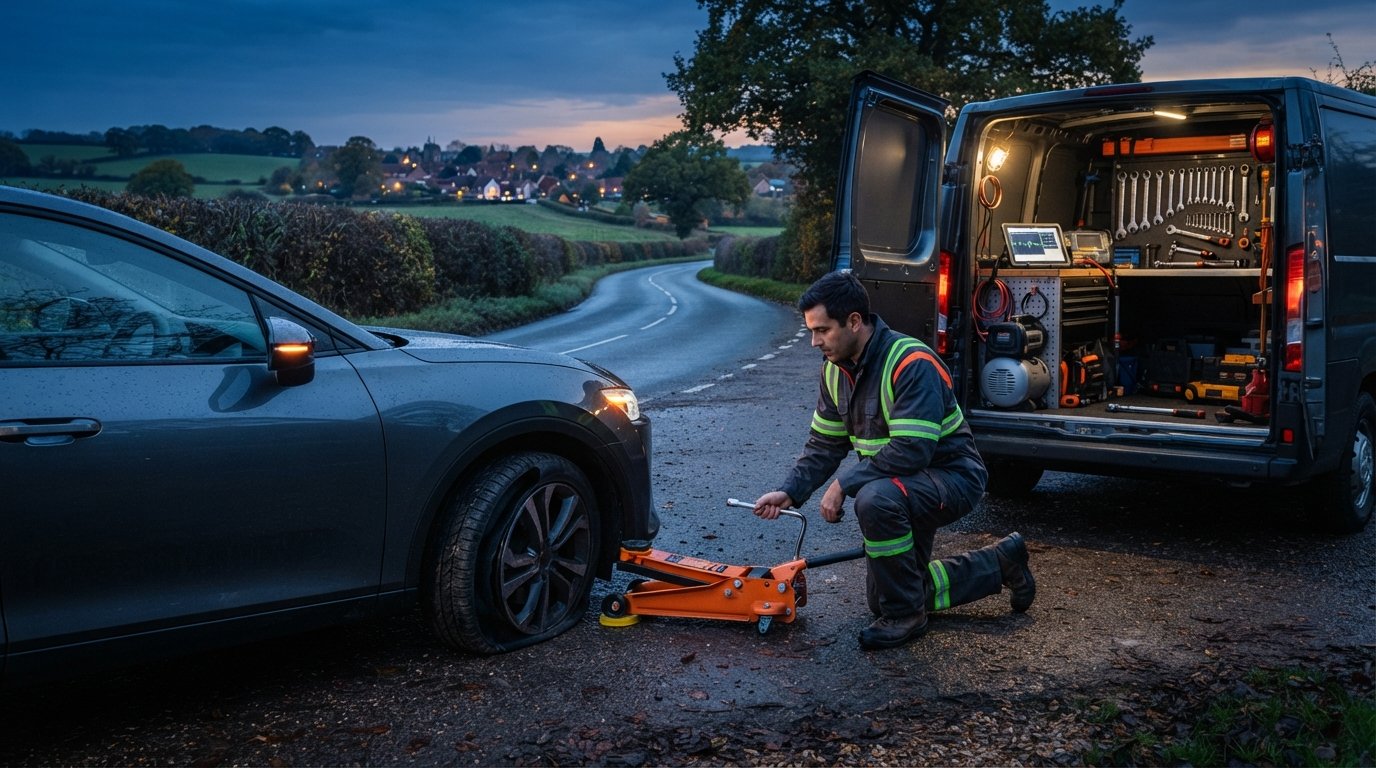
According to breakdown data from LV= Britannia Rescue, electric vehicles are twice as likely to suffer tyre failures as petrol or diesel cars, yet over 90% carry no spare wheel. When you encounter a sudden flat, securing a dedicated EV tyre puncture repair Essex service becomes an urgent technical priority. You already know electric cars cannot simply be treated like standard combustion vehicles; improvising with generic floor jacks risks crushing delicate high-voltage battery enclosures beneath the sill. Simultaneously, conventional workshops frequently turn drivers away, wrongly claiming that tyres lined with sound-deadening acoustic foam are completely unrepairable.
You don't have to accept disruptive flatbed recovery or replace a tyre that still has plenty of life left. Discover how specialist mobile technicians safely repair EV punctures across Essex whilst protecting high-voltage batteries and acoustic foam layers in full compliance with British Standard BS AU 159. Below, we examine the precision lifting protocols, inner-liner preparation methods, and on-site diagnostics that get your vehicle safely back on the road without workshop delays.
Key Takeaways
- Acoustic foam linings do not prevent puncture repairs; specialists can safely prepare sound-deadening polyurethane layers to complete durable, vulcanised internal repairs.
- Protecting underfloor high-voltage battery packs requires vehicle-specific rubber jacking pucks that direct lifting force exclusively to reinforced chassis points.
- Securing a dedicated EV tyre puncture repair Essex mobile technician directly to your roadside location or home driveway removes the delay and expense of flatbed recovery.
- Strict compliance with British Standard BS AU 159 requires full tyre demounting and internal carcass inspection, ensuring no hidden internal structural damage is overlooked.
- Specialist mobile units carry complete on-site tooling to manage high-load EV tyres, execute permanent combination plug-patches, and re-calibrate sensitive TPMS sensors on arrival.
EV Tyre Punctures vs Standard Tyres: Crucial Technical Differences
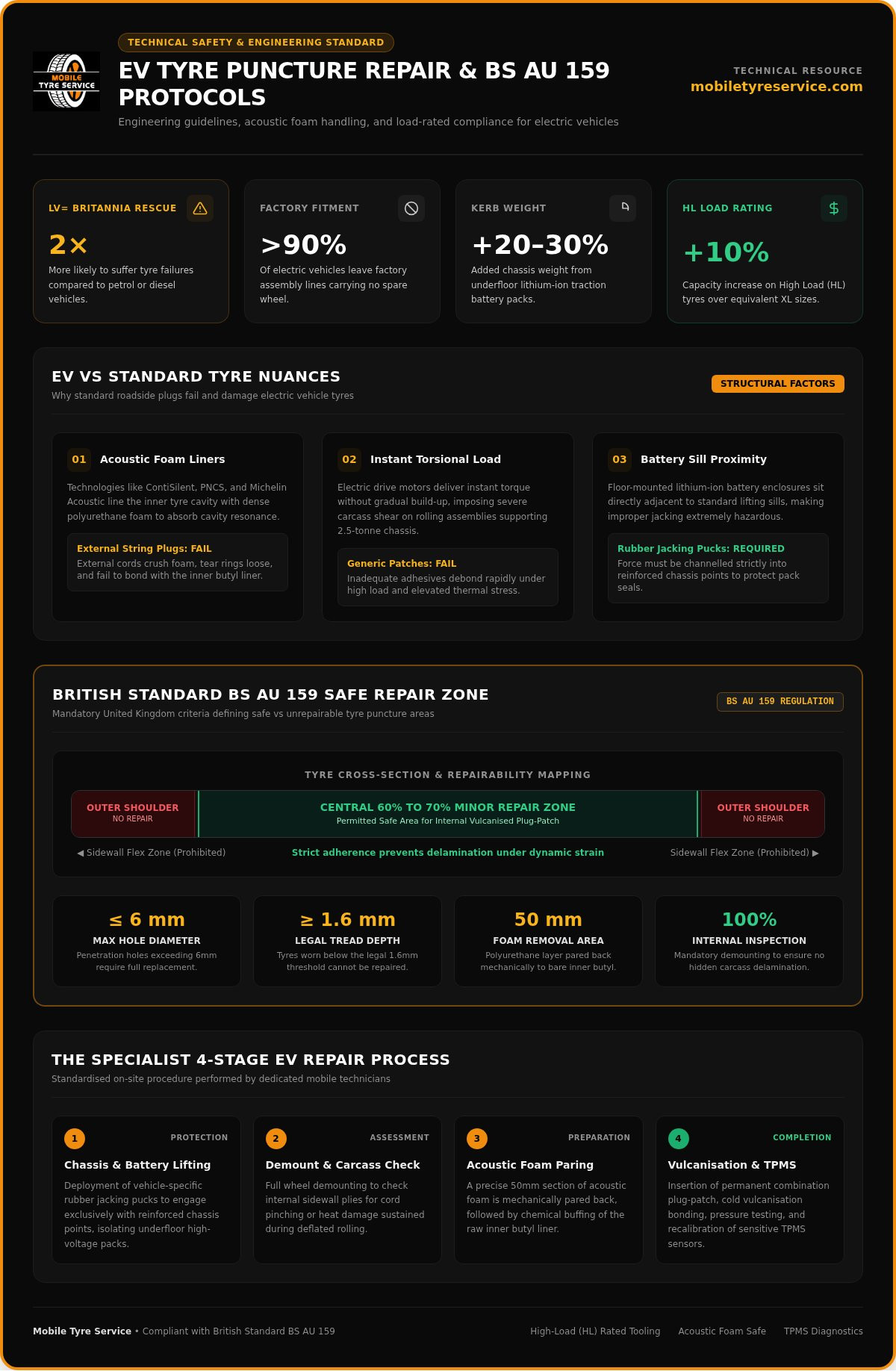
Electric cars place distinct physical stresses on rubber compounds. Underfloor lithium-ion battery packs elevate vehicle kerb weight by 20% to 30% compared to equivalent combustion models. At the same time, electric drive motors deliver immediate torque to the driven wheels without gradual power build-up. This instant torsional load accelerates tread wear and increases vulnerability to road debris. Consequently, carrying out an effective EV tyre puncture repair Essex drivers can rely on requires an understanding of structural nuances that standard garage workflows regularly overlook.
Most modern electric vehicles leave assembly lines without spare wheels. Drivers often encounter reinforced sidewall designs resembling run-flat tyre technology, engineered to manage deflated loads temporarily. However, the internal architecture of dedicated EV fitments features unique complexities that make standard roadside patch kits obsolete.
Understanding Acoustic Foam Liners and Internal Dampening
Because electric powertrains operate silently, tyre cavity resonance becomes the dominant source of cabin cabin noise. Manufacturers counter this using bonded polyurethane acoustic foam, branded under proprietary systems like Continental ContiSilent, Pirelli Noise Cancelling System (PNCS), and Michelin Acoustic. Push-in string plugs inserted from the tread exterior fail completely on these units. External cords crush into the dense polyurethane, preventing an airtight seal against the inner butyl liner while tearing the foam ring loose.
Qualified technicians must demount the wheel and mechanically pare back a designated fifty-millimetre section of foam. This exposes the raw inner liner rubber for proper cleaning, chemical buffing, and vulcanisation without compromising the tyre's ongoing sound-dampening capabilities.
Heavy Kerb Weight and Higher Load Ratings Explained
To safely sustain heavy traction batteries, electric vehicles require Extra Load (XL) or High Load (HL) tyre specifications. The European Tyre and Rim Technical Organisation standardises HL tyres to carry approximately 10% more load capacity than equivalent XL sizes at identical pressures. Applying standard passenger tyre patches to an HL-rated EV tyre introduces immediate structural failure risks:
- Standard internal patches lack the structural reinforcement needed to withstand 2.5-tonne rolling chassis weights.
- Instant motor torque causes excessive carcass shear, debonding inadequate adhesives.
- Heat build-up under load weakens generic repair materials rapidly.
Technicians delivering EV tyre puncture repair Essex wide must inspect sidewall integrity thoroughly. If run-flat deflated driving has pinched the reinforced cords, the tyre's load rating is permanently compromised, demanding immediate replacement rather than repair.
BS AU 159 Compliance: Safe EV Tyre Puncture Repair Criteria
Every legitimate automotive tyre puncture repair in the United Kingdom must satisfy British Standard BS AU 159. This regulatory framework establishes rigid safety boundaries to guarantee that a repaired tyre maintains its structural strength and manufacturer speed rating. Given the acute torsional stress and increased mass associated with electric vehicles, compliance isn't optional; it is fundamental to road safety. When requesting professional mobile tyre repair across the region, understanding these strict benchmarks ensures your vehicle receives safe, compliant treatment.
Defining the Safe Minor Repair Area
BS AU 159 strictly confines minor repairs to the central 60% to 70% of the nominal tyre tread width. The tyre shoulder and sidewall endure continuous flexural movement during cornering, regenerative braking, and hard acceleration. Any puncture located outside this defined central band cannot hold a vulcanised seal safely under continuous dynamic strain. Additionally, the standard caps the maximum allowable penetration hole diameter at 6 millimetres for passenger tyres. Technicians must immediately condemn and replace an EV tyre if punctures display any of the following characteristics:
- Penetration damage exceeding 6 mm in diameter.
- Puncture entry points located on the shoulder zone or sidewall.
- Tread depth measuring below the legal 1.6 mm threshold across the central three-quarters of the tyre.
- Splits, tears, bead distortion, or secondary gouges penetrating the carcass cord plies.
Internal Examination and Thermal Damage Checks
A compliant repair cannot happen while the tyre remains attached to the alloy wheel. External rope plugs inserted blindly from the outside violate British Standards because they skip the mandatory structural evaluation of the internal tyre liner. Technicians delivering certified EV tyre puncture repair Essex wide must demount the tyre entirely to examine the internal carcass. Under BS AU 159 regulations, technicians must discard damaged run-flat tyres.
When an electric car rolls even a short distance whilst deflated, its heavy curb weight crushes the sidewalls directly against the wheel rim flanges. This friction generates extreme internal heat, grinding the inner butyl rubber into black, powdery shavings known as rubber marbles. Once internal ply separation, cord creasing, or thermal blistering occurs, technicians cannot apply combination mushroom plug-patches. Only pristine tyre casings that pass rigorous internal inspection can be prepared, chemically vulcanised, and safely returned to service.
The Mobile EV Tyre Repair Protocol: Chassis and Battery Protection
Lifting an electric vehicle roadside demands surgical mechanical discipline. Lithium-ion traction batteries span the floorpan between the front and rear axles, leaving minimal margin between vehicle pinch welds and high-voltage enclosures. Positioning a bare steel workshop jack against the sill panel risks crushing the battery casing flange, potentially causing internal cell ruptures, thermal runaway hazards, or immediate warranty invalidation. Delivering elite EV tyre puncture repair Essex wide requires specialised lifting equipment engineered specifically to isolate and protect these sensitive underfloor assemblies.
Protecting the High-Voltage Battery Floor Pan
Modern electric vehicles from brands such as Tesla, Polestar, BMW, and Audi utilise dedicated chassis locator sockets set into the underside. Mobile technicians insert bespoke vulcanised rubber jacking pucks into these precise anchor points before engaging hydraulic lifting gear. Dedicated mobile service vans carry low-profile, high-capacity 2.5 to 3-tonne hydraulic floor jacks fitted with broad rubber saddles. This hardware channels lifting force exclusively through reinforced structural subframe members, preventing chassis flex and keeping steel jack saddles clear of battery pack seals.
Step-by-Step Acoustic Foam Repair Procedure
Handling punctured acoustic tyres requires a methodical multi-stage restoration process once the wheel is safely dismounted inside the mobile technical unit:
- Precision Excision: Technicians measure and surgically pare back a 50 mm square of polyurethane foam surrounding the penetration wound using non-rotary contour blades, avoiding tyre casing abrasion.
- Chemical Preparation: The exposed inner butyl rubber undergoes pre-buff cleaning to dissolve mould-release agents, followed by low-speed dome mechanical buffing to create an optimal vulcanising texture.
- Vulcanised Sealing: Technicians pull a BS AU 159-compliant combination mushroom plug-patch through the entry channel from the inside out, applying vulcanising cement to fuse the stem and patch to the inner liner permanently.
- Acoustic Preservation: The trimmed foam margins are sealed with inner liner over-buff sealant, securing the surrounding foam ring so it continues absorbing cavity resonance without peeling under centrifugal load.
TPMS Sensor Calibration and High-Precision Wheel Reinstallation
Deflated electric tyres place direct stress on internal valve assemblies. Mobile technicians exercise extreme care during tyre bead breaking to avoid shearing sensitive electronic components. Our mobile TPMS sensor service provides real-time digital diagnostics to test battery levels, stem integrity, and direct radio-frequency output before refitting the wheel. Once the tyre is remounted and dynamically balanced, technicians reinstall the wheel by hand-threading all lug nuts, finishing exclusively with calibrated torque wrenches set to exact manufacturer specifications to prevent stud stretching or brake disc warping.
On-Site EV Tyre Services Across Essex: Driveway and Roadside Response
Modern electric vehicles rarely include a physical spare wheel, leaving stranded drivers facing inconvenient recovery options. Traditional depot visits mean arranging flatbed recovery or risking catastrophic rim damage by limping along on a flat tyre. When a deflated tyre supports a 2.5-tonne chassis, even a few hundred metres of rolling resistance gouges costly, low-drag aerodynamic alloys. Securing dedicated EV tyre puncture repair Essex wide eliminates these hazards by bringing a fully equipped technical workshop directly to your vehicle's physical location.
Every response unit carries industrial demounting equipment, vulcanised patch materials, and high-load replacement tyres. If on-site structural inspection reveals that tyre damage breaches BS AU 159 limits, our technicians transition instantly to on-site replacement without towing delays. To explore the broader economic benefits of choosing mobile intervention over traditional depot recovery, review our detailed guide examining mobile tyre repair cost factors.
Serving Key Essex Towns and Residential Communities
Mobile support operates extensively across key commercial and residential centres, including Chelmsford, Colchester, Brentwood, Billericay, and Basildon. Technicians attend residential driveways, corporate business parks, and local charging hubs. This doorstep attendance allows you to continue your workday uninterrupted while certified specialists handle the entire technical intervention. Agile mobile vans navigate constrained spaces with ease, servicing vehicles positioned inside domestic carports, narrow private drives, and low-clearance residential bays.
Arterial Roadside Emergency Interventions
High-speed commuter corridors demand rigorous roadside safety protocols. Technicians deploy high-intensity strobe lighting, reflective safety perimeter cones, and impact-resistant gear when attending electric vehicles along major transit corridors:
- M25 Motorway: Rapid intervention across the Dartford Crossing corridor, Junction 26 to Junction 31, and surrounding dynamic slip roads.
- A12 Trunk Route: Strategic response covering the London commuter route through Brentwood, Chelmsford, Witham, and Colchester.
- A127 & A13 Arterials: Direct technical callouts serving Basildon, Thurrock, Rayleigh, and Southend-on-Sea.
- M11 & A120 Corridors: Roadside support supporting logistics routes surrounding Stansted Airport and Braintree.
Stopping immediately when tyre pressure alarms trigger prevents the vehicle rim from grinding through deflated rubber compounds. If you find yourself stranded on an Essex carriageway or stuck at home, you can book immediate mobile tyre fitting to secure professional technical intervention wherever your vehicle sits.
Securing Expert EV Mobile Tyre Repair with Mobile Tyre Service
Mobile Tyre Service operates as a dedicated technical response unit engineered exclusively around mobile convenience. Bypassing fixed-workshop queues, our fleet provides direct mobile tyre repair and mobile tyre fitting at home or at the roadside. Every response vehicle functions as a self-contained fitting bay, carrying vehicle-specific rubber jacking adapters, chemical vulcanising compounds, high-load extraction tools, and replacement EV-specification tyres. By combining rapid dispatch with technical mastery, we eliminate the delays and hazards of unassisted breakdowns, restoring your electric vehicle's mobility with minimal disruption.
What Information to Provide When Requesting Mobile EV Assistance
Supplying accurate vehicle data during initial contact guarantees that technicians deploy with the exact physical components required for your vehicle. When requesting an urgent EV tyre puncture repair Essex callout, prepare the following specifications:
- Tyre Sidewall Markings: Note the complete alphanumeric sequence stamped on the tyre face, such as 255/45 R19 104W, paying close attention to XL (Extra Load) or HL (High Load) designations.
- Acoustic and Manufacturer Codes: Identify proprietary OEM symbols such as "TO" (Tesla), "Elect" (Pirelli EV), "NF0" (Porsche), or branding indicating internal sound dampening like ContiSilent or SoundComfort.
- Precise Physical Coordinates: Provide exact digital map coordinates, a What3words reference, or specific highway marker posts along Essex routes to ensure zero delay in technician arrival.
The Mobile Tyre Service On-Site Guarantee
Resolving an electric vehicle puncture involves far more than simply applying a patch. Once our mobile unit arrives, technicians execute a comprehensive inspection to ensure the damaged casing complies fully with BS AU 159 criteria before proceeding with an internal vulcanised repair. If hidden cord separation or severe sidewall damage condemns the casing, the technician transitions immediately to fitting a fresh, load-appropriate replacement tyre directly from onboard stock.
Every intervention finishes with digital wheel balancing and complete electronic diagnostics using handheld TPMS programming tools. Technicians test valve transceivers, confirm stable sensor communication with the vehicle ECU, and reset dashboard fault codes before hand-torquing wheel nuts to precise factory specifications. Delivering an elite EV tyre puncture repair Essex motorists can rely upon means delivering a complete, workshop-calibre outcome right on your driveway, saving you the expense and logistical frustration of vehicle recovery.
Secure Dedicated Mobile EV Tyre Assistance Across Essex
A punctured electric car tyre doesn't have to result in expensive flatbed recovery or premature tyre disposal. Modern electric vehicles demand dedicated engineering solutions, from precision chassis lifting with battery-safe rubber pucks to compliant BS AU 159 vulcanised repairs that safely preserve internal acoustic foam. By addressing tread damage directly on your driveway or at the roadside, you protect delicate battery packs, shield low-drag alloy rims, and avoid unnecessary replacement costs.
Our dedicated mobile fleet delivers comprehensive technical coverage across all major Essex towns and motorways. Every unit arrives fully equipped with vehicle-specific jacking adapters, on-board digital balancers, and high-load tyre stock. When you require specialist EV tyre puncture repair Essex drivers can depend on, our mobile response eliminates workshop queues entirely. Request urgent mobile EV tyre repair across Essex today to secure certified on-site intervention, accurate TPMS calibration, and seamless journey restoration.
Frequently Asked Questions
Can a puncture in a tyre with acoustic foam be repaired safely?
Yes, provided a specialist technician executes the repair from the inside. The technician demounts the tyre, mechanically trims back a small section of the polyurethane acoustic dampener, and cleans the inner liner rubber. After vulcanising a combination plug-patch compliant with BS AU 159, the technician reseals the surrounding foam margins. While standard workshops often refuse them due to lack of tooling, the procedure is safe, permanent, and recognised by tyre manufacturers.
Why do electric vehicles need specific jacking pads during tyre repairs?
Electric cars house high-voltage lithium-ion traction batteries directly along the floorpan between the axles. Standard metal garage jacks concentrate lifting forces across thin sill seams, which can crush the battery enclosure flange. Specialist rubber jacking pucks slot into dedicated manufacturer chassis sockets, safely transferring vehicle kerb weight directly into reinforced load-bearing frame points without contacting or distorting delicate underfloor battery assemblies.
How do I know if my EV tyre puncture is legal to repair?
Under British Standard BS AU 159, a puncture is legally repairable only if the penetration diameter measures 6 millimetres or less and sits strictly within the central 60% to 70% of the tread width. The tyre must also retain at least 1.6 mm of tread depth. If damage touches the shoulder, or if deflated driving has caused internal cord degradation, executing an EV tyre puncture repair Essex motorists require is impossible, demanding complete tyre replacement.
What should I do if my electric vehicle gets a puncture without a spare wheel?
Bring the vehicle to a safe, controlled stop immediately and avoid driving on the deflated tyre. Heavy electric vehicle weights quickly crush alloy wheel rims into deflated sidewalls, destroying the internal carcass within metres. Avoid using chemical canister sealant if possible, because liquid latex ruins internal TPMS sensors and contaminates acoustic foam linings. Instead, contact a mobile tyre technician to inspect, repair, or replace the tyre on-site.
Will an EV puncture repair affect my vehicle's manufacturer warranty?
A compliant puncture repair will not invalidate your vehicle or battery warranty, provided the work adheres to British Standard BS AU 159 and the technician follows manufacturer lifting protocols. Using dedicated rubber puck adapters prevents stress to the battery casing, protecting high-voltage warranty coverage. Ensuring the repair maintains the tyre's original speed and load rating guarantees that vehicle suspension and drivetrain components remain operating within approved manufacturer specifications.
Can an electric vehicle puncture be repaired at the roadside on the A12 or M25?
Yes, mobile units regularly attend roadside breakdowns along major transit routes like the A12, A127, and M25. Once your vehicle is positioned safely in an emergency refuge area or hard shoulder, technicians establish a high-visibility perimeter to secure the site. The technician dismounts the wheel, inspects the tyre under BS AU 159 standards, and either carries out an on-site vulcanised repair or fits a fresh replacement tyre without towing delays.
What happens if my EV puncture turns out to be unrepairable?
If internal examination reveals structural cord fatigue, severe run-flat overheating, or puncture damage outside safe tread boundaries, technicians must condemn the casing for your safety. Mobile technical vans carry high-load replacement tyres suited to electric vehicle torque demands. The technician installs the new tyre, dynamically balances the wheel assembly, and recalibrates your TPMS sensors on the spot, completing the job without workshop visits or vehicle recovery charges.
Need a mobile tyre service?
We cover Harlow, Bishop's Stortford, Cambridge and all surrounding areas — 24/7.
Call: 01279 881234