Do I Need to Re-Torque Wheel Nuts After a Tyre Change? When to Check
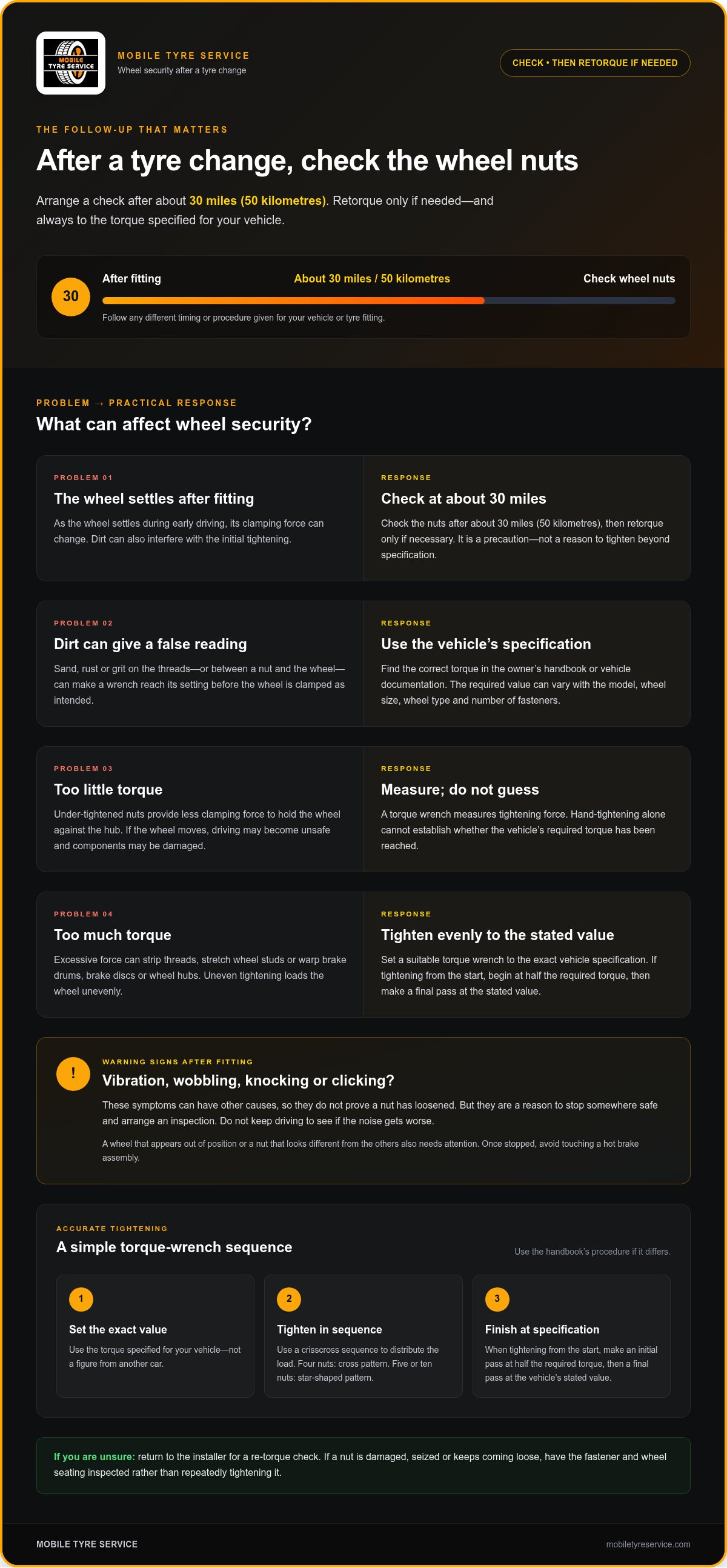
After a tyre change, have the wheel nuts checked after about 30 miles (50 kilometres), then retorqued if necessary. The practical answer to whether you need to re-torque wheel nuts after a tyre change is yes: the check helps confirm they remain secure as the wheel settles during initial driving. It’…

After a tyre change, have the wheel nuts checked after about 30 miles (50 kilometres), then retorqued if necessary. The practical answer to whether you need to re-torque wheel nuts after a tyre change is yes: the check helps confirm they remain secure as the wheel settles during initial driving. It’s a precaution, not a reason to tighten them beyond the vehicle’s specified torque.
It’s understandable to think the job is finished once the tyre is fitted. But correct tightening matters: too little or too much torque can cause problems, and the right setting depends on the vehicle. A follow-up check confirms whether the wheel nuts remain at the required specification.
This guide explains when to arrange a check, why wheel nuts can loosen after fitting, and how to find the correct torque for your vehicle. You’ll also learn what under-tightening and over-tightening can mean, so you can decide what to do after a tyre change.
Key Takeaways
- Arrange a wheel-nut check after about 30 miles (50 kilometres) following a tyre change, and retorque only if needed.
- Use the torque setting specified for your vehicle; the owner’s handbook or vehicle documentation gives the relevant value.
- Dirt or grit around the threads or wheel-nut seat can affect the initial tightening, while the wheel assembly settles during early driving.
- Too little or too much torque can cause problems, so tightening accurately matters as much as checking afterwards.
- If you’re unsure how to check the nuts correctly, return to the installer for a re-torque check.
Why wheel fasteners can loosen after installation
Wheel fasteners can lose clamping force if the wheel settles after fitting or dirt affects the initial tightening. The cause matters: loose, damaged and over-tightened nuts each need a different response.
Causes of wheel fasteners loosening
Wheel fasteners can loosen if the fitted wheel settles into a slightly different position or dirt interferes with tightening. Sand, rust or grit on the threads, or between a nut and the wheel, can produce a false torque reading. The wrench may reach its setting before the wheel is clamped as intended.
Steel-wheel nut seats act like springs, helping retain torque if the wheel settles. However, this does not prevent every change in clamping force. One reported vehicle’s front lug bolts needed retightening two to three times over a couple of weeks before they stopped loosening. Treat this as an example, not a schedule for every car.
Risks of loose or over-tightened nuts
Loose nuts provide less clamping force to hold the wheel against the hub. If the wheel moves, driving may become unsafe and the fasteners or wheel components may be damaged. Pay attention to any change in how the car feels after fitting, rather than repeatedly tightening the nuts without identifying the cause.
Over-tightening is not a safer alternative. Excessive force can strip fastener threads or stretch wheel studs. It can also warp brake drums, brake discs or wheel hubs. Uneven tightening puts different loads around the wheel. Correct tightening protects the fastening surfaces and avoids causing damage while securing the wheel.
Signs of a wheel working loose
New vibration, wobbling, knocking or clicking from one corner after a tyre change can mean the wheel or its fasteners need prompt attention. The symptoms may become more noticeable when driving, braking or turning. They can have other causes, so they do not prove a nut has loosened, but they are a reason to stop somewhere safe.
Look for a wheel that appears out of position against the hub or a nut that looks different from the others. Don’t keep driving to see whether the noise gets worse. Once safely stopped, avoid touching a hot brake assembly. Arrange an inspection and explain when the symptoms began.
Seized, damaged or recurring loose nuts
If a wheel nut is seized or visibly damaged, don’t force it with extra leverage or continue driving if you suspect the wheel is loose. A damaged thread, stud or nut may prevent accurate tightening. Have the fastener inspected and the fault addressed before returning to normal driving.
If a nut keeps coming loose after correct tightening, don’t treat repeated retightening as a permanent fix. The wheel seating, threads and fasteners may need inspection to find the cause. Stop driving if the wheel feels unstable and arrange qualified assistance. Repeated movement can make the fastening problem harder to assess.
Correct torque settings and vehicle specifications
Use the torque specified for your vehicle, rather than relying on a general figure. The correct setting and any re-check guidance depend on the wheel and vehicle combination.
Wheel-nut torque specifications
Wheel-nut torque is the tightening force specified for a particular vehicle’s fasteners. The correct value creates the clamping force needed to hold the wheel securely without overloading components.
The owner’s handbook and vehicle documentation give the recommended setting. A typical range sometimes cited is 110 to 120 N⋅m, but that range is not a substitute for your vehicle’s specification. The correct value can vary with the car model, wheel size, wheel type and number of fasteners. For heavier applications such as diesel trucks and commercial vehicles, specialist service providers like diegosshop.com note that fastener specifications and running-gear maintenance can be considerably more demanding.
Alloy wheels don’t automatically need more frequent re-torquing than steel wheels. However, torque specifications for wheels other than steel rims tend to be on the low side, so check that the nuts remain at specification after the vehicle has been driven for a while.
Using a torque wrench
A torque wrench measures tightening force, allowing fasteners to be set to the vehicle manufacturer’s specification. Hand-tightening alone cannot establish whether the required torque has been reached.
Set the wrench to the exact value for the vehicle, then tighten each fastener evenly. A crisscross sequence distributes the load across the wheel rather than loading one area first. On wheels with four nuts, use a cross pattern; with five or ten nuts, use a star-shaped pattern.
A torque wrench can also check whether wheel nuts remain at specification. If you start tightening with a standard wrench, measure the final setting accurately. When tightening wheel nuts, initially set the torque wrench to half the required torque, then make a final pass to the vehicle’s stated value.
Handbook guidance on torque and re-torquing
Your vehicle handbook or documentation gives the recommended wheel-nut torque and is the right reference for your car. It’s also the first place to look for vehicle-specific instructions on checking the wheels after fitting.
Don’t use a torque figure from another car, even if its wheels look similar. The model, wheel size, wheel type and number of fasteners can affect the required setting. For example, a value suited to one model’s steel wheels may not suit another model’s alloy wheels.
Follow the re-torque timing provided for the tyre or wheel fitting, along with any relevant vehicle instructions. One interval won’t necessarily suit every vehicle and wheel combination. If the handbook gives a specific procedure, follow it using the stated torque and a suitable wrench.
Effects of over-tightening and under-tightening
Wheel nuts need even, vehicle-specific tightening: too little can leave the wheel inadequately clamped, while too much can damage fasteners or nearby components. A torque wrench and the correct tightening pattern help manage both risks.
Under-tightening and over-tightening
Under-tightened wheel nuts may not provide enough clamping force to hold the wheel against its hub. As the vehicle moves, the wheel can shift against its mounting surface and put extra strain on the fasteners. An insecure wheel is a serious hazard, so have a suspected loose wheel checked before driving further.
Over-tightening causes different problems. Excessive force can strip a nut’s threads or stretch a wheel stud, weakening the connection even if the nut feels secure. It can also warp brake drums, brake discs or wheel hubs. Applying extra force repeatedly to compensate for uncertainty can damage parts rather than improve security.
Torque wrenches and tightening patterns
A torque wrench applies measured force to bring each fastener to the vehicle manufacturer’s specified setting. An impact wrench can tighten nuts quickly, but may apply excessive or uneven torque. A final check with a correctly set torque wrench is important, particularly if the fasteners may have received different levels of force.
Use the vehicle’s stated torque, not a setting borrowed from another car. When tightening wheel nuts, initially set the torque wrench to half the required torque, then tighten to the specified value. This staged approach helps bring the wheel into position progressively. The final setting must match the relevant vehicle specification.
Wheel-nut tightening sequence
The tightening pattern spreads the load across the wheel instead of pulling one side firmly into place first. Tighten a four-nut wheel in a cross pattern. For wheels with five or ten nuts, use a star-shaped pattern. A crisscross sequence helps distribute torque evenly across the mounting face.
For example, on a four-nut wheel, tighten one nut, then the one diagonally opposite. Continue across the wheel rather than moving to the neighbouring nut. On a five-nut wheel, follow a star pattern, spacing each tightening point from the previous one. Use the sequence on every wheel and apply the correct torque for the vehicle.
Accurate tightening requires both the specified torque and an even sequence. A torque wrench cannot fix a damaged thread, and a pattern cannot compensate for excessive force. If a fastener resists tightening or won’t hold the specified setting, stop rather than forcing it. The nut, stud or wheel seating needs inspection.
When should lug nuts be retorqued?
Arrange a wheel-nut check after driving about 30 miles (50 kilometres) following a tyre change, then retorque if necessary. For drivers asking, “do I need to re-torque wheel nuts after tyre change”, the practical answer is to schedule this post-fitting check.
A tyre garage may include a re-torque check, but whether it’s included depends on its fitting terms. If the garage doesn’t provide one, return to the installer or arrange a suitable inspection within the recommended distance.
Why retorquing is needed after a tyre change
A re-torque check confirms that wheel nuts remain at the vehicle’s specified torque after the wheel assembly settles during driving. Settling can reduce clamping force, even if the nuts were initially tightened correctly.
Continental recommends having wheel nuts checked and retorqued if necessary after approximately 50 kilometres on new tyres. The check isn’t an instruction to tighten every nut further. A torque wrench determines whether each fastener remains at specification; adjust only those that need it.
This distinction helps avoid unnecessary tightening. The aim is to make sure the nuts are secure enough to hold the wheel, not to apply extra force as a precaution. If a nut won’t hold its specified setting, repeatedly tightening it won’t fix the underlying problem.
Retorque timing and distance
Use about 30 miles (50 kilometres) after a tyre change as a practical point for checking the wheel nuts. Continental’s recommendation is approximately 50 kilometres, whilst other tyre-service advice recommends a re-torque within 100 kilometres after installation. These are recommendations, not vehicle-specific torque settings.
A UK tyre-fitting receipt may advise checking wheel torque within 50 miles of the wheels being fitted. Follow the instructions supplied with your fitting and vehicle, and note the distance before the check is due. If the vehicle documentation or installer gives a specific interval, follow it rather than extending the distance.
Seasonal wheel changes are wheel installations too, whether the tyres are changed on or off their rims. Arrange a check within the stated interval after fitting. Don’t wait for noise or vibration: the check is intended to confirm the wheel remains secure before symptoms develop.
Retorquing after a tyre change in the UK
Yes, after a tyre change in the UK, have the wheel nuts checked and retorqued if necessary. If you’re asking, “do I need to re-torque wheel nuts after tyre change”, arrange the check after about 30 miles (50 kilometres), while following any shorter interval provided with the fitting.
Contact the original installer about returning for the check, particularly if the fitting receipt gives a distance or appointment instruction. Garages and tyre dealers may offer a post-fitting check. If you aren’t checking the wheels yourself, returning to the installer is the practical next step.
If vibration, knocking or a change in handling occurs before the planned check, stop somewhere safe and arrange an inspection. A scheduled re-torque is a precaution, not a reason to keep driving when the wheel may already be loose.
When to check wheel nuts after fitting tyres
Plan the check around the distance driven after fitting, the receipt instructions and whether complete wheels were installed. For drivers in Essex and Cambridge, note the stated interval before setting off, then have the nuts checked and retorqued only if necessary.
Use the fitting receipt as your first practical reference. A UK receipt may advise checking wheel torque within 50 miles of the wheels being fitted. Some garages and tyre retailers invite drivers back on the next working day, which can make the check easier to schedule before a longer journey. Keep the receipt attached to your vehicle paperwork so the mileage guidance stays accessible.
Recommendations use different distances. Continental recommends a check after approximately 50 kilometres on new tyres, whilst other tyre-service guidance recommends a re-torque within 100 kilometres after a tyre service or wheel installation. A receipt may use 50 miles instead. These figures describe follow-up advice, not permission to ignore a shorter interval given with your fitting.
- At fitting: note the wheel installation date and the distance or appointment guidance on your receipt.
- Before the advised distance: arrange a check with the installer or plan a safe stop where a suitable inspection can take place.
- At the check: use the vehicle’s specified torque and retighten only fasteners that need adjustment.
The initial driving period matters because the wheel assembly can settle after installation. Continental describes this settling period as 50-100 kilometres after wheel installation. That helps explain why a check is scheduled after driving, rather than immediately repeating the original tightening at the fitting location.
Consider what was fitted. Replacing a tyre on the existing rim still involves removing and refitting the wheel, while a seasonal changeover may involve complete wheel assemblies. Re-torque advice applies after seasonal wheel changes whether tyres are changed on or off their rims. Use the receipt and vehicle instructions to establish the right timing for that job.
Don’t wait for a noise, vibration or handling change before arranging the planned check. Those symptoms call for prompt attention, not a substitute mileage target. If you haven’t checked the nuts yourself, return to the installer for retightening; garages and tyre dealers may offer a post-fitting check. Keep the planned distance in view, especially before a longer Essex journey, and don’t extend it simply because the car feels normal.
Mobile Tyre Service: MOBILE TYRE FITTING
Mobile Tyre Service provides mobile tyre fitting at your preferred location, including at home. If a puncture or damage means the tyre needs replacing, mobile fitting can help you arrange a replacement without travelling to a fitting centre.
The re-torque check is a separate follow-up step after fitting. Use the vehicle’s specified torque and follow the fitting instructions on when to check. If the tyre may be repairable rather than replaced, Mobile Tyre Service also offers mobile tyre repair. The right option depends on the tyre’s condition and the work needed.
For mobile tyre fitting or repair in Essex and Cambridge, contact Mobile Tyre Service to discuss your needs.
Make your next tyre change easier to manage
A tyre change is a good time to update your vehicle records, not just restore mobility. Keep the fitting paperwork with your handbook and add any follow-up instructions to your calendar. This gives you a reminder tied to the work, rather than relying on memory during a busy week.
If you need a replacement tyre, Mobile Tyre Service provides mobile tyre fitting, including fitting at home. The right next step depends on whether the tyre needs replacing or another solution suits the problem. If you’re still asking, “Do I need to re-torque wheel nuts after a tyre change?”, use the fitting instructions to plan a follow-up and keep the wheel check on your schedule.
For help arranging a tyre change, contact Mobile Tyre Service. A clear plan now helps you approach your next journey with confidence.
Frequently Asked Questions
What is your car's torque value?
Your car’s torque value is the wheel-fastener setting given in its handbook or vehicle documentation. It varies by vehicle and wheel combination, so the registration number alone isn’t a reliable substitute for the exact specification. Check the information for the wheels currently fitted, especially if they differ from the original set. The value is usually expressed in newton metres, shown as N⋅m.
What does it mean to retorque wheels?
Retorquing means measuring the wheel fasteners’ tightening force against the vehicle’s required setting, then adjusting any that need it. It doesn’t mean automatically tightening every nut further. For example, after a wheel change, a torque wrench can show whether a fastener is below specification. This matters because adding force to a nut that already meets the setting may cause damage.
What happens if I skip the re-torque?
Skipping a recommended follow-up check means you won’t confirm that the wheel fasteners still meet the required setting after driving. If clamping force has reduced, the wheel may move against its mounting surface, straining the fasteners and affecting safe control. A quiet journey doesn’t prove every nut remains correctly tightened. Keep the fitting instructions and arrange the advised check before a longer trip.
How long or how many miles after a tyre change should wheel nuts be re-torqued?
Use about 30 miles, or 50 kilometres, after a tyre change as a practical check point. If you’re asking, “Do I need to re-torque wheel nuts after a tyre change?”, arrange the check around then, unless your receipt or installer gives a shorter interval. Guidance can vary: a UK fitting receipt may say within 50 miles, whilst other advice uses 100 kilometres.
What torque setting should I use for my car's wheel nuts?
Use the exact setting in your vehicle handbook or documentation, not a general figure copied from another car. A typical range may be 110 to 120 N⋅m, but this isn’t universal and mustn’t replace the vehicle-specific value. The correct setting depends on factors including the model, wheel size, wheel type and fastener count. Record the specification with your vehicle paperwork for future tyre changes.
Can I re-torque wheel nuts myself with a torque wrench?
Yes, you can check and retorque the nuts yourself if you have the correct vehicle specification and a suitable torque wrench. Set the wrench accurately and follow the specified tightening sequence. Don’t force a seized or damaged fastener, or keep tightening one that won’t hold its setting. Drivers in Essex and Cambridge can also arrange mobile tyre fitting through Mobile Tyre Service when a tyre needs replacing.
What is the correct procedure for checking and re-torquing wheel nuts?
Use a safe, level place to work and the torque value for the fitted wheels. Follow this order:
- Set the torque wrench to the vehicle’s specified value.
- Check the fasteners in the correct cross or star pattern for the wheel.
- Stop when each fastener reaches the setting; don’t add extra force.
If a nut turns unusually, looks damaged or won’t hold the setting, stop and arrange an inspection.
What are the risks of over-tightened or loose wheel nuts?
Loose wheel nuts may let the wheel shift against the hub, straining the fasteners and affecting vehicle stability. Excessive tightening can strip threads, stretch wheel studs or warp brake components and hubs. For example, applying more force to resolve uncertainty can weaken a stud rather than secure it. Use the vehicle’s specified torque, and treat vibration or knocking after fitting as a reason to stop safely.
Need a mobile tyre service?
We cover Harlow, Bishop's Stortford, Cambridge and all surrounding areas — 24/7.
Call: 01279 881234