Dead TPMS Sensor Battery: Professional Replacement Solutions for Essex & Cambridge
What if that persistent amber light on your dashboard is more than a simple pressure warning? Ignoring the TPMS indicator is no longer a minor inconvenience; it is a guaranteed MOT failure for any vehicle manufactured after 2012. You likely understand the frustration of a warning light that refuses…

What if that persistent amber light on your dashboard is more than a simple pressure warning? Ignoring the TPMS indicator is no longer a minor inconvenience; it is a guaranteed MOT failure for any vehicle manufactured after 2012. You likely understand the frustration of a warning light that refuses to clear, particularly when navigating the busy roads of Essex or Cambridge. A dead TPMS sensor battery is a common culprit, yet many motorists are surprised to learn that these sealed components cannot be serviced with a simple cell replacement without compromising their structural integrity.
This article explains why a professional sensor exchange is the only viable path to maintaining safety standards and legal compliance. We will detail how our specialised mobile units bring high-precision diagnostics and replacement directly to your driveway. You will discover how our elite technicians resolve the issue with minimal disruption, ensuring your vehicle remains MOT-compliant and safe for high-speed driving. Our approach prioritises technical accuracy and rapid response, delivering a fully functional safety system without the inconvenience of a traditional garage visit.
Key Takeaways
- Identify why a dead TPMS sensor battery requires a full unit replacement to maintain the airtight seal and high-speed safety of your wheels.
- Recognise the critical diagnostic signals that separate routine pressure drops from total system failure, preventing unnecessary anxiety and MOT delays.
- Evaluate the operational advantages of mobile TPMS intervention, which delivers precision diagnostic equipment and sensor coding directly to your location.
- Ensure your vehicle meets stringent safety standards through professional relearning procedures that synchronise new sensors with your car's central computer.
Understanding TPMS Sensor Lifespan and Battery Failure
The Tyre-Pressure Monitoring System (TPMS) serves as a critical safety feature, designed to warn drivers of dangerous inflation levels before a potential blowout occurs. This system relies on a small, internal lithium-ion battery housed within each wheel's sensor. This power source is essential for operating the radio frequency transmitter that communicates with the vehicle's onboard computer. While these batteries are engineered for longevity, they possess a finite energy reserve, typically lasting between five and ten years. Extreme temperature fluctuations and the constant centrifugal force of high-speed rotation accelerate the chemical depletion of these cells, eventually leading to a dead TPMS sensor battery.
The Anatomy of a Sealed TPMS Unit
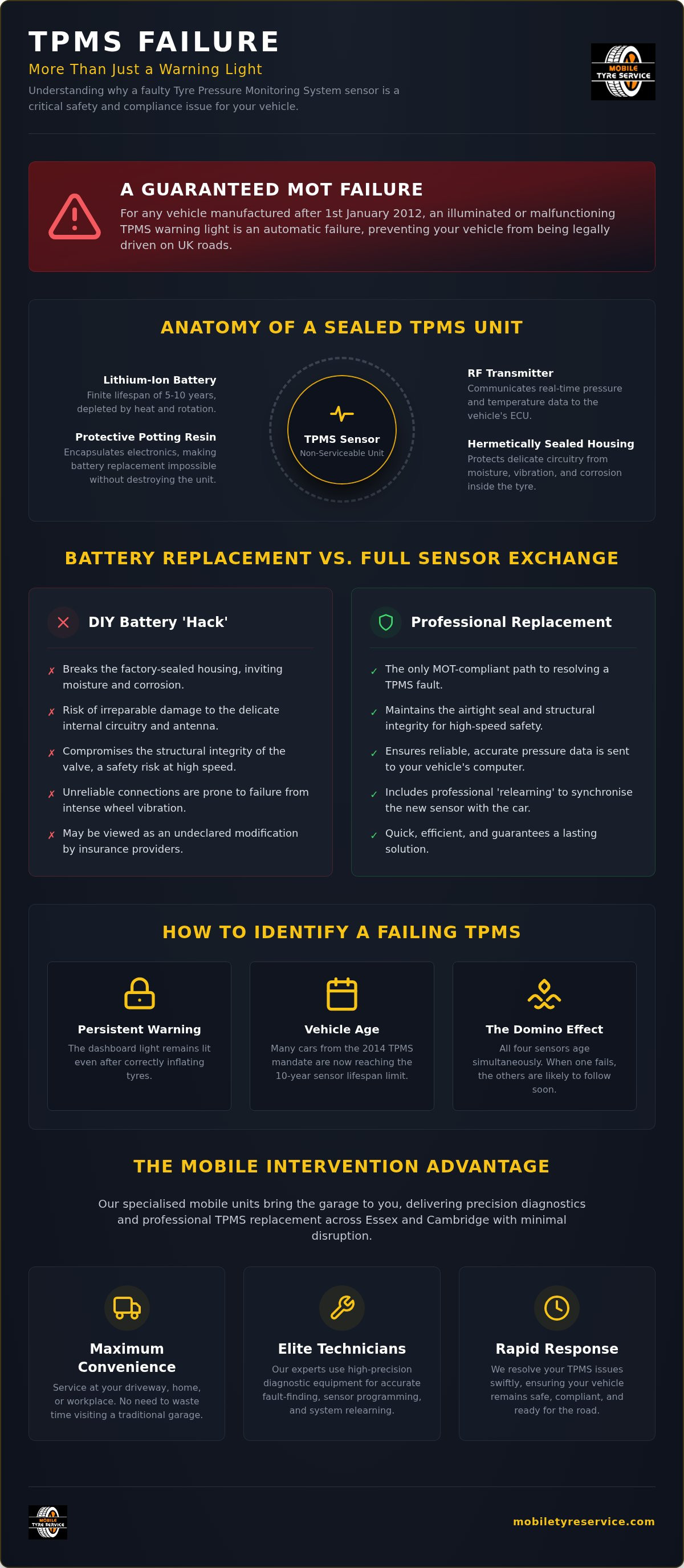
Manufacturers encapsulate the internal electronics in a specialised potting compound to ensure the sensor survives the harsh environment inside a rotating tyre. This dense, resin-like material protects the delicate circuitry from intense vibration, moisture ingress, and the corrosive effects of brake dust. However, this protective layer makes the unit a non-serviceable item; attempting to dig out the compound to reach the battery inevitably destroys the sensor's delicate housing and compromises its airtight seal. The sensor's primary function is to report real-time pressure and temperature data to the Engine Control Unit (ECU), a task that requires a constant, stable voltage. Once that voltage drops below a specific threshold, the sensor ceases to transmit, leaving your dashboard safety system blind and unresponsive.
Why 2026 Vehicles Face Frequent Sensor Faults
By 2026, a significant volume of vehicles on UK roads are reaching a critical maintenance window. The 2014 mandate requiring TPMS on all new passenger cars means that many original factory-fitted systems are now over a decade old. In regions like Essex and Cambridge, the damp, cold winters place additional strain on battery chemistry, reducing the available voltage and triggering "low battery" fault codes. If you encounter a dead TPMS sensor battery in one wheel, it's rarely an isolated incident. Because all four sensors were likely manufactured and installed at the same time, the failure of one usually indicates that the remaining three are nearing the end of their operational life. Professional intervention through a mobile TPMS sensor service ensures that all units are tested and replaced before they trigger a system-wide failure.
Battery Replacement vs. Full Sensor Unit Exchange
Online tutorials often suggest that a dead TPMS sensor battery can be revived by carefully removing the protective potting resin. This approach is fundamentally flawed from an engineering perspective. These units are hermetically sealed at the factory to withstand the extreme pressures and rotational temperatures of a moving wheel. Any attempt to breach this protective layer introduces microscopic pathways for moisture and corrosive brake dust. Once moisture enters the housing, the delicate electronic components face rapid oxidation, leading to total system failure when you least expect it.
Beyond the immediate risk of electronic failure, the labour required to manually extract and replace a battery is economically inefficient. A professional technician can perform a complete unit swap in a fraction of the time, whereas a manual "hack" involves hours of precision work with no guarantee of success. High-speed driving exerts immense centrifugal force on the valve stem; a compromised sensor housing can lead to structural weakness, potentially causing a sudden loss of tyre pressure. Maintaining the structural integrity of the valve assembly is paramount for vehicle stability on the motorway.
The Risk of DIY Battery Swaps
Extracting a battery from a resin-filled housing requires surgical precision that is nearly impossible to replicate in a home garage. One slight slip of a tool can sever the integrated circuit board or damage the internal radio antenna. Even if the battery is successfully replaced, standard soldering joints are not designed to endure the high-vibration environment of a tyre. These joints frequently crack under mechanical stress, rendering the sensor useless. Insurance providers often view modified safety sensors as an undeclared liability, which could complicate claims in the event of a tyre-related incident. To ensure your vehicle meets all safety and performance standards, TIPS Automotive offers professional diagnostics and repairs for critical engine and transmission systems.
For vehicles registered after 1 January 2012, a non-functioning TPMS is an immediate MOT failure. A "hacked" sensor that provides intermittent or incorrect data is treated with the same severity as a total system blackout. Professional replacement ensures your vehicle meets all UK safety regulations. New units come equipped with fresh rubber seals, high-quality valve stems, and a factory-calibrated power source designed to last another 5 to 10 years. If you are currently dealing with a TPMS warning light on, a full unit exchange is the only method that guarantees long-term reliability. For a definitive solution, consider a professional TPMS sensor mobile intervention to restore your vehicle's safety systems without leaving your home.
Diagnostic Indicators: How to Identify a Failing TPMS Battery
Differentiating between a simple drop in tyre pressure and a hardware failure is vital for maintaining vehicle safety. A solid, unblinking TPMS warning light usually indicates that at least one tyre has fallen below its recommended pressure threshold. In contrast, a light that flashes for 60 to 90 seconds upon starting the vehicle before remaining illuminated signifies a system malfunction. This specific sequence is a clear indicator of a dead TPMS sensor battery or a sensor that has ceased communicating with the vehicle's central computer. Intermittent signal loss, where the light appears and disappears unpredictably, serves as a classic early warning of a dying lithium cell.
Environmental factors often provide the first clues of impending power failure. You may notice the warning light appears only on cold mornings, only to extinguish once the tyres have warmed up during a drive. This occurs because low temperatures cause battery voltage to drop; a weakened cell may struggle to provide the necessary power to transmit its data packet until the internal temperature rises. Professional diagnostic equipment can interpret the internal "battery status" hex code transmitted by the sensor, providing a definitive assessment of the remaining energy levels before a total blackout occurs.
Decoding the Dashboard Warning
The vehicle's Electronic Control Unit (ECU) is programmed to monitor the heartbeat of every sensor at regular intervals. When the ECU fails to receive a data packet within a specific timeframe, it enters a fault state to alert the driver that the safety system is compromised. During the initial 60 to 90 second flash sequence, the system is actively attempting to "handshake" with the missing sensor. If the handshake fails, the system stays in a degraded mode. Direct TPMS systems provide real-time pressure and temperature readings for each wheel, whereas indirect systems rely on ABS wheel-speed data; identifying the specific failure point in a direct system requires specialised signal interception.
The Role of Professional Signal Scanning
A visual inspection of the valve stem or sensor body cannot provide any data regarding the internal battery health or radio frequency signal strength. Our mobile technicians utilise sophisticated handheld scanners to "ping" each sensor individually whilst it remains mounted inside the tyre. This process allows us to isolate the specific unit causing the fault and verify its transmission frequency. This type of advanced electronic troubleshooting is essential for modern vehicles; for those requiring broader support with intricate automotive systems, MonacoPro Auto Garage provides expert diagnostics for complex wiring and sensor issues. We ensure the issue is a dead TPMS sensor battery rather than a simple blocked valve or external electronic interference. By capturing the unique ID of the failing sensor, we can prepare the replacement unit for seamless coding, ensuring your vehicle's safety system is restored to its factory-specified operational status without the need for a garage visit.
Driving a vehicle with a dead TPMS sensor battery creates a significant safety deficit that you should not ignore. Navigating the busy A14 or M11 without active tyre pressure monitoring increases the risk of an undetected puncture developing into a high-speed blowout. Traditional garages often require you to book appointments days in advance, forcing you to sacrifice productive hours in a waiting room. Our mobile TPMS sensor service eliminates these logistical hurdles by bringing the workshop directly to your location. We provide a rapid response across Essex and Cambridge, ensuring your vehicle remains safe and MOT-compliant without disrupting your schedule.
Rapid Roadside and Driveway Response
We organise our fleet to provide elite coverage for busy professionals and residents throughout the region. Our technicians reach Cambridge business parks and Essex residential areas with professional urgency, acting as a specialised intervention force. Each mobile unit carries the necessary diagnostic and coding hardware to resolve sensor failures on-site. This approach minimises vehicle downtime whilst ensuring absolute technical accuracy. Because we operate where you are, we can resolve a dead TPMS sensor battery issue whilst you continue your work or domestic routine. Our "while you wait" service model prioritises your time and convenience.
Bespoke Equipment for On-Site Precision
Technical mastery requires the right tools. Our mobile units are equipped with bespoke tyre-changing machinery designed to protect high-value alloy rims during the sensor exchange process. Precision is paramount; we don't simply fit the hardware and leave. We perform a comprehensive on-site re-learning procedure to ensure your vehicle's ECU correctly recognises the new sensor signal. TPMS sensor fitting is a core mobile competency for our team, involving rigorous calibration to restore factory-level safety standards. We ensure the system is fully operational and the dashboard warning is extinguished before we depart. For immediate, high-precision assistance at your home or workplace, contact our mobile tyre service team now.
Elite Mobile TPMS Solutions from Mobile Tyre Service
Mobile Tyre Service operates with the disciplined professionalism of a technical first responder. We recognise that a dead TPMS sensor battery represents a critical failure in your vehicle's safety perimeter. Our intervention begins with a systematic signal interrogation using elite diagnostic scanners to isolate the failing component immediately. Once the fault is confirmed, our technicians execute a high-precision mechanical exchange using specialised mobile equipment that protects your alloy rims from damage. We maintain a comprehensive stock of premium, high-accuracy sensors compatible with the latest 2026 fleet requirements, ensuring a factory-grade fit for all vehicle makes and models across Essex and Cambridge.
Our Precision Coding and Pairing Process
While our specialists focus on TPMS and tyre safety in the East of England, for broader vehicle electronic needs such as security or audio systems, Safe & Sound Mobile offers professional nationwide installation services to ensure your car is fully equipped and protected.
The physical installation of a sensor is merely the first phase of our technical process. Every replacement unit carries a unique digital identification code that must be paired with your vehicle's Engine Control Unit (ECU) to function correctly. We perform a rigorous "Relearn" procedure to ensure the car accepts this new data stream without error. Our mobile units are equipped to handle complex OBDII port connections on-site, allowing us to clear persistent fault codes that standard dashboard resets cannot resolve. We conclude every intervention by verifying that all four sensors are communicating at the correct frequency and providing accurate pressure data. This level of electronic precision ensures your safety system is fully restored and technically beyond reproach.
Schedule Your Mobile TPMS Diagnostic
Avoid the risks associated with unverified DIY repairs and choose the reassurance of an authoritative expert. Our specialised mobile intervention force delivers elite technical mastery directly to your preferred location, whether you are at a Cambridge business park or an Essex residential driveway. We operate with clockwork efficiency to minimise vehicle downtime, providing a high-end service that respects your professional schedule. A fully functional, MOT-compliant TPMS is essential for safe high-speed driving and legal compliance. Book your mobile TPMS sensor replacement today to secure your vehicle's safety with the region's leading mobile specialists. Our team remains ready to restore your vehicle's monitoring capabilities with speed and precision.
Restore Your Vehicle's Safety Network Today
A dead TPMS sensor battery compromises your vehicle's safety intelligence and guarantees an MOT failure. Attempting a manual battery swap is a high-risk gamble that threatens the structural integrity of your wheels at high speeds. Our specialised mobile diagnostic units deliver elite technical mastery directly to your driveway, ensuring every sensor is precision-coded and fully paired with your car's ECU. We provide MOT-compliant sensor replacement that respects the demanding schedules of Essex and Cambridge professionals, eliminating the need for disruptive garage visits.
Maintaining a fully functional safety system shouldn't be a source of anxiety or logistical frustration. Our rapid-response fleet operates with the clockwork efficiency of a technical intervention force, restoring your dashboard's status and your peace of mind in a single visit. Don't let a failing battery compromise your next journey or safety inspection. Secure Your Professional Mobile TPMS Service Now and experience the reliability of garage-level precision at your preferred location. Your vehicle's safety remains our primary objective; we're ready to deploy to your location immediately. Once your car is roadworthy, you can focus on more enjoyable travels; for a bespoke luxury escape, we suggest you check out Tailormade Journeys Limited.
Frequently Asked Questions
Can you replace just the battery in a TPMS sensor?
You cannot replace only the battery because TPMS sensors are hermetically sealed units. Manufacturers encapsulate the internal electronics in a dense potting compound to protect them from moisture and vibration. Any attempt to extract the lithium-ion cell involves destructive digging that compromises the sensor's casing. The only reliable solution for a dead TPMS sensor battery is a full unit exchange to ensure the component remains airtight and structurally sound at high speeds.
How long do TPMS sensor batteries usually last in the UK?
Internal TPMS batteries generally have an operational lifespan of 5 to 10 years. In the United Kingdom, environmental factors such as cold winters in Essex and Cambridge can impact battery chemistry and reduce voltage output. Frequent short journeys also contribute to depletion as the sensor activates more often to transmit data. Once the battery reaches its end-of-life, the sensor loses the ability to communicate with the vehicle's central computer, necessitating a professional replacement.
Is it a legal requirement to have working TPMS sensors for an MOT?
A functioning Tyre Pressure Monitoring System is a legal requirement for all passenger vehicles manufactured since 2012. If your dashboard displays a persistent TPMS warning light or a system fault indicator, your vehicle will fail its annual MOT test. This regulation ensures that safety systems are operational to prevent accidents caused by under-inflated tyres. Our mobile units provide MOT-compliant sensor installations directly on your driveway to resolve these failures before your test.
Will my TPMS light go off automatically after a battery or sensor replacement?
The warning light rarely extinguishes automatically after a physical sensor swap. Most vehicles require a specific "relearn" procedure or electronic coding via the OBDII port to synchronise the new sensor's unique ID with the Engine Control Unit. Without this step, the car continues to search for the old, missing signal. Our technicians carry specialised handheld scanners to perform this pairing on-site, ensuring the dashboard light is cleared and the system is fully operational.
Can a mobile tyre fitter replace TPMS sensors on my driveway?
Elite mobile technicians can certainly replace TPMS sensors at your home or workplace. Mobile Tyre Service operates specialised units equipped with the same high-precision diagnostic and coding hardware found in premium garages. We reach locations across Essex and Cambridge to perform the entire process, from initial fault identification to final sensor pairing. This service is designed for busy professionals who require technical mastery without the inconvenience of taking time off for a garage visit.
How much does it cost to replace a TPMS sensor battery professionally?
The cost of professional TPMS replacement depends on several technical factors, including your vehicle's make, the type of sensor required, and the complexity of the relearn procedure. Whilst aftermarket sensors offer a more affordable path, premium high-accuracy units provide longer-term reliability. We focus on delivering a high-precision intervention that includes on-site coding and system verification. This comprehensive approach ensures your safety system functions correctly for the next 5 to 10 years without further issues.
Why does my TPMS light flash and then stay solid?
A light that flashes for 60 to 90 seconds before remaining solid indicates a hardware malfunction or a dead TPMS sensor battery. This differs from a solid light, which usually signals low tyre pressure. The flashing sequence is the ECU's way of reporting that it has lost communication with one or more sensors. Identifying the specific failing unit requires professional signal scanning equipment to intercept the radio frequency and verify which sensor has ceased transmitting data.
Do I need to replace all four TPMS sensors if one battery dies?
Replacing all four sensors is not strictly mandatory, but it is often the most efficient strategy. Because all sensors were likely installed at the factory simultaneously, the failure of one battery usually suggests the remaining three are nearing depletion. Replacing them in a single visit prevents the inconvenience of multiple call-outs as the other sensors fail in quick succession. Our technicians can test the remaining battery life of all units to help you make an informed decision.
Need a mobile tyre service?
We cover Harlow, Bishop's Stortford, Cambridge and all surrounding areas — 24/7.
Call: 01279 881234