Brentwood Emergency Tyre Service: Safe, On-Site Help in 2026
A tyre failure on the A12 or near Brentwood can leave you stranded with little time to decide what to do next. Put safety first: if you can move off the carriageway safely, do so, then keep everyone away from passing traffic. A Brentwood emergency tyre service can bring mobile tyre repair or fitting…

A tyre failure on the A12 or near Brentwood can leave you stranded with little time to decide what to do next. Put safety first: if you can move off the carriageway safely, do so, then keep everyone away from passing traffic. A Brentwood emergency tyre service can bring mobile tyre repair or fitting to your location, so you don’t have to drive on a damaged tyre or make an unnecessary journey to a garage.
It can be difficult to tell whether a puncture is repairable or the tyre needs replacing. The tyre must be assessed before anyone can recommend the suitable option. Mobile Tyre Service provides on-site tyre repair and mobile fitting at home or roadside locations in Essex, including Brentwood, as well as in Cambridge. It’s a practical option when travelling to a garage isn’t suitable.
This guide explains what to do after a tyre emergency, how to arrange on-site help and which details to share. Use the simple checklist below to describe your vehicle, tyre and location clearly, without putting yourself at risk trying to inspect the damage.
Key Takeaways
- Use a Brentwood emergency tyre service to arrange mobile help at your location when a damaged tyre makes a garage visit impractical.
- Whether a puncture can be repaired or needs replacing depends on the damage and the tyre’s overall condition.
- Share your vehicle details, tyre information and precise location, such as a nearby road name or recognisable landmark.
- Mobile tyre support can include fitting, repair and TPMS sensor services, depending on the issue.
- Follow a clear order: secure the vehicle, share the relevant details and arrange an on-site assessment.
Brentwood emergency tyre service: what to do first
A tyre problem can be unsettling, especially if it happens in traffic or makes the vehicle difficult to control. Focus on safety before arranging repair or replacement. Whether you’re in Brentwood town, on the A12 or on a nearby road, don’t continue driving on a visibly damaged or deflated tyre. Doing so may affect control and cause further damage.
Use this order of steps, adapting them to the road and conditions around you:
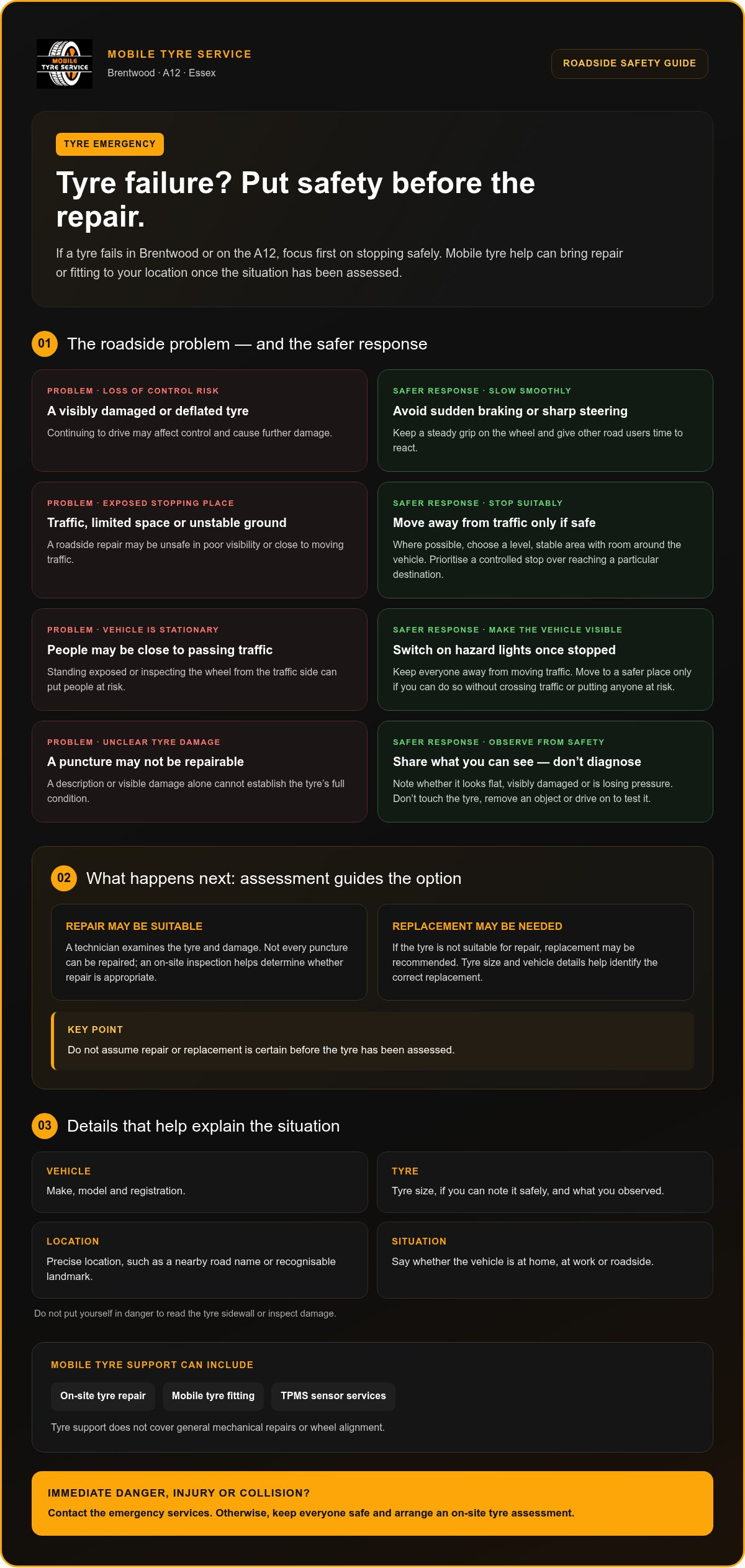
- Slow down smoothly. Avoid sudden braking or sharp steering. Keep a steady grip on the wheel and give other road users time to react.
- Stop somewhere suitable. Move away from moving traffic if you can do so safely. Where possible, choose a level, stable place with room around the vehicle.
- Switch on your hazard lights. Use them to alert approaching drivers once you’re stopped, particularly if your vehicle is close to traffic or obstructing the road.
How to stop safely with a damaged tyre
Prioritise a controlled stop over reaching a particular destination. A driveway, car park or other safe area may be preferable to stopping beside a live lane, but don’t take a risky route to get there. Avoid attempting a roadside repair if traffic, poor visibility, limited space or unstable ground makes the work unsafe. If there’s a collision, an injury or immediate danger, contact the emergency services.
Tyres support the vehicle and help maintain contact with the road. For general background on their function and safety, see this tyre overview. In an emergency, the practical priority is straightforward: don’t test a damaged tyre by driving further when you can stop safely.
What to do once the vehicle is stationary
Keep yourself and your passengers away from moving traffic. Don’t stand beside the vehicle in an exposed position or inspect the wheel from the traffic side. If you can reach a safer place without crossing traffic or putting anyone at risk, move there and stay alert to your surroundings. Don’t attempt to change the tyre if the location is unsafe.
From a safe position, note what you can see without touching the tyre. Is it flat, visibly damaged or losing pressure? You don’t need to diagnose the fault. These observations help you explain the situation when arranging a Brentwood emergency tyre service. An on-site assessment can determine the appropriate next step.
Safety summary: Slow down smoothly, stop in a safe place, switch on your hazard lights and keep everyone away from moving traffic. Don’t drive on a visibly damaged or deflated tyre. Contact the emergency services if there’s immediate danger, an injury or a collision.
What Brentwood mobile emergency tyre help can involve
Once you’re safely stopped, mobile tyre help can bring fitting or repair to your location, removing the need to drive to a garage. Mobile Tyre Service provides mobile tyre fitting and on-site tyre repair at home or roadside. The suitable option depends on the tyre’s condition and whether the vehicle can be worked on safely where it is.
A tyre that looks as though it has a simple puncture may have damage that makes repair unsuitable. If the tyre cannot be safely repaired, replacement may be the appropriate outcome. The technician’s inspection guides the decision, so don’t assume that repair or replacement is certain before the tyre is assessed.
When on-site tyre repair may be considered
A technician examines the tyre and damage to determine whether repair is appropriate. Not every puncture can be repaired, and a description over the phone cannot establish the tyre’s full condition. For general tyre-care context, the U.S. Tire Manufacturers Association provides Tire Safety and Maintenance Guidelines. For your tyre, an on-site inspection remains central to deciding what action is suitable.
If you can safely describe what you noticed, such as a sudden loss of pressure or an object visible in the tread, share that when arranging help. Don’t remove an object or continue driving to test the tyre. A clear description helps explain the situation, but the inspection determines whether repair can proceed safely.
When mobile tyre replacement may be needed
If inspection shows the tyre isn’t suitable for repair, replacement may be recommended. The tyre size and vehicle details help identify the correct replacement. If you can do so safely, note the size printed on the tyre sidewall and provide the vehicle make, model and registration. Don’t put yourself in danger trying to read the tyre beside moving traffic.
Mobile tyre support covers fitting, repair and mobile TPMS sensor services. It doesn’t cover general mechanical repairs or wheel alignment. This distinction sets clear expectations: if the problem is a damaged tyre, an on-site tyre assessment can identify a suitable tyre-service option. If the issue concerns another part of the vehicle, tyre fitting or repair won’t address that fault.
For a tyre problem in or around Brentwood, share your location and vehicle information when arranging a Brentwood emergency tyre service. Explain whether you’re at home, at work or roadside, and describe what you can safely observe. Mobile Tyre Service provides tyre fitting and repair at your location, with the suitable action guided by the tyre and conditions on site. You can arrange mobile tyre help for an on-site assessment.
Repair or replacement: how the tyre assessment guides the decision
A puncture or loss of pressure doesn’t automatically mean a tyre can be repaired. Visible damage alone doesn’t tell you which replacement is required either. For a Brentwood emergency tyre service, the decision follows an inspection of the affected tyre, including where the damage is, how extensive it appears and the tyre’s overall condition. Treat repair and replacement as possible outcomes, not decisions to make from a quick roadside glance.
| Assessment stage | What it means |
|---|---|
| Inspection | The tyre and visible damage are examined, alongside signs of pressure loss and its general condition. |
| Repair suitability | If inspection indicates repair is appropriate, a mobile tyre repair may be considered. |
| Replacement | If the tyre is unsuitable for repair, replacement may be the appropriate outcome. |
What the technician assesses on site
The assessment considers visible damage, any loss of pressure and the condition of the tyre as a whole. The location and extent of damage can affect whether repair is suitable, as can the tyre’s broader condition. Your description can help explain what happened, but it cannot replace an inspection. Don’t assume a puncture can be repaired before the tyre has been assessed.
Assessment must come before the repair decision because visible signs alone cannot establish whether a repair is suitable.
How to understand the possible outcomes
Repair and replacement are different outcomes. If repair is appropriate, it addresses the assessed damage. If it isn’t, fitting another tyre may be recommended. Neither outcome should be assumed before inspection. The technician’s assessment gives the decision a clear basis and avoids treating every puncture as though it has the same solution.
If replacement is needed, accurate vehicle and tyre information helps identify the required tyre. Useful details include the vehicle’s make and model, registration and the size shown on the tyre sidewall, if you can read it safely. Don’t approach a wheel beside moving traffic to find these details. Share what you already know and let the on-site assessment guide the next step.
Tyre safety resources can provide general background, but guidance written for another country shouldn’t be mistaken for UK-specific repair rules. The US National Highway Traffic Safety Administration provides NHTSA Tire Safety Information on tyre safety and care. For a repair-or-replacement decision in Brentwood, rely on the condition of the tyre assessed at the vehicle, rather than treating general advice as a diagnosis.
Once the technician explains the outcome, you can make an informed decision about the mobile tyre repair or fitting required. The key point is simple: inspection establishes whether repair is suitable; replacement remains an option if the tyre’s condition calls for it.
Requesting Brentwood emergency tyre help: details to prepare
A precise description helps Mobile Tyre Service understand what has happened and where the vehicle is located. You don’t need to diagnose the fault or inspect the tyre at risk. Share what you know from a safe position, and say if you’re unsure about a detail. When arranging a Brentwood emergency tyre service, prepare:
- Exact location: road name, nearby junction, safe parking area or recognisable landmark.
- Vehicle details: make and model, and registration if available.
- Tyre information: size, if you can read it safely, and which wheel is affected.
- What you observed: whether the tyre is flat, visibly damaged or losing pressure, and whether one or more tyres are affected.
- Access conditions: any gate, height restriction, narrow entrance or other feature that could affect reaching the vehicle.
Location and access details that help
Give a location that can be identified accurately. A road name and nearby landmark can distinguish your position from another stretch of the same road. If the vehicle is safely stopped near the A12, mention the direction of travel and a recognisable junction or nearby access point, if known. Don’t move closer to traffic or leave a safe place to find a sign or take a photograph.
Explain where the vehicle is positioned and whether there’s clear space around it. If it’s in a car park, driveway or work site, describe the entrance and any access restrictions you already know about. Don’t approach a barrier or walk around a hazardous area to check. Clear location and access details help the mobile service understand the call-out and plan its approach.
Vehicle and tyre information to share
Provide the vehicle make and model, then say which tyre is affected and what you noticed. If you can see the tyre size from a safe position, read it from the sidewall. Don’t step into traffic or lean into an unsafe area to find it. If the size isn’t accessible, say so. The vehicle details can still help identify the information needed for mobile tyre fitting or repair.
Be specific but factual. “The front passenger-side tyre is flat” is more useful than “the car has a problem”. If you noticed a sudden pressure loss, a cut or an object in the tyre, report it without trying to remove anything. Mention if another tyre appears affected. These details help explain the situation, but the technician’s inspection determines whether repair or replacement is suitable.
For general background on repair considerations, the article Mobile Tyre Repair Cost: The Complete 2026 Professional Guide discusses mobile tyre repair. Your tyre still needs an assessment before its condition or repair suitability can be determined.
Keep the details together before arranging mobile tyre help. Arrange mobile tyre repair or fitting by sharing your location, vehicle information and a clear description of what you can safely observe.
Arrange mobile tyre service in Brentwood with Mobile Tyre Service
A tyre emergency can disrupt a journey, but the next steps are clear: reach a safe stopping place, share your location and vehicle details, then arrange an assessment. Mobile Tyre Service provides mobile tyre fitting, on-site tyre repair and mobile TPMS sensor services. For drivers in Brentwood and across Essex, this is an on-site option when travelling to a garage isn’t practical. Mobile Tyre Service also provides mobile tyre services in Cambridge.
The service focuses on tyre work. The appropriate next step depends on the tyre’s condition and the circumstances at the vehicle. An assessment helps determine whether repair or replacement is suitable. Neither outcome should be assumed before the tyre is inspected.
What to expect from a mobile tyre call-out
Mobile tyre fitting or repair takes place at your preferred location where access is suitable, including at home or roadside. Share the exact location and explain any access conditions. The tyre is assessed, then the suitable tyre-service outcome can be determined. Mobile TPMS sensor services are also available as a separate tyre-related service.
Keep expectations practical. A description of a puncture or pressure loss helps communicate the problem, but it doesn’t establish whether the tyre can be repaired. The tyre’s condition and the working conditions at the location inform the assessment. If the location isn’t safe for work, safety remains the priority.
Take the next step
Before contacting the service, gather the details you can provide safely:
- Your precise location in or around Brentwood, using a road name or recognisable landmark.
- The vehicle’s make and model, and registration if available.
- Which tyre is affected and whether it appears flat, damaged or to be losing pressure.
- Any access information that could help identify the vehicle or reach its position.
You don’t need to diagnose the tyre or approach traffic to read its size. Share what you know, and say clearly when you’re unsure. Accurate location and vehicle information gives Mobile Tyre Service a clear account of the call-out and helps frame the on-site assessment.
Once you’re safely stopped and have the key details to hand, contact Mobile Tyre Service to explain the tyre issue and arrange mobile tyre help. A clear account of the location, vehicle and visible problem is a practical starting point for fitting or repair at your location.
Make your next move with confidence
A tyre emergency can make every decision feel urgent. Keep the next move simple: focus on safety, explain what has happened and let an assessment guide the tyre work required. This gives you a practical way forward without guessing whether repair or replacement is suitable.
If you need a Brentwood emergency tyre service, Mobile Tyre Service provides mobile tyre fitting and repair at your location in Essex, including Brentwood, and in Cambridge. Mobile TPMS sensor services are also available. This on-site option can help when taking the vehicle to a garage isn’t practical, with the suitable tyre service determined by the assessment.
When you’re ready, share your location and the details you can provide safely. Arrange mobile tyre help in Brentwood and take the next step towards resolving the tyre issue.
Frequently Asked Questions
What should I do if I get a flat tyre in Brentwood?
Slow down carefully and find a safe place to stop rather than trying to reach a garage on a flat tyre. Once stationary, switch on your hazard lights and keep passengers away from moving traffic. If you’re on a busy road, don’t inspect or change the wheel beside traffic. From a safe position, note your location and what you can see, then arrange appropriate tyre help.
Can a mobile tyre service repair a puncture at the roadside?
Yes. Mobile Tyre Service provides roadside tyre repair when the location is safe for work and the tyre is suitable for repair. The technician must assess the tyre before deciding. A puncture that looks small from outside may not be repairable, so don’t assume repair is certain. If repair isn’t appropriate, mobile tyre fitting may be the alternative.
Can I drive on a flat tyre to a garage?
No. Don’t drive on a flat tyre to reach a garage. Driving may affect control of the vehicle and cause further damage to the tyre or wheel. If you’re obstructing traffic, move only as far as needed to reach a safe stopping place, if you can do so safely. Otherwise, stay clear of traffic and arrange help at your location.
How quickly can a mobile tyre fitter reach me in Brentwood?
There’s no fixed arrival time to rely on for a mobile tyre fitter in Brentwood. Travel and job timing can vary with your exact location, road conditions and access to the vehicle. Give a precise road name or safe, recognisable landmark when arranging help, and explain where the vehicle is positioned. Don’t wait beside moving traffic. Remain in a safe place whilst assistance is arranged.
What information should I provide when requesting emergency tyre help?
Give your exact location, vehicle make and model, and a clear description of the tyre problem. Say which wheel is affected and whether you’ve noticed a flat tyre, visible damage or pressure loss. If you know the tyre size, share it, but don’t approach traffic to check. Mention access restrictions, such as a barrier or narrow entrance, so the call-out details are clear.
Can a mobile tyre service replace a tyre at my home or roadside?
Yes. Mobile Tyre Service provides mobile tyre fitting at a customer’s location, including at home or roadside where access is suitable. The vehicle and tyre details help identify the replacement required. Share the tyre size if you know it, along with the vehicle make and model. The technician assesses the situation on site, then fits a replacement when that is the appropriate outcome.
What happens if my tyre cannot be repaired?
If inspection shows the tyre isn’t suitable for repair, replacement may be recommended. The correct replacement depends on the vehicle and tyre specifications, so share any details you have, such as the tyre size and vehicle model. Mobile Tyre Service provides mobile fitting and repair in Essex and Cambridge, as well as mobile TPMS sensor services. The on-site assessment guides the next tyre-service step.
Need a mobile tyre service?
We cover Harlow, Bishop's Stortford, Cambridge and all surrounding areas — 24/7.
Call: 01279 881234